This is a post I wouldn’t have conceived when I put up my last officially made post, as it relates to Super Mario RPG Switch, something that had been first announced in June 2023, but Super Mario RPG Switch does provide a stellar blueprint for how things could be improved. I am making this post to get it out of the way because this is too good to pass up.
Still, what happens when Japan involves happy medium ideas in their game design for how us Americans handle things? What happens when we can involve a similar point to provide suggestion on how to enhance their own ideas in manners improving their health?
Kid Icarus Uprising already interested me for involving happy medium knockback immunity in the form of Armor Powers, most notably Super Armor. Even though the Buff Powers that provide KB immunity but not damage immunity covers only 4 Powers out of 60, giving some useful tools to the local Mighty Glaciers still is helpful, and it turns Unconditional Flinching into a design strength at the point where people can use Armor Powers to uniquely stop that from being a cheese-inducing problem in comparison to people who don’t. At that point, Japan is encouraging players to never give up, to trust their instincts. Kind of something us Americans want to do. At the same time, they make it clear not to do that alone, but rather to augment as much with more robust assessment.
Where does Super Mario RPG: Legend of the Physical DEF Ally Buff (as I nickname the Switch remake of SMRPG) come into this? Quite simply, its own ideas of happy medium balancing of the tank archetype. There are a couple that are worth going over.
The Ally Buff system
Mallow’s damage taken from Axem Black’s attack is heavily reduced due to Bowser’s Physical DEF Ally Buff (Super Mario Wiki’s image for the Ally Buff page, granted that I’m the image’s uploader)
Remakes tend to be a worrisome subject, as they innately involve revisiting a game and potentially just selling the same game all over again for more money to the company. They can easily become cash grabs if they don’t involve that good ol’ TLC to do things like address major problems, especially those that either don’t bolster the art, or simply take it too far.
Fortunately, Super Mario RPG: Legend of the Physical DEF Ally Buff avoids that. While there are SOME introduced defects here and there, they far from outweigh the merits. I can even that as far as aesthetic goes, Star Hill gets the clearest benefit of the Polished Port involvement even if we ignore its involvement in the postgame, as I already commentated about. Of course, we’re here for key gameplay changes, how they improve the gameplay, and how they relate to the ideas here.
The Ally Buffs system, actually visible as early as the very first trailer, provides performance incentive, not only with battle music amp-up for having 5+ Chain, but also strong benefit that don’t cost resources to set up. It gets to the point where I made a 30-page document about the Ally Buff system. Bowser, with his Physical DEF Ally Buff, got the biggest section at 8 pages, simply of how shockingly helpful it is, and I can punctuate the game design involved.
As I point out multiple times in the document, Super Mario RPG is a game that uses subtraction defense, which is to say that it has the defense stats be values that are chosen between for being subtracted from the attack value directly. The design space with this is that enemies with high enough defense stats successfully discourage attacks that don’t attempt to break through or bypass the defense stats, and it particularly makes Physical DEF important when it comes to enemy durability, since the normal Attack command, as well as the Triple Move attacks in the Replace, always has to calculate with it, resulting in offensive Specials and Items being desirable for anything with a high enough Physical DEF. Anybody who has played any games in the Fire Emblem series where Armor Knights aren’t the jokes that power creep has turned them into may recognize what I’m talking about.
Of course, the player can conceivably make use of subtraction defense themselves, and when that happens, they can just focus on addressing the anti-armor threats, although having a tank won’t necessarily stop enemies from going after your more vulnerable targets if given the chance, at least if your less safe people aren’t equally protected. The big thing with Bowser’s Physical DEF Ally Buff is that it’s guaranteed to help provide that protection. Although it doesn’t protect against magic, it does still provide a drastic effect against any boss that uses multiplier damage attacks (which are always physical) to be a threat. Suddenly, you have guys who don’t die so easily at all simply because you had everybody use the Attack or Special command. At least, that’s the theory that it would break the game.
In practice, the Physical DEF Ally Buff isn’t unearned, because block timing for enemy physical attacks, the very thing it’s designed for, is typically more dependent on the caster than most magic attacks are. It’s where I argue that ALL damaging physical attacks being blockable by timing actually gives Axem Black a returning buff despite the damage nullification possibility even with Spritz Bomb’s added block timing being confounding, simply because he is that undermined by Bowser’s Physical DEF Ally Buff and he would at least get the chance to break the monster buff by breaking the Chain, instead of simply doing now laughable damage. Axem Black is a massive Adaptational Wimp either way because he’s a Fragile Speedster with the Physical ATK to match, but at least with his attacks being blockable and consequently influencing the Timing Chain, he’s involving gameplay. It’s great to have this happy medium defensive power effectiveness that promotes skill, which kind of sounds familiar. I’m not sure why there is familiarity, so I should ask somebody who just happens to regularly use some Power called “Super Armor” in KIU to see what they think. I wouldn’t be surprised if they turn out to be some known electrical heavy hammer main who believes in supporting the underdog.
To be sure, boosting Physical DEF wouldn’t do anything for players who get Sweetspot timings on blocks without fail, meaning Bowser’s usability in speedruns tracks to other nuances. However, for those of us who don’t have that reliability, which is most players, being better able to wall enemy Abilities in their damage multiplier reliance is a great contributor to survival. There is some fall-off, but it never stops being useful overall, even having some use against Smithy, and at that point, it’s a great thing to have. This isn’t even getting into the other Ally Buffs, with Mallow’s Magic ATK Ally Buff being popular with speedrunners simply by allowing attack spells to hit harder, combining with Weakness targeting. Geno and Peach’s Ally Buffs aren’t as mighty, but they do serve sensible purposes at times.
Something that is worth noting is my Restricted Weapons/No Deaths Run. With the SNES version, the premise has been to accommodate as many players as possible, one of the reasons I attempted to ban Crystallines only to need them for Culex, Earth Link (Cloaker’s snake), and Smithy. I already had the intent of replaying the Switch version with the old design in mind for a compare-and-contrast. This brings up that I couldn’t do anything about Ally Buffs if I wanted without suddenly failing every bit of timing, but the big question was, did I want to? Ally Buffs is a buff to both Bowser and Mallow in a way that adds to the gameplay in a healthy manner, and I’m able to battle later bosses at lower Levels, allowing the Restricted Weapons rule to matter. We get depth that actually is warranted and helps to make sure there’s never a dull moment when attacks that deal little if any damage become capable of utility.
What would something like Ally Buffs do for Kid Icarus Uprising?
Seriously, WHY does Skreetle survive a low range Skyscraper Club Shot at all? …oh right. 9.0 durability.
The biggest overall issue with Kid Icarus Uprising, outside perhaps the controls, tracks to an overemphasis on the arms race. Weapon modifiers provide an absurd amount of boosting even if we ignore a certain +35% intangibility per point to dodge moves, which Team Hitless rightfully declares would be EXTREMELY broken in Dark Souls despite that game having significantly less intangibility time on dodging. And unfortunately, single player on higher intensity gives enemies inflated stats, the most condemning being excessive durability that leads to weapon types struggling to do anything at all on 9.0 with base stats unless the weapon types themselves have their own involvement of insane default stats, and even that much isn’t a full guarantee, to say nothing of how bosses and major threats become time sinks even when they can be reasonably repelled.
In summary? The game overencourages dealing with an arms race just to be able to survive some inane stuff, because any alternative is much less tolerable.
Now doesn’t that problem sound familiar? As a matter of fact, it does, because it also was involved Super Mario RPG SNES, although it wasn’t nearly as harsh as it is in Kid Icarus Uprising, but honestly, my Restricted Weapons/No Deaths Run there made No Deaths the more important rule, when enough bosses were capable of cheap kills, often enough by potentially killing Mallow from full health with unblockable attacks either in a single hit or in a turnclump, with Factory Chief and Gunyolk even getting to potentially kill BOWSER from full health with Funguspike and Echofinder (BOTH OF WHICH ARE PHYSICAL ATTACKS WITH MULTIPLIERS) before the player can even act. This problem stops being nearly as bad in Super Mario RPG: Legend of the Physical DEF Ally Buff, and it particularly shows with the Shoguns, who no longer serve as a Beef Gate in the Restricted Weapons/No Deaths challenge simply because Carni-Kiss actually can be blocked, and now their difficulty gets shifted from screaming through a loudspeaker for the player to get Mallow to Level 14 for Snowy to vaporize them with, to involving potential Special variants that become tense with clear punishment for not Sweetspot blocking their attacks, providing healthier highlighting toward the intent of the Shoguns’ Valor Up response to attack magic usage.
And this is keeping in mind that Super Mario RPG SNES has LESS excuse than Kid Icarus Uprising for Super Mario RPG: Legend of the Physical DEF Ally Buff to address the arms race problem, because Super Mario RPG SNES still has a standard Level Up system that gives the stat improvements without fail, still has Level Up bonuses that the player can choose, and still didn’t make the game nightmarishly hard by default regardless, being more interested in the heart and soul of things. Super Mario RPG: Legend of the Physical DEF Ally Buff still did more than make ANY enemy attack that inflicts damage and doesn’t all-target blockable. We see it gave Ally Buffs, which end up getting to the point of creating the argument that the ability to nullify damage from Axem Black’s bomb attacks BUFFS Axem Black, simply by the fact that he can even try to zap off the Ally Buffs, even if it’s inevitably a Shooting Wonder Woman case. Ally Buffs also made durable threats more capable of active engagement as a result of both involving an effectively passive buff for sustained fighting as long as the player manages the desired gameplay (in Super Mario RPG’s case, it would be rhythm); as well as catching the player falling into fatigue.
A Kid Icarus Uprising remaster would welcome a similar system for one particular reason: design space. Such a mechanic would allow whoever the developers would be to shift some of the weapon modifiers’ boost amounts to it, which would especially help the lower Value weapons function and compete with better with even the min-maxed stuff. If the developers extend this to the effectiveness of the modifiers as well, then material that is slightly stronger than the higher end of what is expected to be obtained from the randomness can effectively just require a little more skill to have the same amount of power as before, only now stronger competition would exist and insane power rampages would have a slower start that reduces brokenness.
This is the key thing: the available power wouldn’t have to be reduced too much, as long as it is harder to achieve and abuse in the first place. The whole goal with something similar to Ally Buffs would be to make the game more playable, especially on higher Intensities, without relying on luck or the extremely convoluted weapon fusion system. We could call it the “Star Boost”–keeping in mind that “Angel” is already an actively used term, by the way, so “Angel Buff” would feel awkward, although I’m open to a cleaner name anyway.
There are some modifiers that would still be overtuned, most notably Evasion+ (NOTHING is redeemable about 2.4 times intangibility duration, being something that would be broken on a low cost Power, never mind a 30ish Value modifier), and Health+ wouldn’t be quick-fixed for how it undermines burst damage. However, it wouldn’t be hard to fine-tune given values to the following:
Old and suggested new values
Stat
Current Amounts
No Buff
Max Buff, Value +0
No Buff, Value New Amounts
Max Buff, Value New Amounts
Attack Stars (Zero Stars in opposite category)
1.12~2.74
1
2
1.05~1.16
1.05~1.336 (2.1~2.672)
Attack Stars (Full 6 Stars in opposite category)
1.12~2.74
1
2
1.05~1.16
1.05~1.6 (2.1~3.2)
Attack Stars (Maxed Negative)
1.12~2.74
1
2
1.05~1.16
1.05~1.248 (2.1~2.496)
Attack+ (Zero Stars in opposite category)
1.27~2.15
1
(2)
1.06~1.12
1.076~1.232 (2.152~2.464)
Attack+ (Full 6 Stars in opposite category)
1.27~2.15
1
(2)
1.06~1.12
1.1~1.4 (2.2~2.8)
Attack+ (Maxed Negative)
1.27~2.15
1
(2)
1.06~1.12
1.068~1.176 (2.136~2.352)
Power ATK+
1.4~2.1
1
1.25
1.08~1.2
1.12~1.6 (1.4~2)
Item ATK+
1.3~2
1
1.1
1.08~1.2
1.1~1.25 (1.21~1.375)
Full Health Boost attack power (Zero Stars in opposite category)
1.2~1.7
1
(2)
1.25~1.3
1.25~1.38 (2.5~2.76)
Full Health Boost attack power (Full 6 Stars in opposite category)
1.2~1.7
1
(2)
1.25~1.3
1.25~1.5 (2.5~3)
Full Health Boost attack power (Maxed Negative)
1.2~1.7
1
(2)
1.25~1.3
1.25~1.34 (2.5~2.68)
In-Peril Attack Boost (Zero Stars in opposite category)
1.2~2.2
1
(2)
1.25~1.3
1.25~1.38 (2.5~2.76)
In-Peril Attack Boost (Full 6 Stars in opposite category)
1.2~2.2
1
(2)
1.25~1.3
1.25~1.5 (2.5~3)
In-Peril Attack Boost (Maxed Negative)
1.2~2.2
1
(2)
1.25~1.3
1.25~1.34 (2.5~2.68)
DEF+
0.93~0.44
1
0.9
0.925~0.75
0.82~0.4 (0.738~0.36)
Overall DEF-
1.12~1.36
1
0.9
1.35~1.8
1.25~1.4 (1.125~1.26)
Melee/Shot DEF-
1.15~1.3
1
0.9
1.5~1.8
1.3~1.4 (1.17~1.26)
Speed+
1.09~1.36
1
1.14
1.04~1.1
1.08~1.2 (1.2312~1.368)
Speed-
0.75~0.9
1
1.14
0.8~0.95
0.91~1 (1.0374~1.14)
Full Health Boost movement
1 2/30~1 7/30
1
(1.14)
1.03~1.08
1.03~1.08 (1.1742~1.2312)
Shot Range+
1.21~1.48
1
1.08
1.02~1.04
1.04~1.1 (1.1232~1.188)
Shot Range+ velocity
1
1
1.08
1.02~1.04
1.04~1.1 (1.1232~1.188)
Shot Range-
0.6~0.9
1
1.08
0.7~0.9
0.9~0.95 (0.972~1.026)
Shot Range- velocity
1
1
1.08
0.7~0.9
0.9~0.95 (0.972~1.026)
Shot Homing+
1.21~1.41
1
1.1
1.05~1.1
1.1~1.2 (1.21~1.32)
Effect Duration+
1.1~1.33
1
1.12
1.1~1.16
1.1~1.25 (1.232~1.4)
This covers all of the important modifiers other than Evasion+ (irredeemably broken, needs outright revamping) and the debuff modifiers (variable values, would take a while to cover, but generally should reduce favoritism of having +1 over +2 or +3 in particular). Modifier maxing would still be powerful with the general values I’m providing, but they would be less so without effort, as well as dealing with better competition across the board, and I even suggest for mixed star incentive and deterrent for using the negative modifiers as dump stats when it comes to general attack power, by involving the buff benefit to modifiers being fractioned without 6 Stars in the opposite category and no negative mods, though of course this deterrent wouldn’t be massive, but it would at least convolute attempts to milk 1HKO and 2HKO thresholds.
Worth mentioning is an added proposal of mine that isn’t inspired by Super Mario RPG, either the original OR the remake, but rather set up to disrupt long range abuses. Namely, for determining damage exclusively, damage multipliers (starting with the additive value used by the offense modifiers, result multiplied by the buff multiplier in my suggestion) should be changed from multiplying the damage, to the result outside the Light VS Dark Angel’s natural damage multiplier being a “firstDamageRatio” that would be replacing the 1 value that would be used in the comparison with “lastAttackRatio”, itself improved for damage calculation by a quarter of the buff’s provision (so a maximum multiplier of 1.25), obviously not influencing the base damage’s point itself to keep debuffing, shot breaking, and other relevant aspects unchanged. (A Flintlock Staff benefitting from 2x attack power for example would effectively have a max range damage multiplier of 2.875 instead of 4.6 for the simple purposes of pure damage, and with full Energy Charge it would be 1 43/72.) This would prevent absurd amounts of damage from cheap sniping hits from somebody trying to abuse endgame power. Melee wouldn’t be weakened by this, and there’s stuff like melee clashing overly centralizing button mashing that should still be addressed, but it’s practically a non-issue, where sniping attack abuse could easily still snowball even with the usage of the buff concept’s design space if not checked before we get even more of arrogant players who lose multiple Crisis Mode Lives to Great Reaper’s Side Shot tutorial attacks brag about beating a Royal Blade setup that was being field tested when said arrogant players are blatantly carried by stages like Lava Basin and natural 5+ SCL weapons that have min-maxed modifier setups including Speed+ creating and bolstering 1-dimensional gameplay.
Of course, the big question is, how would the player get the “Star Boost” influence to begin with? Well, the original Kid Icarus involved a point system to allow for getting power upgrades, and this point system actually had penalties for attacking too much without sufficing reason and especially getting hit. I can propose something somewhat similar with the following points:
A meter of 1600 points to fill, for each player in multiplayer, actually capping at 1600 (working somewhat similar to the Action Gauge in Super Mario RPG: LOTPDAB) and not able to be a negative value, with the amount of the buff being provided being proportional to the percentage of the meter that is filled up
Additionally, in team battles, the player receives only half of the buff from their own meter with the other half being split evenly between teammates
Point changes would be calculated after all relevant buff effects are handled for whatever triggers them
Points would be gained by the following methods, additionally contributing half of the amount to each teammate:
Catching an opponent with a damaging non-Item attack other than a Neutral Rapid or Neutral Shot, at a provision rate of min(Base Damage, 40) x (60 + clamp(Base Damage, 4, 68))/128
Melee for all Families other than Claws and Arms multiplying effectiveness of Base Damage in calculation by 1.25
Last Melee Combo hit and Cannon explosion hits both treating Base Damage as doubled (multiplicatively stacking with above, so Last Melee Combo hit would generally be multiplying Base Damage influence by 2.5 in general) and also ignoring the Base Damage influence cap on the first half of the multiplication
Base Damage would also use body spot multipliers (basically to boost hitting weak points), but NOT Element multipliers
Provision would be quadrupled for the melee of the following weapon types: Royal Blade, Aquarius Blade, Palutena Blade, Ancient Staff, Flintlock Staff, Divine Bow, Angel Bow, Hawkeye Bow, Midnight Palm, Virgo Palm, Halo Club, Fireworks Cannon, Sonic Cannon, Eyetrack Orbitars, Fairy (Flies) Orbitars, Drill Arm, Bowl Arm, and Phoenix Arm
Provision would instead be merely doubled for the melee of all other weapon types except the following: Samurai Blade, Brawler Claws, Raptor Claws, Babel Club, Ogre Club, Magnus Club, and Taurus Arm
Attack Powers (this means you, Land Mine) would have doubled provision
Provision would be doubled in multiplayer 1V1s
Value influence on provision would be a multiplier of (400 – clamp(Attacker’s weapon Value, 200, 300))/200
Provision would have all multipliers stack multiplicatively
Provision would be done for each hit
This would ignore Bumblebee auto-dodge triggering (not a gameplay system limitation, as Power Thief already does that) and any defensive power changes including full invincibility (Brief Invincibility and Trade-Off) and even Power-Up Drop’s reflection, but would be forfeited if hitting a target that is under Petrify, Frozen (Today), Eggplant, or Tempura, or stuck under the freeze frames of something like Smart(-rear) Bomb
Parry Dodging against an attack that otherwise would hit for damage (windboxes obviously would be ignored, as would the default dodgebox of Hades’ Heart) within the next several frames, waiting half a second for a hit check before granting:
100 points on a Parry Dodge that isn’t staled or part of an established sequence of dodge moves, or 25 on one that is
When already at full chargeup when doing the Parry Dodge, further Parry Chargeup Ratio x 400 on non-sequential/stale, or Parry Chargeup x 100 on sequential/stale (current Staves would get +100 or +25 from this part for reference)
Result of above multiplied against a multiplayer opponent by their total “firstDamageRatio” modifier for the attack, including from Powers such as Energy Charge, but again not including the LVD Angel’s natural multiplier
Prior intangibility from ANY previous source when doing the Parry Dodge, including from Playing Dead, will forfeit this provision due to already preventing the hit
The Parry Dodge being cancelled into a Dash Shot/Rapid would NOT forfeit this
Points would be lost by the following reasons:
Releasing a projectile, counting for EACH bullet (yes, this would mean this would be counted twice for Orbitars’ Shots in general) with the Neutral Rapid of the Blade and Claw families being counted at the Hit Rest intervals; the penalty would be 25 points
Getting hit by a damaging non-Item attack, including environmental hazards in single player, at a penalty rate of Base Damage x (60 + clamp(Base Damage, 4, 68))/16; this would bypass Bumblebee auto-dodge triggering (not a gameplay system limitation, as Power Thief already does that) and any defensive power changes including full invincibility (Brief Invincibility and Trade-Off) and even Power-Up Drop’s reflection, but would not be incurred if under Petrify, Frozen (Today), Eggplant, or Tempura, or stuck under the freeze frames of something like Smart(-rear) Bomb
Using Effect Recovery, Warp, any jump Power, or any Power that has a casting animation, at a penalty of 500 points for the charge use
Using an attack item, at a penalty of 800 points (would apply for individual item uses so Double Item would end up with an overall penalty of 1600 points for full use)
Grabbing a buff item (discounting any item that simply provides recovery, including Drink of the Gods), at a penalty of 400 points
The meter would also start at 0 during a gameplay session and would be reset upon death, but would NOT be reset by loading screen splits in single player
To be sure, the math would have to be worked out since I imagine what I have right now can be overkill, but the important point of the “Star Boost” would be to stop abuses of the system, seeing as in the current game, Fragile Speedsters so richly benefit from the inflated attack boost increase rates and the low cost of modifiers like Speed+ for their obscene effectiveness, while Squishy Wizard weapon types get left in the cold short of involving grossly broken things. The following would also be intended to be addressed by the “Star Boost”:
9.0 being borderline unplayable within base weapons and no Powers due to enemy durability inflation
Regard to teammates in multiplayer not being healthily encouraged
Weapon modifiers overfavoring min-maxing instead of overcoming adversity and luck issues, while lacking even halfway decent counter play
Gameplay speed having a habit of feeling reliant on weapon modifier abuse
Cheap kills at the start of the match leading to players reporting being killed at the start of the match without rhyme or reason
Range combat overfavoring the advantaged player while Parry Chargeup is too inconsistent at providing working reward for reliability in checking oppressive gameplay
Close range not being sufficiently methodical or involving of healthy reward
Orbitars being obscene in single player and polarizing in multiplayer in general
Powers that provide invincibility, effectively (Aries Armor, Bumblebee to an extent) or otherwise (Trade-Off, Brief Invincibility), having bad counter play
Panic button abuse (CELESTIAL FIREWORKS) as well as Effect Recovery flowchart being basically free and generally dominant
Attack items being over-the-top (obviously, NOTHING can address Smart Bomb’s ridiculous hit freeze anyway so Smart Bomb itself has to be nerfed or it gets instantly banned from a serious setting, but other attack items can at least be softened by attack power nerfs, although X-Bomb would still be stupidly powerful against players with the 340 default damage between all 4 bullets)
I am also unsure if the “Star Boost” idea also suitably disrupts speed advantages in multiplayer–after all, Axem Black’s double turn shenanigans in Super Mario RPG was simply owing to his scripted behavior instead of anything to do with his Speed stat beyond aesthetic relationship. Nonetheless, using the blueprint of Ally Buffs in Super Mario RPG: Legend of the Physical DEF Ally Buffs, I do outline critical aspects to cover and a baseline for a KIU remake creator to fall back upon.
Triple Moves
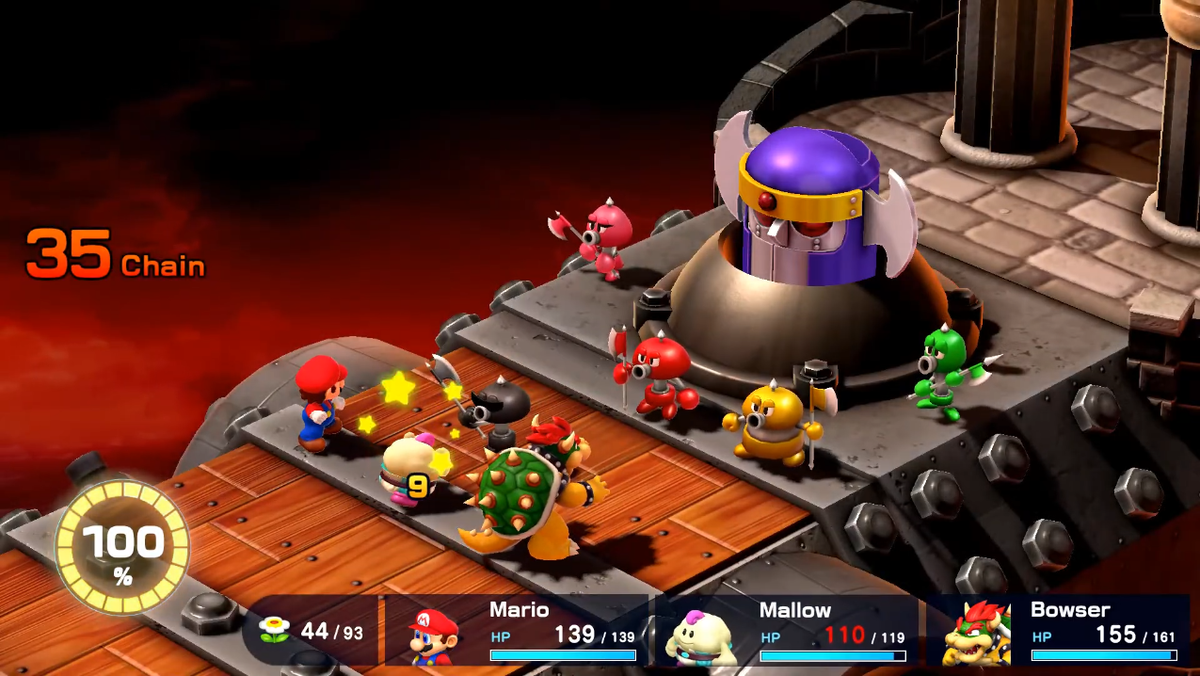
Clown Car Barrage shells Culex and his Crystals
Notes about the image, unmarked spoilers
For starters, Water Crystal is destroyed here since this is from my recording run and I didn’t want Water Crystal to be able to allow for an RNG spike, which can still happen as long as Fire Crystal is active for 218 Total Magic ATK Flare. I could have had CCB available at the start of the fight via 100% Action Gauge, but, ya know, the rules of my challenge. And of course, I’m perfectly aware of Culex 3D’s existence. CCB would actually be better against him than against original Culex by actually damaging Wind Crystal 3D, since that has 140 Physical DEF instead of Wind Crystal original’s 200. CCB still actually hits the other Crystals with Weaknesses. Also, Culex 3D is a spoiler in the first place, and that’s not getting into how I don’t have recording management near him at the time of writing this in general.
This is a subject that I am less invested in, but it’s nevertheless worth covering, especially since Sakurai is adding a similar mechanic to Kirby Air Riders, namely Special moves, which had him add a second button. Unfortunately.
The Triple Move is an action in Super Mario RPG that involves all 3 characters of the Active Party using a teamup attack. While it requires only a single character’s turn as opposed to the requirement of all 3 characters’ turns that Triple Techs in Chrono Trigger did, it requires having the Action Gauge at 100% to use, as well as the obvious requirement of all 3 characters not being out of HP or under an ailment that keeps them from doing anything. Triple Moves, other than Healing Rainbow, also use physical stats instead of magic stats for damage calculations–the reason they get labeled as Game Breakers ultimately tracks to Super Mario RPG in general having later weapons provide Attack improvements that are massive and eventually outpace even Ultra Jump’s 65 Magic Power for the used attack’s part of the power provision. Anything that strongly hampers Attack command flowchart simply by having enough Physical DEF won’t feel a thing, and this simply fixes bosses like Smithy’s Magic Head by providing an actual option that all of the compositions that don’t involve Peach (who has both Group Hug AND her Magic DEF Ally Buff to begin with) can use to effectiveness.
Unlike Ally Buffs, Triple Moves has a trope that it involves, namely Limit Break. All the same, it’s worth bringing up since Triple Moves have had their balancing be used as a piece of the puzzle for party composition balancing. You may recognize that Mallow/Bowser, arguably the newly weakest party composition otherwise since Geno/Bowser has Super Mario RPG: Legend of the Physical DEF Ally Buff revamped the inventory system to actually work better in their favor and Geno Boost to accommodate, has Clown Car Barrage target the entire classic Element trio (Fire, Ice, and Bolt) and not only ignore any immunities, but also get the Weakness damage doubling to apply for each enemy simply by that enemy being weak to ANY of the classic Element trio members. Meanwhile, Geno/Peach, which has Geno Boost AND healing AKA the makings of “a well-balanced party” as Backlog Buster would put it, gets Spare-Us-All, which is basically Secret of Evermore’s Force Field spell, not only comparable to something that (somewhat) rightfully wasn’t a Call Bead spell there, but also having the added shortcoming that it doesn’t even stop influence on the Timing Chain by attacks with potentially problematic enough block timing. Mallow/Peach for amplified healing also has Healing Rainbow simply be Group Hug and Come Back rolled into one and applied to the entire party, with the healing calculation be 30 plus the sum Magic Attack of Mario, Mallow, and Peach, ultimately seemingly redundant, but the Triple Move usage can be recharged without material resource involvement where Group Hug still uses some FP that could go to attacks like Shocker. The other compositions’ Triple Moves are attacks that don’t quite compare to Clown Car Barrage and do request some thought for effectiveness, though they are able to give purpose to dummy turns consistently.
The Action Gauge is built up the same way the Timing Chain is: by successful Action Commands. Unlike with the Timing Chain, however, the Action Gauge actually is built up faster by Sweetspot timing. It also gets added buildup by reaching a multiple of 10 with the Timing Chain, at a provision of 10%. Action Gauge buildup doesn’t get lost to Action Command failures, so while it won’t serve any purpose before reaching that magic number of 100%, the benefits eventually would be provided.
To make it clear where I’m going with this as far as Kid Icarus Uprising is concerned, there are 2 issues that need to be addressed: poor engagement against 9.0 enemies due to their durability bloat, and innate performance differences between modes for weapon types. Both of these would be softened by a Limit Break with clear intent of balancing in mind.
The performance differences point would particularly be why a Limit Break feature should be different between all 108 weapon types, rather than simply the 9 weapon families and leave it at that, with my big example being how Skyscraper Club is so much better against bosses in single player than Aurum Club is, while being in the same weapon family. Skyscraper Club eats bosses alive with a particularly good matchup against Hades’ Heart, thanks to its incredible damage bases on its Shots that are balanced by the clearly low Shot velocity and the high enough chargeup time, while Aurum Club gets basically nothing for bosses except maybe some safety against Hades’ Heart like Skyscraper Club doesn’t have its own innate Slip Shot property on its Neutral Shot. And anybody who wants to say “Possessed Palutena” to call Aurum Club’s much lower attack power preferable misses the part where Skyscraper Club STILL won’t have a nightmarish time hitting Sir Cheetsalot Tutlee Nuhtaseeim McKaoskhin exclusively. There’s a reason why Skyscraper Club is as high as it is on the Boss Battles Normal tier list while Aurum Club is at the very, VERY bottom, tracking to the heightened relevance of attack power. This isn’t even getting into how Phosphora Bow is similarly atrocious because of bad attack power at relevant ranges against bosses, and WOULD actually benefit actively from the Buff idea, but that much wouldn’t suffice for Boss Battles Hard, yet Phosphora Bow shouldn’t get cracked attack power anyway given its concept.
For this, a Limit Break feature would allow for improving weapon types that suffer without making their intended weaknesses pointless. Of course, since there’s 108 weapon types and Kid Icarus Uprising wouldn’t exactly have the budget and notoriety managed by Super Bash Sisters, which still doesn’t reach triple digits with the character count on its own roster, it would be ideal to be more creative within restriction. I can at least provide a start, with what Skyscraper Club would do with its involvement of the Limit Break feature:
Supercharge – Buff player and any teammates for (undecided but likely 20 seconds) duration with the following effects:
Attack power influence on damage, debuff, and Shot Breaking capability across all distances multiplied by 1.25 for user, and 1.125 for teammates
Received damage, knockback, and debuff influence multiplied by 0.8 for user, 0.9 for teammates
“lastScale” (size multiplier at end of lifespan) and “setoffRemain” (Shot Stamina) of regular projectiles multiplied by 1.25 for user, and 1.125 for teammates
All attacks from Powers have “Scale” (including for hitbox sizes and would apply to “firstScale” and “lastScale”) and forward “Offset” (basically how far forward the attack is placed with things like Black Hole having this at 150) multiplied by 1.125 for user, and 1.0625 for teammates
User gets +2% extra mobility times the number of total spaces used by active Buff Powers (this will count things like Transparency and, yes, Effect Recovery, but no, this will not count item buffs) they personally have active, while each given teammate gets +1% extra mobility per total used spaces of active Buff Power of their own, in both cases with each space multiplied by the average between 1 and the Power’s Level treating any Power requiring at least a full line as +1 Level; consistently updating based on a Buff Power either activating or expiring
This would actually be much better for multiplayer, where the human opponents can capitalize better upon Skyscraper Club’s Shot velocity issue to begin with. The “lastScale” improvement on projectile attacks would create better involvement of Skyscraper Club’s Shot size growth, allowing for temporarily easier trapping at longer ranges, and Shot Stamina would also improve walling ability (Side Shot would welcome this), while attack Powers would catch people more easily, and stacking Buff Powers with this would be an engaging buff of a conditional fix to perhaps Skyscraper Club’s biggest shortcoming. Naturally, on singleplayer, it is already reasonable enough to snipe enemies with Skyscraper Club Shots or fight them at a desired distance due to the computer-controlled enemies rarely having the understanding of what is going on, and Powers already have a habit of being stretched thin in their effectiveness, so what I suggest is ultimately situational for singleplayer, and simply would help quite a bit more in multiplayer. …oh, and the power boosts? Those would be generally standardized.
For contrast, Babel Club could have its differences be the user getting a consistent “Scale” multiplier of 1.25 for ALL attacks, as well as +2.5% extra mobility per Power Grid space used by an active Buff Power, each space multiplied by influence from both the given Buff Power’s Level and applicable full line cost….but it would NOT provide teammates with mobility OR attack size increases at all. This would be involving the theme of Babel’s intent on “unity” at any cost, by painting it as a more selfish weapon type, while still having a teamplay element if the player is willing to put in the work. I can even point out that Babel Club is actually VERY good against the Chapter 20 Sweep Juggernaut, so it already has enough competence in single player in general when the player knows what they’re doing–if anything, the Neutral Shot needs to be nerfed via longer Hit Rest to reduce some of the flowchart exploitation it can pull on multiplayer as a result of massive knockback.
I have provided 2 examples that should work out, 106 more to go and that would be interesting for discussion. What I am thinking for Royal Blade for example is actual buffs that would involve the saying “the king must lead for the subjects to follow.” It’s worth pointing out that the King in Chess was in fact able to take ANY opposing piece on the board, including the Queen if circumstances permitted as much. (Yes, I’m aware that King moving into a controlled space is an illegal move, but Checkmates themselves can involve the Checkmated King having a space controlled exclusively by the opposing King be within the Checkmated King’s movement capability.) What Royal Blade should get, with the intended weakness of limited travel distance on attacks and lower damage output on Forward attacks (discouraging the getup attack) and melee (which gets knockback power in return already–that should be expanded), as well as a retroactively added weakness of low Pierce by not getting Pierce improvement with the idea of most weapon types’ Shots in general getting better Pierce in mind for lineup reward, is something to address the following:
Lack of tools for addressing earlier bosses being a blatant endurance fest for Royal Blade
Underwhelming control against weapon types that have 5+ SCL attacks and enough mobility to pull persistent harassment
Bad ability to control snipers due to travel distance limitations
Excessively bad ability to break disadvantageous situations or evasive enemies
Royal Blade does have notably high competence against Skreetles and Bladers in singleplayer, but this doesn’t make up for the general problem, and it tracks to how Sakurai saw how Marth in Super Bash Sisters had been overtuned (and frankly, his kiting Forward Airs still need counter play), and decided to give a weapon type designed for that playstyle of mid-range control some clear weaknesses…and obviously, Sakurai succeeded alright. I don’t think Royal Blade is THE weakest weapon type in the game, but it’s definitely undertuned and in need of actual damage output and especially a clearer purpose.
In this regard? Royal Blade could get something that would let the player boost teammates better. I don’t know what would work out best, but if Royal Blade is rewarded for overcoming fear instead of hiding behind meatwalls, that would be ideal. While Royal Blade should already be having improved damage output during passive combat in general for better dueling capability, it should nonetheless get to have something that could let it work with healthier gameplay depth. I honestly wish I knew exactly what sort of buffs or whatnot would have to be involved for this, but at least I can provide the material for discussion about these ideas.
I can especially point to how it would help to come up with healthy design, with this chat log from the V100 competitive Discord:
Chat log
LemonEdd — 9/13/2025 8:07 PM Anyone else get Uprising vibes when sakurai showed off the machines in the Kirby Air RIders direct? :pitjoy: (Images of Kirby Air Riders machines.) Master Knight DH — 9/13/2025 8:59 PM That would be an interesting aesthetic idea, at least. Actual icons for the individual weapon types, rather than just the weapon families. Master Knight DH — 9/13/2025 9:24 PM Kirby Air Riders does bring something up that is worth talking about: Sakurai is not against involving long chargeup EX attacks. I’m already thinking about the notion because Super Mario RPG: Legend of the Physical DEF Ally Buff does have Triple Moves to encourage getting a bunch of Action Commands off so as to be able to release a superpowered attack, or in the case of Mallow/Peach or Geno/Peach, you get this utility provision that doesn’t have immediately obvious usefulness, but CAN do their jobs with efficiency with solid usage. Of course, the general concept of chargeup EX attacks would have issues with unmitigated implementation for Kid Icarus Uprising. You either have 9 EX attacks, one for each weapon family, and some cracked weapon type within the weapon family can potentially milk it. Or you have 108, one for each weapon type, which would require TONS of asset involvement in and of itself. Master Knight DH — 9/13/2025 9:33 PM I think 108 would be preferable regardless. SMRPG:LOTPDAB’s Triple Moves in general are clearly built with party composition balancing in mind–Mallow/Bowser, arguably the newly weakest team composition, gets Clown Car Barrage which is VERY good by having the classic element trio and ignoring element immunities, while all of the compositions involving Peach (who has GROUP HUG) can easily feel lackluster. And it would help work around how balance in singleplayer and multiplayer isn’t the same. You take a look at my Boss Battles Normal tier list, and you can see how much the game favors Skyscraper Club over Aurum Club there. Aurum Club is ABYSMAL against bosses, with the added bonus of being a trashfire against Possessed Palutena, who is right after Chariot Cheater, so it ends up the worst weapon type for BBN. Skyscraper Club, OTOH, is at the very top discounting the Master Tier stuff because it has Parry Chargeup on a 242F chargeup weapon with incredible damage bases against bosses, and it also has a uniquely strong MU against Hades’ Heart. Master Knight DH — 9/13/2025 9:41 PM But of course, bosses aren’t going to make projectile velocity so relevant. Human players by contrast are significantly more likely to manage to jump out of the way of a Skyscraper Club Shot than they would an Aurum Club Shot. Master Knight DH — 9/13/2025 9:49 PM So I can provide my example of what Skyscraper Club’s EX attack would do: providing the player and ally players a buff, with Power attacks (counting things like the Interference effect) having their Scale (their size including hitboxes) increased by 12%, and mobility improved by 14% per buff Power active (basically a multiplier of 1.42 with 3 Buff Powers active), both benefits being halved for allies, at a duration of 15 seconds. LemonEdd — 9/13/2025 9:53 PM I’m personally not a huge fan of EX moves, once someone gets an EX move charged up it turns into a game of run away so it kind of discourages player interaction Master Knight DH — 9/13/2025 9:55 PM If you’re thinking of Little Mac’s KO Punch idiocy, we obviously wouldn’t want anything that degenerate. LemonEdd — 9/13/2025 10:00 PM There’s a handful other smash characters that have broken/annoying EX moves, Terry, Sephiroth, Cloud, Kazuya, and Joker to an extent given Arsene buffs his everything. I just don’t trust sakurai with balancing EX moves :viridiUGH: Master Knight DH — 9/13/2025 10:03 PM I think we would see what happens with Kirby Air Riders at least. Though something like involving stat buffing could catch people just running away in the first place. Just has to be handled right. Also, single player balancing would still have to be addressed. Oh, and I’m not seeing Sakurai on KSSU’s staff anyway. So who is to say Sakurai would be handling a KIU remake anyway? Of course, the interaction-killing runaway point should be ticketed anyway. Playing Dead already exists, but besides how Playing Dead uses space on the Power Grid for limited charges, damage by interaction killing can still conceivably be limited to that. LemonEdd — 9/13/2025 10:11 PM I think EX moves would be fine for single player, and then they could have a settings toggle to include them or not in muliplayer matches Master Knight DH — 9/13/2025 10:14 PM Ah yeah, that would actually be good.
At the very least, hit-once-and-run is something that should be called out before we have more cases of people turning Sonic into a degenerate mess. Of course, I do notice a pattern in the characters LemonEdd brought up, a pattern that applies to Little Mac, and it’s that the involved mechanics involve rewarding the character simply for taking MORE damage, rather than simply not being in the lead. Further worth pointing out is that I particularly remember how Cloud gets mobility boosts at full Limit to disrupt people just camping to capitalize upon Limit Gauge being drained if ANY of his B moves, including his only projectile Blade Beam, is used. It really goes to show how execution is important by allowing better counter play.
This is where we can talk about the chargeup method. The rules would be similar to the “Star Boost” involvement except with no way to lose points besides the obvious expenditure on the Limit Break:
A maximum of 43200 points for 100%, with surplus points directly contributing to Power regeneration at a rate of 16200 points being equivalent to 1 multiplayer Death
Point provisions from the following:
Catching an opponent with a damaging non-Item attack other than a Neutral Rapid or Neutral Shot, at a provision rate of Base Damage x (60 + clamp(Base Damage, 4, 68))/64 x 216/125
Melee for all Families other than Claws and Arms multiplying effectiveness of Base Damage in calculation by 1.25
Last Melee Combo hit and Cannon explosion hits both treating Base Damage as doubled (multiplicatively stacking with above, so Last Melee Combo hit would generally be multiplying Base Damage influence by 2.5 in general)
Base Damage would also use body spot multipliers (basically to boost hitting weak points), but NOT Element multipliers
Provision would be quadrupled for the melee of the following weapon types: Royal Blade, Aquarius Blade, Palutena Blade, Ancient Staff, Flintlock Staff, Divine Bow, Angel Bow, Hawkeye Bow, Midnight Palm, Virgo Palm, Halo Club, Fireworks Cannon, Sonic Cannon, Eyetrack Orbitars, Fairy (Flies) Orbitars, Drill Arm, Bowl Arm, and Phoenix Arm
Provision would instead be merely doubled for the melee of all other weapon types except the following: Samurai Blade, Brawler Claws, Raptor Claws, Babel Club, Ogre Club, Magnus Club, and Taurus Arm
Attack Powers (this means you, Land Mine) would have doubled provision
Doubled provision in 1V1s on multiplayer
Value influence on provision would be a multiplier of (400 – clamp(Attacker’s weapon Value, 200, 300))/200
Provision would have all multipliers stack multiplicatively
Provision would be done for each hit
This would ignore Bumblebee auto-dodge triggering (not a gameplay system limitation, as Power Thief already does that) and any defensive power changes including full invincibility (Brief Invincibility and Trade-Off) and even Power-Up Drop’s reflection, but would be forfeited if hitting a target that is under Petrify, Frozen (Today), Eggplant, or Tempura, or stuck under the freeze frames of something like Smart(-rear) Bomb
Parry Dodging against an attack that otherwise would hit for damage (windboxes obviously would be ignored, as would things like the default dodgebox of Hades’ Heart) within the next several frames, waiting half a second for a hit check before granting:
216 points on a Parry Dodge that isn’t staled or part of an established sequence of dodge moves, or 54 on one that is
When already at full chargeup when doing the Parry Dodge, further Parry Chargeup Ratio x 864 on non-sequential/stale, or Parry Chargeup x 216 on sequential/stale (current Staves would get +216 or +54 from this part for reference)
Result of above multiplied against a multiplayer opponent by their total “firstDamageRatio” modifier for the attack, including from Powers such as Energy Charge, but again not including the LVD Angel’s natural multiplier
Prior intangibility from ANY previous source when doing the Parry Dodge, including from Playing Dead, will forfeit this provision due to already preventing the hit
The Parry Dodge being cancelled into a Dash Shot/Rapid would NOT forfeit this
Gradually in multiplayer (including for the LVD Angel) at 4 points per frame (assuming 60 frames per second), increased outside LVD to 8 if not in first place in Least Deaths to Most HP, and further by double the Death count difference from first place in Least Deaths, capping at 16
All provisions would be multiplied by lerp(1, 2, “Star Boost” Fill Percent)
There’s obviously even more room for finetuning this, but the important goal would be to break apart camping. Gradual gain favoring trailing players would prevent dominance by first blood cheapness and generally disrupt stalemates, and furthermore, Power regeneration with surplus chargeup would discourage just camping out the Limit Break, in addition to fixing single player’s nasty little inability to recharge Powers without dying while still retaining the incentive for the player to not overly rely on them. As an added bonus, having this be harder to fill without the “Star Boost” mechanic idea would encourage extended fighting.
Now having this be an option to toggle in multiplayer would still be nice to have, but in the first place, we wouldn’t want a useful idea that could put a stop to abuses to go to waste, so it should be balanced to actually help the balance, not generate the power bloat problems that people have with Final Bashes in Super Bash Sisters. Balancing it to actually do good at addressing key issues such as inflated survival capability from people who flowchart would be very welcome.
The value of a remake that remembers its roots yet still shows empathy
Super Mario RPG: Legend of the Physical DEF Ally Buff went with the old graphics for the ending parade. The nostalgia appeals to me, so I can work with th-
…wait, what? ….WOW!
This is ultimately a worthwhile point about bringing up Super Mario RPG: Legend of the Physical DEF Ally Buff. We have a remake that doesn’t forget its roots, and indeed, it even retains battle system quirks like the Defense Up bonus and the Defend command’s defense boost not stacking–and by the way, did you know that the Mushroom ailment is basically forced Defend commands? The fact that I didn’t until EVENTUALLY researching upon seeing an apparent math oddity while calling out Megasmilax being newly able to spam Petal Blast (which is STILL his most dangerous attack even before the Mushroom infliction involvement) shows how debilitating a loss of available commands truly is, but it’s not like Kid Icarus Uprising would half-effort the note taking. (Spoiler alert: KIU’s Petrify debuff halves the victim’s received damage but its Freeze debuff has no such drawback.) At any rate, there are things that contribute to the game’s artistic choices, which is why I stay mindful about calling out bites of Fake Difficulty in Kid Icarus Uprising when it’s meant to shout out to the NES era of balancing, although some things like the Chapter 20 Sweep Juggernaut are indefensibly stupid regardless.
That said? Super Mario RPG: Legend of the Physical DEF Ally Buff, with less excuse as I called out, showed from the start how it was willing to adjust gameplay to improve balance and ultimately the player experience by extension. While there aren’t too many nerfs to the player, it did still at least nerf equipment’s ability to provide elemental immunity from simply nullifying Fire, Ice, and Bolt elemental damage, to reducing it by 70%, something that most notably hits the Safety Ring and keeps it from breaking Culex as easily. With that in mind, a good remake would be fixing what WAS broken, to which Super Mario RPG: Legend of the Physical DEF Ally Buff can practically claim it has 1 Special Variant Shogun and 1 Axem Black: The Adaptation Wimp for every 1 Megasmilax newly using Petal Blast whenever she feels like it instead of every 4 turns.
I can also talk about ANOTHER, more recent remake worth bringing up because of some of KIU’s ultimately more boneheaded decisions: Pac-Man World 2 Re-Pac. Pac gets a new attack called the Flip Kick, or at least it’s new in the Re-Pac series, but it was in the original PMW2, though there, it was assigned to the same button as the Rev Roll, so it could only be used in the air. In Re-Pac, it’s usable on the ground, though it can’t be used when Rev Rolling, so there’s still favoritism of usage in the air when it would be building off of using a jump to end a Rev Roll. The end result, all the same, is that Pac gets not only ANOTHER melee attack, but one that can poke the more dangerous threats, and it shows when it’s absolutely helpful in being able to get around the Top Secret(TM) boss’s left hand slap counterattack, keeping in mind that while said boss IS still taller than Pac, they’re (fittingly) relatively Napoleonic in comparison to the rest of the game’s boss roster.
Know what other games involving mobile melee combat has the ability to do controllable enough melee for doing freaking pokes? Well, here’s your answer: a lot of other games, and this even includes Star Fox Adventures, where the combat system was completely automatic to the point of practically being a cutscene, so it’s also bad about the combat, but it didn’t involve bosses just involving nasty counterattacks in general. I call out Kid Icarus Uprising for having overall unsatisfactory melee as a result of excessive position commitment and having moments of punishing the player simply by existing. Of particular mention, while Smash 4 did come out after Kid Icarus Uprising, this showcase of Samus using her Melee Counter before Metroid: Competent Nintendo Returns was even made was still able to happen. Kid Icarus Uprising involves only so much such as Kraken’s head slam attack to work with for band-aiding the overarching issue, and it ends up with Kid Metroids being overly forceful of sacrificing still abusable stats to have capability with an ultimately underdeveloped melee system, rather than disrupting the abuses themselves and bolstering people who care enough about finesse instead of killing interaction.
A Kid Icarus Uprising remake fixing up the balance instead of just the controls COULD seem weird in a sense people wouldn’t necessarily agree with, but it’s worth keeping in mind that bad balancing isn’t needed for the nostalgia trip, least of all with 108 choices in weapon types even if we ignore both Powers and weapon modifiers that both provide so much customization on top of that, and this is not even getting into how Kid Icarus Uprising also is built around having multiplayer. At some point, what the player’s equipment can do is not worth turning a blind eye toward at all, especially with the randomness of drops as a whole, something that further shows how equipment options have limited contribution to the key parts of the game’s art.
What is needed, is for 9.0 and especially Boss Battles Hard to be much more playable with random drop weapons for any player who is willing to put in the effort, while the min-maxers would be less able to exploit the system and also dealing with actual competition. With the help of some…legal grey area, I had some randoms recently with somebody who used Power Thief, Transparency, and Virus on their Raptor Claws setup that was dealing with the complications of weapon fusion, and Raptor Claws habitually involving excessive effectiveness in simplistic gameplay aside (to say nothing of that ultimately counterbalancing my involvement of weapon modifier advantage), I have to say that I really liked how Transparency got me wanting to use Jump Glide over Counter, and how Virus could debilitate both Counter AND Jump Glide even if the former STILL doesn’t get stopped entirely in bringing up how Power Thief contradicts both Aries Armor and Trade-Off on the Power Grid. Power Thief was already enough for me to do strategic footsies at that. We need more of people being encouraged to put in the effort with anti-armor innovation like that with willingness to dedicate enough of their Power Grid (in the case of Power Thief/Virus/Transparency, their minimum costs is over half the Power Grid) to as much when not involving clear, inevitably counterbalanced weapon type luxuries; and less of people just being able to easily kill people from freaking Pluto or otherwise being able to pull cheap kills like mobile melee, especially with ever so toxic Freezing+, being able to abuse Interference’s poor interaction involvement for its 3~5 space cost despite looking like the freaking Light Beacons from Metroid Prime 2: Echoes.
Now to be sure, calling people out for being “stuck in the past” is inevitably going to involve some degree of hypocrisy when we’re talking about remakes, when we could want new games. However, the original will always exist regardless for a compare-and-contrast at the very least. Nostalgia will always have some degree of appeal. It just has to be treated with care so that more people see the positives in the past games more clearly while keeping any “negatives” to intended or welcome quirks, such as the Spin Shot technique, that DO contribute to the art.
Closing
This has truthfully been a while in the making, especially when writer’s block continues to be a pain. Even so, if this post were to be shown to whoever would create a Kid Icarus Uprising remake, if they understand and follow through on the points I present, then it’s ultimately worth it. Obviously, that could apply to any of my other posts about the game’s balancing, but this one gets special attention for the brilliant idea that is Ally Buffs in Super Mario RPG: Legend of the Physical DEF Ally Buff.
When all is said and done, a Kid Icarus Uprising remake could really stand to take notes from other games to clean up the original’s failings. If Japan wants to say they’d be ripping off of Americans? Like I say, the Japanese devs are the ones who came up with Ally Buffs, and all I’m doing is providing input on how their blueprint could help balance a KIU remake. If the Japanese are going to let us boisterous Americans use skill to power through in a direct approach to effectiveness, then I’m more than happy to involve the Power system’s involvement of resource management and attention to detail, as well as the Spin Shot technique’s trick movement merits.
Camera controls. Note the horizontal shifting speed (upper left) for later reference.
I had stated in Part 1 that I would not focus on the controls unless otherwise stated; I figured at the time that things may change, and change they did. I come to realize that the controls is a necessary subject. I do at least have Part 2 and Part 3 up and running, to cover about more things that the Kid Icarus Uprising remaster would want to handle beyond controls. It helps that as I stated, talking about the controls is practically preaching to the choir at this point. Nonetheless, I imagine that people would be more interested in what I have to say about the controls. I do have plenty to say about the controls, don’t you worry, but I don’t want the game’s persistent imbalances resulting from things like weapon modifiers to get ignored, or we will have the same problems in the multiplayer all over again.
That said, there are some subjects to cover.
The Positives
The controls of Kid Icarus Uprising is unanimously considered mishandled, but this doesn’t change that there are a few good points to the controls. These are good points that should at least make it clear that there should be options that would not abandon them.
For starters, the game involves a simple premise: move, aim, and shoot. This is designed to allow anybody to pick up the game and be able to play it well. Nothing involving Powers has to be involved yet, as long as the player can do things without learning too many controls.
Something that also gets involved is that when you’re close to an enemy, the game switches your attack to melee strikes, which has its cons as I will get into, but as far as the pros go, this does mean not having to assign another button in order to do melee attacks, and there’s the added bonus that sometimes, especially if you’re wanting to do the Melee Combo, you do want the automation, since the Neutral Shot/Rapid avoids being committal guaranteeing that no time is lost trying to do a Melee Combo, which if done in empty space would waste significantly more time.
The dodging system also has its moments. When an attack is about to hit the player, the Parry Dodge is available and replaces the Dash, meaning that it can be used to avoid attacks a little more easily because no additional buttons are needed. When nothing is deemed to be on top of the player, the Dash is not replaced and is done normally instead, preventing any complication. I should mention that this is similar to Metroid Other M’s Sense Move mechanic, but Parry Dodges give only partial chargeup, and I also want to say that Parry Dodges have more rough timing and less capability for spam outside Evasion+ abuses that says more about Evasion+ than about the Parry Dodges.
There’s also the Dasharound, done by trying to strafe while using the touch screen or equivalent to aim and also aiming at a nearby target to Dasharound against, and it actually grants slightly more intangibility than the Parry Dodge, so this simply adds an option rewarding close range combat. I actually have done Dasharounds without meaning to, but I can safely attribute that to me being habitually fidgety about aiming, so the Dasharounds’ design where it stands isn’t a bad thing so much as surrounding factors that I will get into.
I also like being able to do the Spin Shot technique, for the options afforded by it improving the directional attack system, and the reward it provides for skill. The touch screen has the convenience of being able to swipe quickly across the screen to faster camera rotation, so the touch screen does have its clear advantages, so unless the aim sensitivity adjustment were to be given improved maximum speed allowance, which it should be anyway, a Gyro Controls option wouldn’t be able to keep up with the current touch screen’s speed. I’m also pretty sure that tapping the screen allows for sudden stops to avoid traction issues. Like spinning a globe.
Not needing to hold down the attack button for charged up attacking is a unique take on the charguep mechanic, sans the oddballs like Final Fantasy Adventure/Adventures of Mana. On the one hand, the lack of need to hold down a button eliminates the involvement of player choice to chargeup an attack, which is what gives some degree of satisfaction to doing it in games where the button holding would be necessary, such as Battalion Wars where the choice to set up burst damage is still subconscious yet the player is remembering to do that themselves. On the other hand, it is understandable that chargeup should be happening when doing other actions, and chargeup attacks in Kid Icarus Uprising have a lot of any of their potential rely on how the weapon type is meant to be used, contrasting from other games giving you clear benefits out of the box such as the Zelda series’ clear damage improvement for the spin attack, Battalion Wars’ involvement of improved range for the Bazooka Vet, or Secret of Evermore’s pseudo-intangibility for Level 2+ attacks. Kid Icarus Uprising does still have working balance around the point that chargeup has no button hold requirement, aside from plenty of misfires that still have nothing to do with controls.
Finally, Power usage does involve options, between the Power slider on the touch screen that can even involve technique for more efficient usage, most notably quick swiping to shift all the way to the leftmost or rightmost Power for convenience; and being able to use buttons to switch between them and use them. To be sure, Powers are defaulted to the D-Pad, which throws enough people off, as shown by them just standing in place simply to invoke Powers, but I do set Powers to ABXY as shown in the picture at the very top, and I can tell you that having Powers like Super Armor under the control of my mere pinky on my non-dominant hand is satisfying, especially adding to the feeling of having Counter and Black Hole be but a mere thought away. You might also notice that I mentioned that my right hand is the non-dominant one. That brings up that I’m both a natural southpaw in addition to being a Squishy Wziard, which does punctuate that the Spin Shot technique is learnable with enough effort at the point where I would already have reason to even overcome the controls issues, again to my satisfaction.
With all of that covered, we can see that there are still plenty of merits to the current controls, but there are still plenty of ways that a remaster could improve upon the controls. I can state that some of the controls issues do get on my own nerves, but my interest will be more for improving accessibility. I may as well get this going, especially since there’s no telling at this point when Smash Creator will post his episode on Kid Icarus Uprising.
Why Gyro Controls are needed
Ocarina of Time 3D’s involvement of Gyro Controls (source: ExoParadigm’s OOT Remake Or Rebreak)
My ideas for fixes:
Addition of Gyro Controls option for aiming
Preference: Gyro Controls only being active when holding an assigned button
Other methods of aiming (touch screen and right control stick) still retained
Higher max reticle speed on aiming adjustment settings, particularly to benefit Gyro Controls and right control stick aiming
Button pressing with a control stick being set for aiming to stop reticle movement (would help the right control stick aiming option)
Less shaky natural camera movement when moving around
“Align Camera” option addressed with likely removal
I am getting the obvious problem out of the way first and foremost. Gyro Controls were used by The Legend of Zelda: Ocarina of Time 3D, released about 9 months before Kid Icarus Uprising was, and not only that, but Ocarina of Time doesn’t even have things like archery in the forefront, so the Gyro Controls weren’t even for a core mechanic with Ocarina of Time, where it would have been with Kid Icarus Uprising. There is another game that also proved itself to work well with motion aiming as well.
With no casualties as that
This is Battalion Wars 2. This is a Real Time Strategy game where you maneuver your units while you yourself directly control a given unit for their combat. While for the most part the motion aiming tends to be used for lock-on, being able to do that at all allows for better camera control without having to sacrifice movement. The moment I snapshotted is a particularly hard segment for avoiding any unit losses, with the strategy required being to snipe off 2 Heavy Tanks and 4 Light Tanks before they start pressuring your intended fortification area that won’t have much in the way of combatting all that armor, keeping in mind that while the tanks are waiting to be called, they are protected by RPG Towers that disrupt any preemptive strike. Motion aiming allows for more feasible lock-on against the tanks to snipe them with manually controlled Bazooka Vet shots while still organizing the defenses via emplacement assignment toggle to address all the other more immediate threats still involved. My point is that motion aiming allows for faster, more streamlined action, and you might not realize but the Wiimote aiming on the Nintendo Wii was basically Gyro Controls before Gyro Controls was a more official thing with a game like Splatoon.
Kid Icarus Uprising would benefit from the option of Gyro Controls, simply because the player’s hands wouldn’t have to be used for the aiming, and could be used for other controls, particularly Power usage. The only real drawback is that the aiming won’t be as easily controllable as it would be with touch screen aiming. Touch screen aiming allows for faster swipes to begin with, which is what has allowed for the Spin Shot technique even with Flintlock Staff’s Forward Shot. Speaking of, I had provided my aiming adjustment settings to showcase that I have the horizontal shifting on maximum speed, and this is with me using the touch screen to begin with; I imagine that Gyro Controls would have even more problems with this.
Still, Gyro Controls would allow for reaching both shoulders’ buttons, which would be useful, though this also brings up another point: the Align Camera option. You might notice that I have it set to the R button, which I can’t reach while covering the touch screen. This thing is just garbage. Kid Icarus Uprising has some shaky camera handling when moving on land battles, only even kept under control with touch aiming, but Align Camera does so little to help. The entire 11 years the game has been out, I have not thought up any better purpose for this thing than I have thought up for using Club Dash Swings. Align Camera has the problem that it’s aligning the camera in Pit’s facing direction VERY constantly, when Kid Icarus Uprising is already fast-paced, and I can just call out that Super Mario 64, which revolutionized camera controls, kept things simple with usage of the C Buttons for general camera control. Super Mario 64 was out for about 15 years at that point, so Kid Icarus Uprising should be stabilizing the camera better, because I do have legitimate reason to excessively use the touch screen aiming.
Oh, and yes, Gyro Controls aiming would avoid accidental Dasharounds, most likely. Unless, of course, it’s involving holding an assigned button to have it toggled on.
There would likely be physical movement on part with the Gyro Controls user anyway, but that is actually fine. It would be an alternative to holding the system with only one hand because of the other hand being so busy with the aiming, which in the past has given me some physical pressure such as my left wrist cramping and my right pinky taking some paralysis, even though I’m using the original 3DS. I never had this problem with Battalion Wars 2, and I don’t think I even had this problem with any Wii-U game, which naturally includes Zelda: Twilight Princess HD, which means that something is going on with the Touch Screen aiming, so that punctuates how these options shouldn’t be effectively forced.
Lack of alternatives to the automation
Apparently, I wanted a Melee Dash Attack, not a Back Shot (context; timestamp 2:49)
My ideas for fixes:
Option to set default view to 1st Person
Addition of the following button control options: Gyro Aim Toggle, Melee Attack, Range Attack, Dodge, Jump, Crouch, and Power Shortcuts
Melee Attack leading to Melee Dash Attack with no enemies in range should lead to Manual Melee Dash Attack effects; see below for rebalances with that in mind
Melee Attack leading to Melee Combo with no enemies in range should not have any of the homing movement
Dodge should still allow Parry Dodge Attacking (basically Dash Attacking with Parry Dodge intangibility; possibly a glitch, but definitely worth keeping around with balance checks akin to the Mega Laser Cancel), but should have Parry Dodges with no registered threats have no Parry Chargeup, reduced intangibility duration, and increased Dodge Staling increase
Jump by this method should use Stamina and have reduced jump height compared to Sky Jump even with Blades or Claws
Crouch should allow simultaneous walking movement
Manual Melee Dash Attack effects changed to have its cooldown timer merely accumulate with consecutive Manual Melee Dash Attacks, and determine for further Manual Melee Dash Attacks to issue Stamina use
Dodge Staling to actually decrease intangibility duration, with default dodge move intangibility being improved slightly to compensate; Dodge Staling should additionally fraction Evasion+’s bonus influence, with no bonus from Evasion+ at max Staling
Ability to toggle both the Manual Melee Dash Attack and the Dashing-based Parry Dodge on or off in configuration
Kid Icarus Uprising does provide control customization, but it is too painfully limited, and the fact that many people complaint about its controls regardless shows as much. I can tell you that there are definitely problems beyond the need for using the touch screen for aiming. The other key issue is that there is no alternatives available to dealing with the controls automation. As I stated, the automation has its moments of being handy. The problem is that the automation also likes to kick in at moments where it’s not welcome. In a game that is built to be fast-paced, the slightest weird unfavorable thing happening is a very real possibility, and having moments that being worsened or simply caused to heavy effect by the game itself is a massive problem.
As a note before I start talking about the individual problems, I am going to talk about why added control options will be a good thing. The standard that I will use is the SN30 Pro USB Gamepad by 8BitDo, intended for the Nintendo Switch but also available for usage on Windows and Steam which is why I bought it to have a better time even playing on pre-N64 emulators with interest of getting things done with Link to the Past because I still haven’t done Ganon’s Tower yet and I would want something to ease things with that long mess. I checked out how things go with it and it’s actually very promising based on test runs, but whether or not a non-defective copy is good isn’t the point. The point is that the SN30 Pro has 4 face buttons and 4 shoulder buttons (L, R, L2, and R2; I’ll be referring to the latter 2 as ZL and ZR respectively after the Wii-U Gamepad equivalents) in addition to the standard Start and Select Buttons, D-Pad, and 2 analog sticks. In comparison, the GameCube Controller has 4 face buttons and 3 shoulder buttons (L, R, and Z), in addition to the standard 2 analog sticks, the D-Pad, and just the Start Button; while the Nintendo 64 has 6 face buttons (A, B, and the 4 C buttons) and effectively 3 shoulder buttons (L, R, and Z–and L isn’t placed well to begin with), in addition to 1 analog stick, the D-Pad, and the Start Button. And for reference, the Wii-U GamePad has effectively the same buttons as the SN30 Pro, except with the added bonus of a touch screen and Gyro Controls.
Now I do understand that inevitably, both the touch screen and Gyro Controls should be available as options, but please bear with me, because I know the Switch thankfully has both, so that should be a non-issue by standard circumstances. What I want to point out is that there’s inevitably limited control options if enough options are added, though with Kid Icarus Uprising, that’s a ways yet. Now let’s assume that moving and aiming are used on the control sticks. That right there leaves only one of the 3 basic controls (Attack) for any of the EIGHT buttons. Beyond that, the other controls are the Powers stuff that use 3 buttons, Align Camera, and Change View. Align Camera can safely be removed, and Change View just shifts to 1st Person View, which I think should have an allowed default view anyway, and I definitely would make use of defaulted 1st Person View, so it too can safely be possible to shut off even if we ignore that I have it set to Up on the D-Pad which I don’t have to worry about pressing by accident. This just leaves Select Power Left/Right and Use Power for a total of 3 buttons used. On the S30 Pro? I can easily set both Attack and the Powers stuff to the shoulder buttons, at which point the only thing I’d ever have to worry about on the SN30 is not having the touch screen’s stuff to work with.
There’s plenty of ideas for added controls, to which I say to many of them the more the merrier, but I should go over all 3 aiming types before I talk about the individual ideas that would be welcome to add. First, the touch screen, as I talked about, has the best aiming speed, which allows the Spin Shot technique, and faster reticle speed availability to let the other control options use the Spin Shot technique will further enhance the touch screen’s own ability to use it. This comes at the cost of the used hand’s ability to use the respective shoulder buttons, unless of course the shoulder buttons become available on the touch screen for convenience. Gyro Controls is next with unquestionably the best aiming control capability of the 3 options in addition to not requiring either hand to be away from any buttons, but it would likely be volatile if it’s perpetually on, so a hold for toggle button would likely be required. And finally, there’s the basic stick aiming, the method we had to work with before the original Nintendo DS was a thing, but this will likely have the slowest reticle speed unless given a bonus modifier. However, since the aiming would not be forced whatsoever, there would be no need to assign a new button to this and old school players would have something to work with, though the stick aiming hand may have its attention drawn away from the face buttons.
With all this in mind, stick aimers would be the most likely to benefit from more control options, simply because they would have more to work with if they get past the aiming difficulty, where touch screen users would still work more off of having the best aiming capability and Gyro Controls users would be in the middle of the road. When all is said and done, more options would more actively involve the pros and cons of each aiming option, and it helps that at this point, analog stick pressing seems to be standardized if the Wii-U Gamepad and the SN30 Pro are any indication, so that will be more leg room for control options. So with that covered, it’s time to go over what is around.
The first thing I will cover involves my biggest annoyance: how melee is stuck with involving context sensitivity, as I link to an example of such above, where I was wanting a Back Shot for its better damage and clearly had the chargeup to manage as much, so I press down on the analog stick and the attack button, and then the game acts like I inputted for a Melee Dash Attack. I’m sorry, what? Game, I said I wanted a Back Shot, not a Melee Dash Attack that does less damage on its own because Eyetrack Orbitars and also doesn’t make use of the chargeup. And this is the example I dig up from quick digging. There are more times where this sort of inconvenience occurs, and I think part of it actually tracks to the Manual Melee Dash Attack, which I will get to. But the summary is that you see why there should have been an option to assign melee attacks to its own button.
Not today, Gravitt!
Here is a game that assigns a melee attack to its own button, to welcome effect. This is Metroid Samus Returns. Here, the Melee Counter is assigned to the X Button, and with that in mind, it is usable at any point, only having its advertised effect when used as, naturally, a counterattack move. It still can be used without the counterattack signal, but with lesser effect, though it’s also notable that if the enemy is using a lunge move that would be susceptible to the Melee Counter, there is actually VERY lenient timing window for triggering the heightened effectiveness, as long as you hit the enemy, which more easily happens at close range to be right there for you or the enemy to bonk each other over the head. The important thing is that the Melee Counter is given depth, helped by it allowing for Aeion recovery to make sure it never becomes obsolete even in late game where the Plasma Beam and Screw Attack speak for themselves, and this is working because when the Melee Counter isn’t needed–and there’s no point where it’s a strict necessity discounting the tutorial shenanigans–it is safely ignored.
Kid Icarus Uprising can stand to take notes. There have been plenty of instances where I input for a range attack and get a melee attack instead, or visa versa. Particularly not helping is the Manual Melee Dash Attack, which is actually easy to input by accident sometimes, usually in place of a Back Shot/Rapid, while only being locked out of its usage by a cooldown timer that is placed there to prevent somebody from spamming the Manual Melee Dash Attack for much faster distance coverage with the majority of weapon families. Here’s how things could be fixed: allow for range attacks and melee attacks to be assigned to different buttons; then have the Manual Melee Dash Attack’s cooldown timer changed to merely have a Manual Melee Dash Attack, counting the MDA with the Melee Button use when no enemies are registered for its usage, use additional stamina and add to the cooldown timer where the cooldown timer would originally have kicked in to block the MDA; and the Melee Combo only attempts homing movement if an enemy is detected to be within valid melee range. The Manual MDA as its old button combination can get to stay around but should be possible to toggle off for convenience. BTW, I should also point out that having melee as its own button would also buff Super Speed as an offense option as a result of being able to Melee Dash Attacks without needing to be right on top of the target enemy, so a weapon type like Bear Claws would actually be improved by that.
Next is dodge moves. Having them on the movement control stick with Parry Dodging when deemed possible outprioritizing Dashing is not as intrusive as melee and range attacks being on the same button, but this still has its moments of being problematic, and there’s nothing that would make a hard-lock to either Dashing or Parry Dodging necessary either. Dashing can get you hit by an attack that would have had to worry about the Parry Dodge’s intangibility provision, and Parry Dodging can butcher your momentum, which I’d be willing to accept as me wanting to think about my Jump Glide usage if inevitable attack density wasn’t an issue at close range to make the game think I could want to Parry Dodge attacks I know I wouldn’t be hit by–I’m looking at you, Phoenix (Wright) you easily evaded tri-shockwave abuser of a melee-suffocating flying pest. (Timestamp 8:40) Dodging being its own button or some such would be great for this, though I understand that people could very well spam Parry Dodges if nothing else stops that, but dodge staling should be a thing, Evasion+ absolutely should be nerfed, and false timing Parry Dodges can simply be given sufficient penalties as well, obviously including the prevention of Parry Chargeup to prevent people from spamming their newfound option. As a matter of fact, Dodge Moves could even make use of the D-Pad via assignment of different directions, since with D-Pad Parry Dodging, it’s unlikely anybody even wanting to use them would be using the movement stick for their movement. This won’t be a free option either, since people using the option would not be getting off on Parry Dodges against attacks that they weren’t aware of; if anything, this would involve a case of risk-reward. Especially worth noting is that this would avoid the problem of being unable to Dash Shot if put under pressure of Neutral Rapids, enough of which don’t even cause flinching to begin with and Compact Arm’s Neutral Rapid is no exception to that either. Neutral Rapid spam would suddenly become significantly riskier.
Oh, and keep the Parry Dodge Attack, as I call doing a Dash Attack with Parry Dodge intangibility; it has been useful at times, it has some clash with the Spin Shot technique reducing its reward capability, and if anything, it just needs to be treated as reward for risk assessment.
As for Dasharounds, I’m far less mindful of what is going on with them if, as I indicate, they expose my bad habits, and if they’re kept the same as ever, control stick aimers would be far less likely to have to worry about doing them by accident, assuming the camera’s natural movement stops being nutty.
Finally, there seems to be a couple of things missing from Kid Icarus Uprising that I seem to recall having been in the first 2 Kid Icarus games, but I can’t quite seem to put my finger on what ex-
….oh yeah.
If you don’t get it, you can see that the original Kid Icarus and its sequel Myths and Monsters have both jumping and crouching. Both movements are staples in the platformer genre, Super Mario Bros. seeing to as much. Kid Icarus also allows for crouch-walking that results in this funny animation of Pit’s body being a shifting crouched person statue, though jumping can’t be initiated while crouching for some weird reason. Now Kid Icarus Uprising is a shooter, but this isn’t much of an excuse because Battalion Wars also has jumping, as well as crouching to a lesser extent in the first game. Both movements would be great to add for the purposes of basic, understandable gameplay. I also don’t think any level design would be broken by either jumping or crouching without blatant overtuning, keeping in mind that crouch-walking should be possible and crouching could be made to weaken homing against the crouching person as well. Jumping by standard controls could also be made to be weaker for a few families in addition to using stamina, so that it wouldn’t obsolete Sky Jump Level 1.
A convenience from Adventures of Mana; a weapon switch is about to occur
One of Adventures of Mana’s biggest improvements over Final Fantasy Adventure was making use of 3 Shortcut Buttons that could be assigned to individual weapons, items, or magic. Having Cure available at a moment’s notice is actually nice, but I do also like the weapon switching for more speedy gameplay. By the way, if you don’t notice from the involvement of BlueStacks, this is the cell phone version, so the touch screen involvement is a given. Kid Icarus Uprising could similarly allow for Shortcut buttons for Powers, which shouldn’t ever be a problem if the touch screen is big enough, given Ocarina of Time 3D also made use of this in addition to giving the Ocarina its own slot. What could even be done to assign Power Shortcuts would be to mark given spaces on the Power Grid, and whichever Power is on a marked space will be assigned to the Shortcut slot. The only real drawback is that Effect Recovery and Obnoxious Air Horn of the Gods, the latter of which is totally not named “Celestial Fireworks”, would both have to be better balanced to avoid everybody placing them as Shortcut Powers, but getting both under control goes without saying.
Now that covers all of the ideas for added controls, but you might notice that all of this together would be adding one button for Gyro Controls toggle (although this shouldn’t be a problem for touch screen usage or control stick aiming), one for melee attacking, one for dodge moves, one for jumping, one for crouching, and possibly 3 for the Power Shortcut Buttons. That would be 6-8 buttons for the 4 face buttons. Like I say, though, button customization is our friend and players can figure out what works best for them. It helps that the Power Shortcut buttons would just be a workaround, so those could be safely disabled by somebody wanting the maximum number of options. The customization just has to provide enough options so that if the default setting is unsatisfactory, there would be alternatives with significantly more appeal, moreso than having the Power system controlled within the pinky of one’s non-dominant hand.
The Uninformative Interface
My ideas for fixes:
Chargeup display on the reticle, showing both ready chargeup for Shots, and Neutral Rapid clip remaining percentage
Stamina meter displaying remaining Stamina, as well as increase to the low stamina warning trigger percent from 25% to 37.5%
Visibility of the player’s weapon type when in 1st Person View
Indicators of the opponents’ weapon modifiers in multiplayer
Added graphical auras for Buff Powers and certain combinations, detailed at various points in Part 2
Controls aren’t the only issue that should be addressed in terms of the standard gameplay. There’s also the matter of user interface not providing sufficient communication involvement. I am going to start with a couple of features that would actually be fair information for the player to have. Please excuse me for milking the Battalion Wars 2 cow, but that game does get things right with the UI.
Chargeup display; the meter on the reticle is 2/3 full, displaying 2/3 chargeup
“Oxygen Bar” shown right below the Submarine’s Health Bar
The Chargeup display is worth bringing up because Kid Icarus Uprising doesn’t even give partial credit with partial chargeup, where Battalion Wars would let the player still benefit from extra attack power and range proportional to the chargeup percentage, yet it still cares to let the player know how much chargeup they have to work with. Kid Icarus Uprising could really do with the Chargeup display making it clear when chargeup is about to be full instead of handling blind guesswork and potentially using a Rapid thinking a Shot was ready. I can mention that Kid Icarus Uprising does have a moment of using a Chargeup display in the last phase of the final chapter, and that moment definitely benefits from that. Making the resident standout Deadpan Snarker in the game’s World of Snark look like a Slowpoke? Priceless.
It helps that the Parry Chargeup mechanic would become clearer to players with the Chargeup display, since the abrupt increase in Chargeup would communicate that happening to begin with. While I’m on the subject of displaying stuff relating to shooting resources, Battalion Wars also has clip percentage display, in case you’re wondering what the blue part of the meter on the reticle is about. KIU could do a bit with having Neutral Rapid clip amounts shown for good measure.
Somewhat less self-explanatory is the involvement of Stamina. I brought up about Battalion Wars 2’s Oxygen Bar because it’s exclusive to the Submarine unit, showing that the developers were caring to make a quality-of-life provision with the navy with a feature that doesn’t involve other units, keeping in mind that the Submarine doesn’t even instantly sink or surface upon running out of oxygen, but rather gradually takes damage as long as it is dived with no oxygen. The Oxygen Bar also flashes between visible and invisible when it gets low–I would have to check when that precisely happens, but it does definitely do that to warn the player that the Submarine is running low on air.
Kid Icarus Uprising, by contrast, has Stamina as a global mechanic, and it’s significantly more punishing. When the player runs too much, they are stuck having to either continue running in an awkward manner with VERY limited ability to do anything, or just inevitably stop for a precious moment to catch their breath. At least the player won’t take damage, which didn’t kill the BWii Submarine’s freedom unless it ran out of health and sank from that. The player just becomes so open to attack with no way to do anything in the meantime. The indication of how much Stamina a player has left is the 25% Stamina warning, which unfortunately isn’t much, barely giving Clubs 3.125 seconds to do much with it. A Stamina meter display would really be handy. Improving the low stamina warning with a better trigger percentage, such as 37.5%, would also allow more reasonable reaction to the alert.
Another QoL improvement that could be managed would be for somebody in 1st Person View to have a way to see their weapon type directly without having to do anything such as attack. This would particularly help when transformed into the Angel in Light VS Dark, assuming the Angel still has a randomized weapon type. This wouldn’t be the biggest thing in the world, but it would be a show of TLC.
Meanwhile, in the world of multiplayer, there is some communication issues with opponent setups, and they have turned deciphering the key problems into a hassle. Weapon modifiers are first to cover because they are passive abilities, a lot of them are attack boosts making them farcical to reasonably decipher in-match, and they can all too easily outweigh Value being used as a check against them. There needs to be indicators of which weapon modifiers are involved from an opponent either in or before the match so that the player can reasonably respond to them.
Additionally, I have suggested for various Buff Powers, in addition to certain combinations (hello, Libra Sponge + Aries Armor), to get their own aura graphics. I’d be most interested in Super Armor and Counter getting a shield aura of differing colors based on which one is active (orange for Super Armor, blue for Counter) or if both are active (violet), because I would feel better if people could see more reliably that an Armor Power is active. Other Buff Powers, particularly the ones with their own track records, should get this as well so that people can more reasonably see and combat them. Anything of interest can be looked over in Part 2 for reference. (Please note that I do cover a few of these Powers in Part 2 with some changes here and there, but nothing to the visuals.) Graphics overload shouldn’t ever be a problem either because of the 3 Active Buffs Rule.
At the end of the day, we do want the UI to be improved, perhaps just as much as the controls.
Closing
Pending future factors, there is guarantee of more parts to this series at some point. At the very least, undertuned weapon types would be worth covering because some like Burst Blade just aren’t good where they stand, and some like Bear Claws are contending with the environment that they are given. I also have the idea floating in the back of my head about giving certain Clubs including Ore Club some innate debuff application for more complete design with the Clubs. However, I’ve been wanting to get Kid Icarus Uprising stuff that would have any sense of urgency handled first, so that I can focus on other projects. It might be a while before I handle those parts. I can at least get this ready to show to Smash Creator.
This part is really about gameplay accessibility, and I could easily have titled it as such, but I wanted to punctuate that I’m covering about the controls and the user interface, so that I can have more people notice that I’m covering about the controls, thereby drawing more attention to the ideas that I provide for more people to potentially suggest them and spread information about my points a lot better.
To clarify about my stance on accessibility, for starters, I have already pioneered Grid Reading and the Spin Shot technique, to the point where if those get developed better, that won’t detract from how I managed both first, and I would have had plenty of difficulties with getting things going with either one. Accessibility in a remaster would only provide an improved product for the players. There’s more as well, because well before Game Developer’s Conference, I had recognized how suffocated the Mighty Glacier tends to be in game design, so my usage of tactically the least mobile weapon type in the game, which already was clearly going to be slow, was me making an effort from the start to take a look at how well the game design holds up, which is where I could determine what was working and what wasn’t. A recent video by Vars III about heavyweights in Smash Bros. makes the point that heavyweights can be irritating to fight even when underpowered, but I think Kid Icarus Uprising has the right ideas, by providing skill-based ways to overcome speed advantages and undermine disregard to anti-armor usage by being methodical, and if this display of a hacked Eyetrack Orbitars setup being wrecked by Skyscraper Club even with blatant misplays is any indication, you can tell that better balancing around anti-armor options such as Meteor Shower over keepaway methods like Warp is what keeps the game kinetic with counter play on both sides. We want counter play to have more happy players. If that happens, if we have more people showing their triumphs to be earned and more genuinely satisfying, that would be worth being ol’ Goliath.
That’s not getting into how we do want more people from more walks of life to be able to handle the game. The issues with the controls aren’t impossible to overcome, as I have proven time and again, but they do have excessive difficulty involvement and clear survival of the fittest biases. It’s clear that a Kid Icarus Uprising remaster should fix that in particular above all, even if ignoring lingering imbalances would still be a mark of complacency. We want a game that provides enough healthy options rather than requirements. For that, hopefully, this can get through to Smash Creator and the fanbase in general.
I have decided to continue this series of posts about how a Kid Icarus Uprising remaster could improve things. (Part 1 can be viewed here, and Part 2 is here as well.) In fact, I figure that I would want to cover about the controls in the next part as well. I said early that I wouldn’t cover controls unnecessarily, because if I laser focus on them, important imbalances can very well be missed. However, at this point, my coverage about the controls would not be completely distracting, being late enough that anybody who doesn’t simply jump to the section about controls will first see all the imbalances needing to be dealt with.
That covered, this part will cover about weapon types and Powers that commonly get banned, as well as those that actually deserve as much, and also a few things that are questionable in their own right but not necessarily banworthy. The goal is to indicate what goes awry and then suggestions on how the weapon types and Powers can be nerfed. I am going to state a few ground rules before we start off.
First off, we need to understand what a good, healthy standard for balancing would be. Skyscraper Club with more complete Club design in general and a hotfixed max range damage modifier to 80% rather than the current, VERY unfitting 25% can provide the standard for competence, and we would want weapon types more to challenge it consistently on their own merits refined by active effort. If anything competes in terms of mere ability with the 128 base damage Forward Shot without the brand of justification you get from tactically the least mobile weapon type in the game, it needs to be looked at, and this definitely includes attacks that are simply undodgeable by Parry Dodge (obviously without Evasion+), such as Predator Cannon’s Back Shot under Shot Range+ and Homing Boost. Meanwhile, Paw Pad Orbitars has a fun factor to set the bar, especially helped by the Spin Shot technique, just needing improved competence to overcome the gravity shots. We do want to make sure that these weapon types have consistent fun factor, so we do NOT want to have any nerfs that will butcher the characterization.
Next, these balance change suggestions are intending to keep in mind that weapon modifiers already should be nerfed to curb their overwhelming abuses that particularly have newbies suffer and like it. This video, titled “Kid Icarus Uprising 3DS Is Broken”, displays why weapon modifiers break the game in general. Some of the suggestions will be provided to curb weapon modifier abuses anyway, but ideally, we don’t want newbie quickstudies getting suffocated by endgame loadouts, so these suggestions will avoid weapon modifier involvement where feasible.
I will additionally include some suggestions that would be applying for the weapon type’s involved weapon family in general. Any suggestion that I don’t cover in the explanation is likely a suggestion for the weapon family by default, although if you’re confused about something, you’re free to comment or some such about as much.
And finally, just because something is on Kid Icarus Uprising’s page for Game Breaker on vanilla TV Tropes doesn’t mean that it will be covered here. That page already had an implication that fitting in all 3 Zodiac Powers was possible (it isn’t) until it was removed, and that removal was done by a user named BlurryDawgo on my request on the Discord for Designing For. Otherwise, vanilla TV Tropes already has issues such as condemning Vic Mignogna without sufficient evidence while doing nothing about the July 2020 sexual assailant against whom there is plenty of proof of his general abuses, though that’s getting into politics with them, but at the point where they’re letting politics control things there, they lose the right to be treated as credible. In the meantime, I will cover the entries right here that I deem unworthy of a full-on entry:
Flintlock Staff needs a surplus of precision and has underwhelming mobility–it should be noted that if it was busted, so would be Rose Staff, which is basically Flintlock Staff for Squishy Wizards
Laser Staff and Beeam Claws, the latter moreso and only inflated by meme shenanigans, are too weak to avoid relying on weapon modifiers
Twinbellows Cannon can’t inflict the Burn debuff innately in air battles, and even if it could, the Freeze debuff would prevent its application
Homing Boost costs minimum 7 spaces in a chunky shape without directly providing power boosts
Autoreticle has the auto-aim able to work against the user
Transparency merely messes with opponents’ vision, not their other capabilities, and eats through so much space on the Power Grid for a 7 second per charge duration
Clubs in Free-For-Alls are simply making use of FFAs’ inherently chaotic nature–if anything, other weapon types need boosts in engaging options
There’s also points about Freeze Attack, but that does tie into Effect Recovery, which I will cover for being overused and necessary simultaneously. So without further ado, let’s get into what is going on with each weapon type involved in the common banlists.
Weapon Types
018: Lancer Staff
Projectile base damage values decreased as follows:
Neutral Shot from 45.9756 to 36
Forward Shot from 81.5022 to 63
Side Shot from 64.7838 to 50.625
Back Shot from 71.0532 to 56.25
Neutral Rapid from 10.040625 to 7.5
Forward Rapid from 22.491 to 16.8
Side Rapid from 19.278 to 14.7
Back Rapid from 25.704 to 18.9
Projectile max range damage multiplier increased from 60% to 80%
Dash Rapid Pierce increased from 1 to 2
Dash Rapid Stamina increased from 10 to 15
Dash Shot Pierce increased from 3 to 4
Dash Shot Stamina increased from 40 to 50
Right off the bat, we’re starting off with a weapon type that actually isn’t broken in multiplayer, and it also doesn’t QUITE break single player like another weapon type does–I’ll get to that one–but Lancer Staff is still notable for hands-off effectiveness. It’s still capable enough in Boss Battles Hard, THE hardest thing to beat in the game, to allow decent leeway there as well. What makes Lancer Staff stand out, however, is how easily it munches most of the game otherwise. I can even cite that what I see of trying a No Damage Run of Boss Battles Easy without weapon modifiers or Powers indicates an easy time managing sub-20 minutes, where enough of the already few weapon types that can manage to get under 20 minutes without modifiers, Powers, or Drinks struggle to manage as much. Don’t get me wrong: I understand that the Lancer Staff involves charging in like a knight but also being smart about it, a sentiment that I can very much support. The problem is when Lancer Staff takes it too far.
The most I understand is that Lancer Staff has low velocity projectiles, so human players are more likely to dodge them at longer ranges anyway. The reduced damage at range is still understandable for the character, but the 60% modifier is still overkill, and what particularly doesn’t help is when the resulting damage values have to be so high. High damage values works with Skyscraper Club because that thing can’t use dash attack shifting momentum to its advantage, rendering tactically the least mobile weapon type in the game, and its effective range is equally unimpressive. Lancer Staff doesn’t have this issue to the same level as Skyscraper Club, so there’s no reason it should really outpace Ore Club in the damage dealing department.
Even with this, though, the primary culprit of the excessive power that isn’t called “weapon modifiers” for the umpteenth time is the absolutely insane damage output of the Rapids. I’m going to put this out there: chargeup attacks are supposed to be a reward for finesse, a way to encourage more patient and thoughtful attacking. I even made a design document about chargeup attacks here. Now you might notice that I do have Kid Icarus Uprising listed. I do especially mention that Shot attacks involve characterization in addition to the involvement of finesse that chargeup attacks innately have, where Rapids by contrast are supposed to be the “regulation” attacks. On a decent basis, the characterization via the Shots is either involving suffocating weaknesses, or simply insufficiently rewarding. Neither is a real problem with Lancer Staff, if anything the damage being still too high, but the Rapids simply provide way too much competition with damage output that exploits the bosses’ typically big sizes. In fact, a lot of enemies, with the rare exception of mooks like Cacaws, are actually bigger than Pit. That by itself inflates the Rapids, even with the Rapids having no intangibility duration in their usage.
If you have any doubts to Lancer Staff’s insane power, here is Chapter 20 on 9.0 with just a base Lancer Staff and no Powers used. Everything involving the cheapness of the sweep Juggernaut right before Possessed Palutena is severely reduced to a first recording victory, and it all comes back to Lancer Staff having too much power up close, especially with the Rapids. The max range power doesn’t need to be nerfed, since most battle scenarios in single player will rarely even clear 40m for setting the extreme distance, and the velocity does keep the power under control in multiplayer as well. What is the problem is the exploitation of how single player involves enemies who have only so much dodging capability to work with.
In this regard, a bunch of damage nerfs is warranted, especially on the Rapids at closer range, and then the modifier being at 80% would prevent as big a power loss at higher ranges. The longer range power will still be basically as strong as ever, but the closer range power would no longer be so excessive that they eat through boss durability like candy. Lancer Staff would still have similar power at close range to Ore Club, but this won’t be as bad.
I also suggested for Pierce buffs, as well as Dash Rapid/Shot Stamina buffs, but honestly, those buffs should apply for most Staves. And yes, I did suggest for the Dash Rapids to get +1 Pierce, to give Staves a unique advantage doubling as an engaging option in their already clear desire to use Shots over Rapids.
028: Brawler Claws
Melee Base Damage values reduced as follows:
Combo 1 from 18.6 to 16.5
Combo 2 from 9.92 to 8.8
Combo 3 from 7.44 to 6.6
Combo 4 from 8.68 to 7.7
Combo 5 from 24.8 to 22
Dash Attack from 58.28 to 51.7 (softer hit damage reduced proportionally)
Neutral Rapid Range reduced from 180 units to 166.6 units
All Rapids Shot Cancel Level reduced from 3 to 2
Dash Rapids’ Fan Angles increased as follows:
Forward Rapid from 5 to 8
Side Rapid from 8 to 20
Back Rapid from 8 to 16
Forward and Side Shot Pierce increased from 1 to 2
Back Shot Cancel Level reduced from 5 to 4
Here is a weapon type that actually does break multiplayer, and it’s to the point of being banned universally in multiplayer other than randoms. Brawler Claws has too many things going for it where it stands, including being the most mobile weapon type in the game. Complicating balancing ideas is that that very point is established by in-game dialogue and everything, so nerfing its mobility is a no-go, or else it would be fine to swap its mobility with that of Hedgehog Claws, which could stand to be a Sonic the Hedgehog reference. Even if we ignore story structure, something is inevitably the most mobile thing in the game, so it can’t be just the mobility that causes problems. Don’t worry: Brawler Claws has a few reasons why it’s absolutely overtuned.
For starters, Brawler Claws has 124% Claws Melee Strength where it stands, which is rather high, at 4th place behind only Raptor, Cancer, and Bear Claws. The lead over Viridi Claws, which is in 5th at 107%, is definitely blatant, and with how mobile Brawler Claws is, this is a little too much. Reducing its Claws Melee Strength to 110% would soften the melee shenanigans. In particular, the Melee Dash Attack would no longer simply 4HKO fighters, guaranteeing an extra hit of legroom. This isn’t the only problem that needs addressing, though.
Brawler Claws also has a notorious Neutral Rapid, as well as a Back Shot that is under the radar but still capable of its own easily seen matchup imbalance the moment it’s detected as a problem. The Neutral Rapid gets 3 Shot Cancel, which wouldn’t seem like a big deal, the opponent can just use Dash Shots, but the thing is that it can get Shot Cancel+ and have 4 Shot Cancel, shutting down that idea from too many weapon types. Considering Brawler Claws is already the most mobile weapon type and also has its mobility penalty reduced when using the Neutral Rapid, that needs to go. For good measure, the Dash Rapids need to lose their Shot Cancel bonus as well, and the Neutral Rapid needs a range reduction to make sure that the bullet dispersion involvement is clearer even with Shot Range+.
As for Back Shot, 5 Shot Cancel on ANY attack of the most mobile weapon type would need INSANE justification, which just isn’t around with Brawler Claws also having fast enough chargeup speed. The closest to an explanation is that it arcs, but this doesn’t cover at all for the fast chargeup. This is not okay, so it needs to be hit with the nerfbat.
I do provide one buff suggestion, namely for Forward and Side Shots to have +1 Pierce (Back Shot has 3 Pierce already, BTW), but this is in line with my general Pierce suggestions, and it is also not significant in multiplayer.
031: Raptor Claws
Melee Base Damage values reduced as follows with the Hitlag ratio adjusted accordingly:
Combo 1 from 19.05 to 17.25
Combo 2 from 10.16 to 9.2
Combo 3 from 7.62 to 6.9
Combo 4 from 8.89 to 8.05
Combo 5 from 25.4 to 23
Dash Attack from 59.69 to 54.05 (softer hit damage reduced proportionally)
Projectile Range values reduced as follows:
Neutral Rapid from 214.2 units to 178.5 units
All 3 Dash Rapids from 270 units to 225 units
Neutral Shot from 252 units to 210 units
Forward Shot from 306 units to 255 units
Side and Back Shots from 288 units to 240 units
Dash Rapids’ Fan Angles increased as follows:
Forward Rapid from 10 to 16
Side Rapid from 8 to 32
Back Rapid from 10 to 20
All Dash Shots Pierce increased from 1 to 2
This is basically a tamer version of Brawler Claws as far as role goes, so it’s significantly more subjective. Raptor Claws doesn’t have as much mobility, it doesn’t have any added Shot Cancel, it has a far slower chargeup time, and it even comes with hitlag issues when managing its melee attacks.
So what’s the problem? Well, Raptor Claws still has more power than welcome. It still has the second highest running speed in the game, behind only Brawler Claws itself, and it still leads in melee power over Brawler Claws, which already led by any other Claws other than Bear and Cancer by a clear margin. This does make some thematic sense in the notion that raptors are dinosaurs, but last I checked, weren’t raptors the Fragile Speedsters of the animal kingdom that was prior to the K-T Asteroid? I’m pretty sure leaving Cancer Claws and Bear Claws less able to stand out doesn’t do a good job of reflecting on this. (Both need buffs for given reasons, but that’s irrelevant.) You see from that how my suggestion is to reduce the Claw Melee Strength of Raptor Claws from 127% to 115%, which keeps Raptor Claws in 3rd place, but now has it trail Cancer Claws by more.
I also suggest for the projectile range to be reduced from 90% to 75%, which is intending to keep with the dinosaur theme, and especially to make sure that Raptor Claws doesn’t outpace Viridi Claws in range combat. I’m aware that Viridi Claws has innate Paralysis infliction on the Dash Shots, but Raptor Claws still hits hard enough in comparison and still has overwhelming mobility as well. With how simplistic it is, that’s all it even needs.
As usual, the Pierce increases are for general standards improvement in singleplayer.
032: Artillery Claws
Dash Rapids’ Fan Angles increased as follows:
Forward Rapid from 3 to 6
Side Rapid from 6 to 15
Back Rapid from 4 to 8
Dash Rapids’ damage values reduced as follows:
Forward Rapid from 11 to 8.8
Side Rapid from 11.2 to 6.4
Back Rapid from 11.2 to 8
Dash Rapids’ max range damage multiplier increased from 1 to 1.25
Dash Shots’ Pierce increased from 1 to 2
This is another singleplayer breaker, and this time, Artillery Claws is actually more well known for it. I even made another Chapter 20 run on 9.0 where Artillery Claws eased its way through the usual hotspots, though it’s testament to how it’s been enabled by weapon modifiers that Lancer Staff doesn’t have to think nearly as much as, say, the Monoeyes on the wind bridge, and I can guarantee that weapon modifiers eliminate reason to do that by punching through 9.0’s durability inflation. In as far as multiplayer goes, the projectiles are too small with no homing to break things.
Quite simply, the balance issue is that the Dash Rapids’ damage output is insane, let alone for a weapon type that is flexible with the mobility and attack speed in the first place. The problem gets to the point where the player has to look closely to see that it has a sort of shotgun spread as its intended counterbalance, and actually the intended counterbalance of other Claws’ Dash Rapids in general. Part of the problem is the Fan Angles being too low, reducing skill demand at higher ranges from the spread being so small, though that is not the full explanation, since attacks at close range still are not going to get far to their target before they can spread out, the sort of thing that Missile Vets in Battalion Wars 1 actually milked, although close range incentive in and of itself isn’t the problem. What is, like with Brawler and Raptor Claws, is too much.
What my suggestions are is for the Dash Rapids to have higher Fan Angles, especially the Side Rapid because of the convenient spray direction being the opposite of the movement direction; and for some slight reliance on range for damage. Personally, I think the Fan Angles increase suggestion in general should also apply to most Claws, so that the Rapids would involve more aiming skill to get the heightened damage in play. Artillery Claws has been getting the heightened Rapids damage for free, but overall reducing the close range output 20%, moreso with the particularly busted Side Rapid, would fix that and have Artillery Claws want to live up to its name better without losing its close range incentive fully.
As usual, the Pierce suggestion is a general buff suggestion.
043: Angel Bow
All Shots’ Accel set from 0 to 0.01
Projectile Base Damage values changed as follows:
Neutral Rapid from 4.41 to 4.5
Forward Rapid from 8 2/30 to 9 5/30
Side Rapid from 6 29/30 to 7 10/30
Back Rapid from 7 10/30 to 8 2/30
Neutral Shot from 17.1 to 18
Forward Shot from 35.1 to 40.5
Side Shot unchanged at 28.8
Back Shot from 37.4 to 36
All range attacks’ max range damage multiplier reduced from 1.33 to 1.25
Neutral Rapid Stamina reduced from 20 to 15
Back Rapid Stamina increased from 20 to 30
Neutral Shot Pierce increased from 1 to 2
Neutral Shot Stamina reduced from 40 to 35
Dash Shots Pierce increased from 2 to 3
Dash Shots Stamina increased from 40 to 45
Back Shot Cancel Level decreased from 4 to 3
Angel Bow is remarked to be a broken, banworthy weapon type on multiplayer. I personally haven’t felt that way, but then again, I imagine that Skyscraper Club had put me in an ivory tower because it’s that competent, certainly something that Ganondorf in the Smash series wishes he was. Even by that standard, it hasn’t stuck out like Gemini Orbitars or Raptor Claws. Looking outside it, however, I can see where the Back Shot would involve problems as a result of excessive homing.
Let’s make clear why the Back Shot would get Angel Bow potentially banned: with Homing Boost, the Back Shot becomes allegedly undodgeable. I will say that this is actually close enough, but I had checked out the validity of this claim with Magnus in the Magnus & Gaol fight as my test dummy, and Magnus dodges the Homing Boost Back Shot just fine. Even so, however, the Homing Boost Back Shot has enough capability for frame trapping, with the Back Shot forcing Parry Dodges and then some Rapid pokes being sent where the Parry Dodging goes. This isn’t completely OTT in power, but the capability for forcing Armor Power usage is a little higher than welcome even with Angel Bow’s Shots being slow enough.
Another question worth posing is, how should this be addressed? I try out Angel Bow in singleplayer, and there, I notice that it has a learning curve, and with the abysmal velocity, you certainly won’t get away with failure to adhere to the “intercept, don’t pursue” line of logic that Smash Creator suggested in his Risk-Reward video, even with the high homing. That tells me that the homing is a working characteristic, which is ironic after seeing it feel skill-less all the way back at Game Developer’s Conference 2012, but regardless, nerfing the homing just wouldn’t fit, not to mention that shot looping is still close range incentive, the real problem being mid-range looping. Nerfing Homing Boost also would have the issue that as-is some weapon types can’t even benefit from it at all and some more poorly benefit from it, so it shouldn’t take any unnecessary nerfs for more than select weapon types to work with it.
So what is my proposal? Actually, it’s to give Angel Bow an Accel factor of 0.01 on its Shots.
This would be an overall buff to Angel Bow outside the Back Shot abuses, but as far as the Back Shot abuses go, my math using the internal data suggests that Back Shot under Homing Boost completes a loop in 47 frames and currently lasts 111 frames, or 165 with the current Shot Range+. With a Homing Delay of 22 frames, Back Shot comes close enough to completing 2 loops without current Shot Range+, or 3 with it. 0.01 Accel would very marginally affect individual loops by maybe about a single meter at most, but it would speed up the Back Shot to its range capacity, making it expire about 10 frames sooner without current Shot Range+, or about 20 frames sooner with it.
I also added in a suggestion for the Back Shot to have 3 Shot Cancel rather than 4. The homing would still be able to get around this, but Angel Bow especially with Shot Cancel+ would no longer be able to use it as a bulldozer against certain weapon types, which we don’t want it being able to do in the first place.
The damage suggestions are pretty much what I suggest for Bows in general to go through proportionally, and this includes the 133% max range damage modifier being reduced to 125%. The sole exception is the Back Shot, which has currently 110% Bow Projectile Strength on the Angel Bow, rather than the 90% that the other attacks have that I’m suggesting for Back Shot to have to curb free damage abuses aggravating perimeter camping. I had attempted to make some points about this sort of thing here to showcase how Back Shot’s homing can conceivably outmaneuver key defenses.
The Pierce improvements are the same as usual. I do also suggest for Angel Bow’s projectile Stamina to be revamped to have it still be better than average, as silly as I find that at all, but more reliant on Dash Shots. This shouldn’t be too big a deal, outside weapon modifier shenanigans mind you. Oh, and I think Dash attacks should have better Stamina than their Neutral counterparts in general to slightly encourage risk assessment.
054: Cutter Palm
Back Shot max range damage multiplier increased from 40% to 60%
Back Shot Cancel Level reduced from 4 to 3
Back Shot Speed increased from 5 to 6
Neutral Shot Homing reduced from 4.115932 to 2
Forward Shot Homing increased from 1.3285714 to 3
Side Shot Homing increased from 1.92 to 2.4
Neutral Rapid Stamina reduced from 10 to 7
Dash Rapids Stamina increased from 7 to 10
Dash Shots Pierce increased from 1 to 2
Melee Dash Attack Clean Hit Base Damage increased from 49.44 to 51.5
We have a weapon type that actually isn’t broken in either mode, but it is still worth covering because it has one thing to bring to attention: a Back Shot that under Homing Boost can’t be Parry Dodged successfully outside circumstances granted by external factors. I will call out any attacks that similarly use too much homing to be impossible to dodge with just Parry Dodging, with the exception of Great Reaper Palm’s Shots, which involve Reapettes that are slow enough to destroy in the first place. Shot looping itself is a good concept by giving close range incentive to Homing Boost and homing weapons. The problem is that having these attacks be literally undodgeable can force EVERYBODY interested in close-up combat to pack Super Armor, when the important thing for balance would be for Super Armor to be a clear choice where not using it even when it is equipped is rewarded even subtly.
To be sure, whether or not the devs understood this (they probably did, but undodgeable attacks are still flagrant), they did see fit to make the Back Shot intentionally weak in terms of damage output, at only 87.5% of Violet Palm’s Back Shot damage as far as point blank goes, in addition to having the max range damage multiplier at 50% instead of 70%, so Parry Dodging is still able to provide some sense of damage mitigation. Cutter Palm has the highest chargeup time of any Palm as well to justify the other Shots being stronger than those of Violet Palm’s, but an undodgeable attack is still rather much. It also travels 37.84 meters before expiring, so Shot Range+, which already milks the deceleration factor on the Back Shot, can allow for undodgeable mid-range attacks.
I do provide 2 solutions for fixing this. First is simply to have the Shot Cancel at 3 instead of 4, so that this can actually be bulldozed by Dash Shots or simply halted by Neutral Shots, creating enough risk of dealing with a strategic counterattack if used at mid-range. This would fix a lot of concerns with the attack being undodgeable by allowing for destroying it, also mitigating issues with Shot Range+, though close range combat would still have something to worry about since somebody at close range likely won’t have the time to attack the Back Shot.
For that part, that’s where the other solution comes in: increasing the Back Shot’s base velocity by 20%. You might think that this would buff Back Shot, but I am going to go over two important points about projectile lifespan to make it clear that something that still is bound to be easy enough to react to at longer ranges will be weakened overall. First off, most projectiles have a natural expiration condition of reaching their range capacity, which isn’t true of some projectiles (Guardian Orbitars and Ancient Staff don’t have this condition on their Shots), but Cutter Palm’s Back Shot is no exception to this rule. This means that increasing the velocity also actually decreases the lifespan of the projectile. This also helps soften the influence of the Back Shot’s deceleration in allowing it under Shot Range+ to do higher levels of shot looping. The other important point is that how much of the difference between 100% and the max range damage multiplier is based on the traversed percentage of the calculated lifespan, keeping in mind that calculated lifespan doesn’t account for things like acceleration because that would blatantly complicate the formula. With higher velocity, somebody who doesn’t Parry Dodge the Back Shot would still take the same damage under this change, but then as soon as they DO Parry Dodge it at all, the 50% max range damage multiplier will matter a bit more.
By no means is this a perfect solution, but making Back Shot need more thought would get its key abuses under control while still letting it retain a usable role of playing scissors in a Rock-Paper-Scissors part of gameplay. In return for this, the Back Shot’s max range damage multiplier can be safely increased from 40% to 60%, so that the defender is further encouraged to consider more options.
While I’m covering Cutter Palm, I do note that the Homing is biased in favor of the Neutral Shot over the Forward and Side Shots. I suggest for the Neutral Shot’s Homing to be nerfed and Forward and Side Shots’ Homing to be buffed in return, so that the balance would be cleaner with this.
Meanwhile, I am again suggesting for Shot Stamina adjustment bolstering the Dash Rapids, and this should apply for Palms in general and other weapon families as need be too, as should the minor buff to Clean Hit Damage by 1/24 for slightly improved close range incentive. I will at least note that it’s interesting how Palm Dash Rapids are meant to be fragile, a unique weakness that should consistently be involved, but it’s important that Dash Rapids have that risk-reward factor be involving more consistent reward. And of course, Dash Shot Pierce buffs are self-explanatory.
056: Ninja Palm
Palm Mobility Percent reduced from 128% to 120%
All Projectiles other than Back Shot Max Range Damage Multiplier reduced from 70% to 50%
Projectile Base Damage values increased as follows:
Neutral Rapid from 2.4553 to 2.5788
Forward Rapid from 6.048 to 7.056
Side Rapid from 4.6872 to 5.4684
Back Rapid from 5.7384 to 6.6948
Neutral Shot from 26.3781 to 28.0476
Forward Shot from 39.1919 to 41.6724
Side Shot from 31.6553 to 33.6588
Back Shot from 30.8969 to 32.8524
Projectile Range values in units reduced as follows:
Neutral Rapid from 229.5 to 216
Forward Rapid from 263.5 to 248
Side Rapid from 246.5 to 232
Back Rapid from 238 to 224
Neutral Shot from 314.5 to 296
Forward Shot from 408 to 384
Side Shot from 374 to 352
Back Shot remains at 280
Neutral Shot Homing reduced from 7.717373 to 1.8
Forward Shot Homing increased from 2.25 to 2.7
Side Shot Homing reduced from 2.9142857 to 2.16
Neutral Rapid Stamina reduced from 10 to 7
Dash Rapids Stamina increased from 7 to 10
Dash Shots Pierce increased from 1 to 2
Melee Dash Attack Clean Hit Base Damage increased from 56 to 70
Melee Dash Attack Clean Hit Radius decreased from 4 to 2
Melee Dash Attack Clean Hit Knockback Rate increased from 0.6 to 0.8
Melee Dash Attack Clean Hit Hit Stop Ratio increased from 1 to 1.8
This is another weapon that is capable of obnoxious behavior. It does get restricted by the common banlist to discourage Neutral Shot spam, which is still saying more about weapon modifiers than about Ninja Palm, but I think that there is a legitimate point: Ninja Palm is overtuned in its own right, not quite broken on its own, but it gets more than enough tools that synergize with what it has. The only reason I won a recent LVD against a Japanese Ninja Palm user with an emoticon username was because I could tear his computer support to shreds before he could do the same to mine. Without that, ANY circle camping capability turns Ninja Palm into a nightmare.
What happens is that Ninja Palm has the highest walking speed of any weapon type other than Brawler Claws on multiplayer. Okay, not an irredeemable concept, I did state that something has to be the most mobile weapon type out there. Unlike Brawler Claws, however, Ninja Palm has some regard to range combat. Okay, that’s fine too, Ninja Palm just has to avoid creating busted matchups and keeping it still weak enough at long range that it will need more dedicated tools to punch through more sophisticated defenses will see to that. But yeah, here’s the thing: the Neutral Shot is still flowcharted without sufficient consequence, and I’ll say what I want about the power inflation created by weapon modifiers, but something is what they’re inflating to begin with in some cases.
The most overkill thing by and far is the ridiculous homing ability that allows for Neutral Shot to bypass terrain cover that isn’t heavy enough. Some homing is needed for Ninja Palm’s character, but 7.7 degrees per frame would be absurd on Dash Shots for most weapon types with exceptions like Great Reaper Palm that should be having overwhelming homing as a characteristic anyway. At least this isn’t capable of completing a full loop even with Shot Range+, but the absurd homing still makes Neutral Shot require no skill to hit with in working reliability. Of course, even without the Neutral Shot’s homing, Ninja Palm’s range issues are a little underemphasized too. We should keep in mind that Ninja Palm doesn’t have excessive single player performance in the first place, but in multiplayer, it can pull some annoyance.
Cleaning up the Homing values with the Neutral Shot having its Homing vastly reduced would force Ninja Palm to care about positioning to get around terrain cover. Range nerfs all around also reduce Ninja Palm’s ability to snipe people, and I also suggest for the Ninja Palm’s Palm Projectile Strength to be 84% for all projectiles but with the max range damage modifier to be set to 50%, so that Ninja Palm does get a buff out of the deal, but it is overall nerfed in terms of exploitable behavior.
I end up suggesting for Ninja Palm’s Palm Mobility Percent to be reduced from 128% to 120% anyway, because its lead over Needle Palm, the second most mobile of the Palms, is a little much. Ninja Palm should still have first place, but at least now this reduces the number of weapon types that can’t run as fast as Ninja Palm’s walking and Needle Palm would compare better.
Also worth noting is that Ninja Palm actually doesn’t have a clean hit on its Melee Dash Attack. I’m suggesting for that to be changed up, to the clean hit existing but with heightened Hit Lag and also minimized hitting ability to make sure that it requires precision to land against multiplayer people. You might realize that the Melee Dash Attack is not working off of the superlative walking speed. We want our ninjas to be intelligent, to be more considerate of their options than just moving around the arena all day long.
The Shot Stamina and Pierce changes are the usual fare, of course.
064: Atlas Club
All Shots ability to bounce off of terrain at a maximum angle of 45 degrees
Base Damage values changed as follows:
Neutral Shot from 42.24 to 38.4
Forward Shot from 59.52 to 61.44
Side Shot from 54.72 to 53.76
Back Shot from 38.4 to 42.24
Neutral Swing from 32.5 to 25
Forward Swing from 23.75 to 40
Side Swing from 16.25 to 27.5
Back Swing from 22.5 to 37.5
Melee Combo 1 from 42.5 to 40
Melee Combo 2 from 47.5 to 60
Neutral Shot Stamina reduced from 100 to 64
Dash Shots Stamina increased from 50 to 80
Dash Shots Cancel Level increased from 5 to 6
Dash Shots Pierce Type changed to Thrust Count
Side Shot Deceleraction reduced from 0.15476191 to 0.10317461
Swing reflection ability VS projectile attacks with Shot Cancel system usage with Shot Cancel Leevels at 2 for Neutral Swing, 3 for Side Swing, and 4 for Forward and Back Swings, with any hit projectile attacks that would not be defeated by Shot Cancel system this way still trigger “anmSetoff” (simply being destroyed as would happen with victory by Shot Cancel; cannon explosions would still occur)
Walking Speed Neutral Swing multiplier increased from 110% to 120%
Neutral Swing stops Stamina recovery while in use
We have a weapon type that is no longer on common ban lists, but it had been in the past. Allegedly, it had an undodgeable Forward Shot, but eventually, as time went on, Atlas Club was considered to not be able to do this without full abuse capability. What I can determine, first off, is that the Side Shot actually has better homing, not by values but because the Side Shot is slower and then has a stronger deceleration factor. I actually labbed this: the loop wouldn’t even be able to frame trap if Atlas Club even had Rapids, which obviously it doesn’t because it’s a Club. And of course, I did mention about deceleration, and what else contributes to the confusion but Shot Range+, which doesn’t help weapon types like Skyscraper Club in the first place because it doesn’t improve projectile velocity to get past the problem of the effective range cap, and if it did improve projectile velocity, that would weaken deceleration factor abuses.
If we cut out Shot Range+, what we are left with is the only Club, aside from Magnus, that can’t have its Neutral Shot go through walls without spending a full row and column on the Power Grid. That’s an indictment against claims of Atlas Club being potentially broken.
For good measure, I do suggest for the Side Shot’s Deceleration to be reduced by 33%, so that it would have an advantage in hitting over the Forward Shot, but it would not be as able to exploit Shot Range+, and with that, abuses should never be a problem ever again maybe unless Shot Range+ doesn’t get nerfed even when it should. All of the other suggestions that I input are based off of things I would want Clubs in general to have, not just Atlas Club. Please note that only Atlas would benefit from having its Neutral Shot get the bouncing off of walls for indoor map viability; all of the other Clubs except Magnus, which I will get to, would still have innate Slip Shot to make any bouncing capability pointless. They’re all pretty much buffs, but Atlas Club hasn’t been busted on its own merits, and the buffs would be with improving the engaging options in mind, so this should be sound overall.
I do add on to expand upon the usage of the Neutral Swing usage for power walking, to have it improve mobility further but also prevent the Stamina recovery that would happen when walking naturally, so that it would still be useful but won’t combine with running for excessive mobility. This general change should apply for all Clubs, of course.
069: Capricorn Club
All (Dash) Shots ability to bounce off of terrain at a maximum angle of 45 degrees
Base Damage values changed as follows:
Neutral Shot from 56 to 50
Forward Shot from 78 10/11 to 80
Side Shot from 72 6/11 to 70
Back Shot from 51.07 to 55
Neutral Swing from 23.4 to 18
Forward Swing from 17.1 to 28.8
Side Swing from 11.7 to 19.8
Back Swing from 16.2 to 27
Melee Combo 1 from 30.6 to 28.8
Melee Combo 2 from 34.2 to 43.2
Neutral Shot Range reduced from 500 units to 320 units
Side Shot Range reduced from 500 units to 450 units
Back Shot Range reduced from 430 units to 400 units
Dash Shots Cancel Level increased from 4 to 5
Dash Shots Stamina increased from 30 to 40
Dash Shots Pierce Type changed to Thrust Count
Swing reflection ability VS projectile attacks with Shot Cancel system usage with Shot Cancel Levels at 2 for Neutral Swing, 3 for Side Swing, and 4 for Forward and Back Swings, with any hit projectile attacks that would not be defeated by Shot Cancel system this way still trigger “anmSetoff” (simply being destroyed as would happen with victory by Shot Cancel; cannon explosions would still occur)
Walking Speed Neutral Swing multiplier increased from 100% to 110%
Neutral Swing stops Stamina recovery while in use
Our second Club on this list is one of the three weapon types that is really inflated by Shot Range+. Capricorn Club is known for milking a Neutral Shot that has innate Slip Shot and high enough velocity. There have been claims that this and Back Shot can loop, but the math granted by the internal data doesn’t check out on that. What is around is still enough to warrant the 22% max range damage modifier, the lowest in the game including Skyscraper Club’s own 25% that is around for some inexplicable reason. This provides Shot Range+ with something to exploit, at the point where the max range damage multiplier would have its influence minimized by the range increase. Equally problematic is that Capricorn Club gets a fairly fast chargeup time, at the very least being above average, though this isn’t a bad thing by itself, just complicating things with the Neutral Shot flowchart.
Balance change ideas have to keep in mind that the Capricorn personality is basically a practical hardworker, so the suitably powerful projectiles and fast chargeup do fit. What needs to be checked is the obscene Range on Neutral Shot. Reducing this range heavily would prevent its easy use to ridiculous effectiveness. No longer would people be sniped from across the map at ridiculous ranges for obscene base damage, when Capricorn Club’s Neutral Shot would suddenly care about the max range damage modifier being so low. In combination with the damage changes that I suggest, which does include reducing Capricorn’s Club Projectile Strength from 127.27% to 125%, Neutral Shot’s base damage at 30m with Shot Range+ would go down from about 38 to about 26. Please note that I do say BASE damage, which does influence damage VS projectiles with higher Shot Cancel, kockback, and debuff ability. This is one more reason why Shot Range+ would need to be nerfed anyway, since it’s basically a Base Damage improvement.
The range decreases to Side and Back Shots would be just to make sure that Capricorn can’t terrorize with those 2 attacks, but they shouldn’t be as bad. I do still suggest for Dash Shots to have better Shot Cancel capability, including Thrust Count Pierce for armored enemy swarms in single player.
There’s also the Walking Speed improvement under the Neutral Swing. Capricorn Club originally doesn’t have this, but having this at a lesser level than other Clubs would allow for Neutral Swing walking to actually help.
072: Magnus Club
Base Damage values changed as follows:
Forward Shot from 74.4 to 80
Side Shot from 68.4 to 70
Neutral Swing from 31.2 to 24
Forward Swing from 26.6 to 44.8
Side Swing from 18.2 to 30.8
Back Swing from 25.2 to 42
Melee Combo 1 from 40.8 to 38.4
Melee Combo 2 from 45.6 to 57.6
Neutral Shot Cancel Level reduced from 4 to 3
Dash Shots Cancel Level reduced from 5 to 4
Neutral Shot Stamina reduced from 100 to 64
Dash Shots Stamina increased from 50 to 80
Neutral Shot Pierce reduced from 20 to 10
Neutral Shot Deceleration reduced from 0.95 to 0.8
Neutral Shot Homing Angles reduced from 5(H),7(V) to 4(H),5(V)
Forward and Side Shots Velocity increased from 18 to 20
Swing reflection ability VS projectile attacks with Shot Cancel system usage with Shot Cancel Levels at 2 for Neutral Swing, 3 for Side Swing, and 4 for Forward and Back Swings, with any hit projectile attacks that would not be defeated by Shot Cancel system this way still trigger “anmSetoff” (simply being destroyed as would happen with victory by Shot Cancel; cannon explosions would still occur)
Walking Speed multiplier reduced from 150% to 135%
Walking Speed Neutral Swing multiplier increased from 120% to 135%
Neutral Swing stops Stamina recovery while in use
Our third Club here, while an arguable example, ends up a show that attack speed, or frame data in the world of fighting game communities, is not everything in Kid Icarus Uprising when we have 3 Clubs that get on common banlists and a few other Clubs that still prove competent enough despite Clubs having THE worst attack speed as a whole of any weapon family in addition to other obvious weaknesses. Magnus Club had been banned fully in Nintendo’s official tournament, has been commonly banned regardless of which weapon modifiers are used, and does indeed have some points that make its balancing sketchy. To be sure, if Skyscraper Club is the definitive Mighty Glacier/Melee Tornado hybrid of Kid Icarus Uprising, then Magnus Club is the definitive pure Melee Tornado, with the lowest range as a whole but the stats to make up for as much, perhaps more than welcome. Although I feel that if anything, most weapon types should have their close range competence buffed, not necessarily to the level of most Clubs but definitely to where they have a working chance of standing their ground.
Still, Magnus Club does have some overtuned stats, and its biggest abuse especially is Neutral Shot spam with strafing. Neutral Shot repeat usage does at least involve a rhythm in its usage, so it does have some sense of satisfaction, and Magnus Club is intended to have the fastest chargeup time of any weapon type to make sure that it consistently has options and reflects on us mere mortals having creativity and mastery to work with. Even so, the strafing is a little much.
With this in mind, I am focused on suggesting a nerf to the base Walking Speed itself, so that Magnus Club would be easier to catch in a read, while improving the Neutral Swing bonus to where the walking under Neutral Swing remains virtually unchanged. Magnus Club would still be the most mobile Club, but it would not be as capable of degenerate behavior, especially since the Neutral Swing movement is constricted by Magnus Club’s own fast chargeup.
I added on some further nerf suggestions to check some other abuses. The Shot Cancel needs to be nerfed so that Magnus Club feels like it’s a guy being David to the divinity’s Goliath, and also so that Magnus Club won’t be shattering Dash Shots nearly as easily. Neutral Shot’s deceleration being reduced would keep somebody having Shot Range+ on Magnus Club from running around in as big of a rampage without touching its ability to hit without it (yes, I’m aware that Shot Range+ is an illegal mod on Magnus Club, because that clearly stops hackers), and then reducing its homing as well as increasing Forward and Side Shots’ Velocity would reduce homing abuses and make sure it demands more skill. The only other suggestion that wouldn’t be involved for other Clubs would be the Neutral Shot Pierce reduction and lack of Pierce Type changes (Back Shot already has Thrust Count, but that’s multi-hit to begin with), which is really in line with making sure that Magnus Club has to think against armored groups in single player, although I am unsure when this comes up, so take this as you will. I’m more focused on making sure that Magnus Club still stays uniquely strong without being as capable of degenerate behavior.
075: Predator Cannon
Base Damage values changed as follows:
Melee Dash Attack Chain Hit from 10.5 to 8.75
Melee Dash Attack Final Hit from 42 to 35
Melee Combo 1 from 21 to 17.5
Melee Combo 2 from 10.5 to 8.75
Melee Combo 3 from 33 to 27.5
Homing Angles changed as follows:
Neutral Shot from 0.1792(H),0.0896(V) to 0.2588(H),0.1294(V)
Forward Shot from 0.476(H),0.238(V) to 0.714(H),0.357(V)
Side Shot from 0.408(H),0.204(V) to 0.612(H),0.306(V)
Back Shot from 30(H),20(V) to 3.2(H),16(V)
Neutral Rapid from 0.2448(H),0.1224(V) to 0.3672(H),0.1836(V)
Forward Rapid from 0.3128(H),0.1564(V) to 0.4692(H),0.2346(V)
Side Rapid from 0.272(H),0.136(V) to 0.408(H),0.204(V)
Back Rapid from 0.3128(H),0.1564(V) to 0.4692(H),0.2346(V)
Forward Shot Explosion Pierce increased from 30 to 60
Forward Shot Explosion Lifespan increased from 8 to 12
Side Shot Explosion Pierce increased from 30 to 45
Side Shot Explosion Lifespan increased from 8 to 12
Back Shot Explosion Pierce increased from 30 to 60
Parry Chargeup Percent improved from 18% to 28% (Family change, but the data is on the individual weapon types)
Our first Cannon gets commonly banned because of one attack that, upon datamining its stats, turns out to be a case of whichever developers were behind the attack’s stats not thinking things through whatsoever, and otherwise avoids degenerate. I will elaborate first that Predator Cannon is meant to be a duelist weapon, which isn’t a bad concept, as proven by Ryu in Smash Bros. involving received hitlag by a clear amount to encourage personal efficiency that would allow usage of moves like the Speed Forward Tilt that avoid too much issue with received hitlag. Predator Cannon’s case is that it has a low explosion radius on its Shots, and then the explosions are multi-hit as well, further emphasized by the last frame damage modifier being the highest of any of the multi-hit explosions from Cannons. Now Predator Cannon, on a quick labbing trip, doesn’t seem like anything could be too problematic, with the Rapids being a mediocrity, the Shots being dodgeable enough with the Back Shot just doing a quick and small arc, and even the melee, while having silly high power, at least involving some hitlag.
So what’s the problem? Well, under Shot Homing +3 and/or Homing Boost, Back Shot defies gravity enough to move toward the opponent, and Back Shot’s horizontal Homing angle has a base value of THIRTY.
You can already see the problem, that Predator Cannon’s Back Shot under enough of a homing boost to break the gravity is literally impossible to dodge by simply using the Parry Dodge. This is the result of a Homing value that you might see on the 3 Sacred Treasures, but definitely not on other weapon types, and though I might stand corrected in the future, I did check weapon types with their own notorious Homing and saw that they don’t have Homing angle values that are even near that high on ANY of their attacks.
The Back Shot’s Homing Vertical Angle is also at 20, way higher than for a lot of weapon types, but this is able to be characteristic without being innately broken, since that would allow for the behavior of a hunter, and there’s also the point that the Back Shot will not explode if it reaches the end of its lifespan. It’s really Shot Homing +3 being too much of a boost that creates any problems with the vertical angle, when weapon modifiers at higher Plus values need to be checked, case in point being that Shot Homing +2 (without Homing Boost) doesn’t allow for breaking the gravity and if anything subjects the Back Shot to moon gravity that would make it just easier to dodge. The horizontal angle is what is the problem as a result of making any loops so short, already at only maybe 12 frames even before homing improvements. What we end up with is something that screams at players to carry something like Super Armor just to stand a chance without something even more broken like Evasion+. especially when destroying the Back Shot by Shot Cancel still triggers the explosion.
With a horizontal Homing angle of 3.2 at base, Back Shot at base would need 113 frames before homing changes to manage a full loop assuming the gravity breaking being involved. Homing Boost would decrease that to 45, something FAR more tolerable to Parry Dodge. I also suggested for Back Shot to have a lower vertical Homing angle as well just in case Shot Homing+ doesn’t get nerfed, though it should be, but the sweetspot is Homing Boost letting the Back Shot break gravity at base but being needed for that as a whole as well.
Just for good measure, reducing the Cannon Melee Strength to 125% from 150% will make Predator Cannon less silly about which Cannon has the highest melee power. I understand that the Idol description would have to be accordingly updated, but this will be a small price to pay.
I also suggested for the Homing values of the other Shots to be improved, since it was underwhelming for Predator Cannon to have its Homing-to-Speed Ratio at only 40% of EZ Cannon’s. Obviously, I am suggesting for an increase to 60% instead. Predator Cannon’s Shots in general are still faster than EZ Cannon’s, so too much homing would give Predator Cannon a needless advantage, but it should be living up to its name without any truly busted strengths.
There’s also the explosion lifespan increases for Forward and Side Shots. That’s to allow an additional hit and more damage from them both as a way to make them consistently favorable to use over the Neutral Shot.
Finally, I do also suggest buffs to Explosion Pierce and Parry Chargeup that should be applying to the Cannon family as a whole (proportionally in the case of Explosion Pierce). Explsoion Pierce likely wouldn’t mean much for Predator Cannon, but Parry Chargeup improvement would be a buff that wouldn’t at risk of break Club matchups due to Clubs, aside from probably Magnus and Capricorn Clubs, not being likely to set off Parry Chargeup in the first place, which Predator Cannon likely would benefit from to put it under a blueprint of having few direct weaknesses but being susceptible to armored foes. It just has to be less broken about that first part, that’s all.
080: Doom Cannon
Last Frame Damage Multiplier of all Shots’ Explosions reduced from 50% to 20%
Base Damage values changed as follows:
Neutral Shot Explosion from 2.1 to 2.6
Forward Shot Explosion from 2.55 to 3.6
Side Shot Explosion from 2.55 to 3
Back Shot Explosion from 1.95 to 2.8
Homing Angles changed as follows:
Forward Shot from 0.5(H),0.25(V) to 2(H),1(V)
Side Shot from 3(H),1.5(V) to 1.6(H),0.8(V)
Back Shot from 2(H),1(V) to 1.6(H),0.8(V)
Side Shot velocity increased from 3.08 to 5.775
Forward Shot Explosion Pierce increased from 30 to 60
Side Shot Explosion Pierce increased from 30 to 45
Back Shot Explosion Pierce increased from 30 to 60
Parry Chargeup Percent improved from 18% to 28% (Family change, but the data is on the individual weapon types)
You must have been expecting the Cannon that would be 081, but it was me, the Doom Cannon. This isn’t a weapon that gets banned, but it is suspected that Side Shot under Homing Boost becomes undodgeable by Parry Dodging, and unlike with Predator Cannon’s Back Shot, Doom Cannon’s explosions are unconditional, in addition to begin bigger. Looking at the math, it may be possible, BARELY, by doing a forward Parry Dodge first and foremost, with the involved 180 degree turning, under Homing Boost, having a 2 meter radius on the half circle that would take 24 frames to complete, but I can gather that it would have to chain into precise Parry Dodges anyway, at which point we have the frame-trapping problem that Angel Bow’s Back Shot involved, from an attack that already has 5 Shot Cancel. The Shot Looping being excessive is not a problem with either the Forward Shot, which is simply relatively too fast and incoherently having far less homing; or the Back Shot, which under Homing Boost still needs 36 frames to complete a 180 degree turn, far too long even with the slow speed.
Oh, and get this: the reason this has been completely under the radar is because Doom Cannon itself in general is a hard to use weapon type for how, while not bad, it’s merely decent at best. The Shots having abysmal velocity see to that. The drawbacks are less pronounced in multiplayer where fighters are both on the ground and subject to Unconditional Flinching unless they use Armor Powers that not everybody will equip, but once opposition who shake off collections of hits get involved, Doom Cannon falters, and unlike Leo Cannon, Doom Cannon can’t even inflict debuffs or make use of the pre-explosion hit for remotely working damage. I’m not even going to suggest for any increases to Hit Stop either, because repeat Hit Stop is a bad enough problem on the Smart Bomb. The developers must have seen that part here at least, resulting in Doom Cannon having a 0 Hit Stop Ratio on both the direct hit and the explosion for ALL Shots.
To Doom Cannon’s credit, the Rapids do deal solid damage and have a big enough size. It’s really the Shots being matchup-dependent without sufficient strengths that is a problem. If the Forward Shot was better by enough than the Rapids to justify the immense chargeup time, then that would be sufficient.
What I come up for a solution would be to reduce the Side Shot’s Homing, and then increase its velocity which once again is a nerf in disguise when part of the balance issue with Doom Cannon is the lack of distinction between the Side and Back Shots. The Back Shot also would get a homing decrease to make sure it avoids being excessive with close range as well even as a defense. To make up for this, the explosion base damage of the Shots would be improved, although the last frame damage modifier would be reduced to 20%, but that is to prevent too much damage to people simply getting clipped by the explosions that get big. The overall result would lead to more damage, which would guarantee people wanting to keep pressure on Doom Cannon, while the balance would not get ruined when people with Super Armor can still shake off the latter hits and people without it already want to dodge attacks to begin with.
I do provide the same Explosion Pierce and Parry Chargeup suggestions that I would generally suggest for the Cannon family, but Doom Cannon would especially benefit. With Explosion Pierce, a mere 2 enemies would no longer cause the Dash Shots to Pierce cap, while the Forward Shot and Back Shot would manage plenty of hits even on 5 enemies at a time, so Pierce capping would no longer be as bad. As for Parry Chargeup, Doom Cannon’s saved chargeup time per Parry Dodge would be increased to 7/10 of a second, about as much as what is managed by Flintlock Staff and End-All Arm, which have the highest chargeup times of their respective families. Doom Cannon’s Shots already prove to have problems against opposition who aren’t flinching against them, so this is warranted, and it wouldn’t damage matchups against Clubs in general when Clubs are not going to set off the Parry Chargeup to begin with.
Doom Cannon just needs to have its relative balance improved before somebody comes along to be a smart-alec with an unavoidable attack and then claim their weapon to be low tier.
081: Leo Cannon
Last Frame Damage Multiplier of all Shots’ Explosions reduced from 30% to 20%
Base Damage values changed as follows:
Neutral Shot Direct Hit from 8 to 14
Neutral Shot Explosion from 1.5 to 1.8
Forward Shot Direct Hit from 11 to 22
Forward Shot Explosion from 2.1 to 2.8
Side Shot Direct Hit from 9 to 18
Side Shot Explosion from 1.8 to 2.2
Back Shot Direct Hit from 9.5 to 20
Back Shot Explosion from 1.9 to 2.5
Forward Rapid from 30.96 to 38.88
Back Rapid from 27.36 to 30.24
Melee Dash Attack Chain Hit from 8.68 to 9.1
Melee Dash Attack Final Hit from 34.72 to 36.4
Melee Combo 1 from 17.36 to 18.2
Melee Combo 2 from 8.68 to 9.1
Melee Combo 3 from 27.28 to 28.6
Shots get hard time limit frame counts for base projectile lifespans as follows, triggering if reached:
Neutral Shot: 52
Forward Shot: 32
Side Shot: 34
Back Shot: 50
Back Shot Homing Angles reduced from 3.7(H)/3.7(V) to 2.5(H)/2.5(V)
Dash Shots Direct Hit Hit Rest reduced from 8 to 6 (Neutral Shot Direct Hit Hit Rest stays the same at 8)
Dash Rapids Shot Cancel Level improved from 2 to 3
Dash Rapids Shot Stamina improved from 10 to 25
Forward Shot Explosion Pierce increased from 30 to 60
Side Shot Explosion Pierce increased from 30 to 45
Back Shot Explosion Pierce increased from 30 to 60
Parry Chargeup Percent improved from 18% to 28% (Family change, but the data is on the individual weapon types)
This is a weapon that has a proven undodgeable attack, one that has even been reported to chain infinitely into itself, but at the same time has proven to have efficiency problems otherwise. Improving Leo Cannon’s balance to something more acceptable is not going to be dealt with in one single step because of the bad relative balance, so I should start off with the premise of the Leo Cannon.
As we know, the Leo Cannon is the Zodiac weapon type of the Cannon family, and it is based off of the Leo Zodiac. The Leo is the fiery lion and as such, they prefer to live by leading by example, perhaps to a fault such that I have to wonder if Anakin Skywalker was born at some point from late July to mid August. There are two points involved to cover in terms of the blueprint provided by the character. First is that Leo Cannon should have some degree of offensive combat enthusiasm, so more clear active incentive to attack is welcome. Second is, as actually brought up by Shinparu’s entry for Leo Cannon, a reliance on Powers for efficiency is not a bad thing for balance; if anything, added concern about burning out is a legitimate idea for a weakness. Keep in mind, though, that Power usage in general should be expected for about ANY weapon type, so there should be some degree of baseline efficiency.
With this in mind, the Back Shot is the attack that, under Homing Boost again, is capable of being absolutely absurd by being undodgeable. Like with Doom Cannon, Leo Cannon has its Shots explode even by lifespan expiration. Leo Cannon also has its Shots decelerate, allowing them to make tighter turns and thereby track foes more easily. Not only that, but since it’s the Back Shot, the Leo Cannon user is likely retreating, which absolutely breaks character. If it punishes people who retreat, that’s fine, but I suspect that it guts the Roll getup to cause the reported infinite; if so, I already chew out the Predator Cannon for doing that with its Back Shot, something I’m pretty sure was never caught because modifiers already allow it to basically 1HKO standard fighters without Energy Charge boosting, or else Predator Cannon would already involve its own Back Shot even more clearly outlasting the Roll getup intangibility because the Back Shot still has a longer lifespan.
However, without the Back Shot’s shenanigans, Leo Cannon has little to let it stand out in competency. I will say that where the Predator Cannon focused on duel efficiency, Leo Cannon cares about group control and involves the idea of demanding spacing to set up explosions to get past how 2 Pierce under Thrust Count needs to be used up. Where Leo Cannon fails is that its Shots are exceedingly susceptible to knockback immunity without sufficing power. In multiplayer, my reaction to an opposing Leo Cannon is asking how again it’s a threat, which I would NEVER do with Ness PSI Fire spammers in Super Smash Bros. In single player, mercifully the enemies, as Hades had best put it, are all idiots, but the bosses still take laughable amounts of damage and that’s talking about the blatant Goliaths, not humanoids like Dark Pit, Arlon, and Phosphora who shrug off the direct hits to be on their merry way. With this in mind Leo Cannon is rendered incapable of expression to a welcome degree.
First is preventing abuses by the Back Shot. Reducing its homing will make it less capable of being an unavoidable attack that has been indicated to break the Getup system and punish people with over the top easy effect just for not carrying an Armor Power (which remember can be invoked at the start of a selected Getup) out of convenient preference; with less homing, stacked homing won’t provide a free KO from full health at the point where the Getup actually has to be read. For good measure, giving all Shots a lifespan time limit based on how long they last will also cut abuses created by the deceleration. I can guess that the “existFrame” value is affected by Shot Range+, but as long as the Back Shot can no longer last an absurd amount of time because of Shot Range+, that would prevent the key abuses without changing anything that affects people who don’t exploit Shot Range+ in the first place.
Still, cleaning up that part is just the start. To make sure Leo Cannon is capable of competence, it should get damage improvements across the board. The explosion last frame damage modifier is reduced in turn to avoid excessive power with late hits, but overall, damage should be better, and having the direct hits themselves hit harder, while not capable of anything, would provide more engaging gameplay. Melee gets improvement so that Leo Cannon ends up with 130% Cannon Melee Strength as opposed to 124%.
Dash Rapids particularly need boosts due to being singular bullets, though all that’s really needed is better Shot Cancel stats to avoid being wiped too easily, and better damge output on the Forward Rapid and to a lesser extent the Back Rapid to make sure that they’re managing to get by.
Explosion Pierce and Parry Chargeup improvements are the same as ever. Mostly, Leo Cannon just needs to have better relative balance.
088: Eyetrack Orbitars
All Rapids’ max range damage multiplier increased from 100% to 80%
Base Damage values changed as follows:
Neutral Shot from 18 to 17.5
Forward Shot from 28.5 to 27.5
Back Shot from 43.5 to 45
Neutral Rapid from 2.772 to 3.465
Forward Rapid from 4.95 to 6.1875
Side Rapid from 5.1975 to 5.878125
Back Rapid from 6.75 to 8.4375
Melee Combo 3 from 10.92 to 14.82
Neutral Shot Homing reduced from 2.1(H)/2.1(V) to 1.8(H)/1.8(V)
Side Shot Homing reduced from 2.3(H)/2.3(V) to 2(H)/2(V)
Neutral Shot Stamina reduced from 15 to 7
Forward and Side Shots Stamina reduced from 15 to 10
Back Shot Cancel Level increased from 3 to 4
Yet another weapon type aggravated by weapon modifiers, Eyetrack Orbitars has been considered broken apparently on their own merits rather than because they can be inflated by things like Shot Range+. I will say that without weapon modifiers, Eyetrack Orbitars has to put up with low velocity on the Shots. There’s also an innate reliance on Quick Charge to achieve any overwhelming results because the Rapids are poor and the chargeup time is high enough, although Power usage should be expected in multiplayer. Regardless, I will say that Eyetrack Orbitars is overtuned with a bit of surplus emphasis on charged attack usage even though I feel that charged attacks adds to gameplay system depth and should be worth the trouble. However, the real issue is going to be making sure that any nerfs to Eyetrack Orbitars itself do not break its character.
To elaborate, Eyetrack Orbitars involves a story of mummies in an ancient tomb, or something like that, I don’t know what that’s about; if somebody wishes to explain to me what is going on with that, I request commentary about that part. What I do see is that Eyetrack Orbitars would be built around the idea of seeing. In that regard, the homing does make sense, although invisibility would make this a bit contradictory, but the idea is that if the opponent is seen, you shoot and they are hurt no matter what they do because they’re in your sight. The “low attack power” that the Idol descriptions mention in the same breath that they call Chaos Kin a mindless animal instead of the mind controlling nightmare they truly are with all the visible damage from that, is actually supposed to be based on attempt to counterbalance unconditional hit ability. The truth lies deeper than that as I will get into, but I will first point out that there’s a notion of true sight, or insight, that can be used to manage better at close range where physical vision becomes limited, and Eyetrack Orbitars involves that by having a low max range damage multiplier at 66% rather than the Orbitars’ standard at 150%, although I think the latter should be decreased to 125% with base damage values updated accordingly.
At any rate, I wish to point to this video of mine where I tore through Eyetrack Orbitars with Skyscraper Club. This does demonstrate, given that the opponent using Eyetrack Orbitars was using a hacked setup (it has 345 Value, which alone is evidence of cheat device usage), that Eyetracks is not unbeatable, but there IS matchup bias that went in my favor, most notably that Clubs typically have 100 Shot Stamina on their Neutral Shots and I feel that should be nerfed in general to begin with for better Club option balance as I went over with all 3 Clubs above, though 5 Cancel/64 Stamina would still break through Eyetracks’ Forward Shot anywhere, but not Eyetracks’ Back Shot outside its higher ranges. There’s also Skyscraper Club’s insane damage bases to let me score KOs on the Eyetracks guy quickly in the first place and prevent the eyeball swarming nightmare from being prolonged. The match also took place on Ancient Fortress which doesn’t have OTT hide-and-seek, and Light Team also conveniently starts at a higher height that allowed my Jump Glide ambush at the start, although I imagine Jump Glide would have been equally beneficial from Dark Team’s position too just for transitioning into something else sooner. Even then, it was clear that I misplayed at moments (most notably the Black Hole use right after I respawned because I meant to use Super Armor), so I may have simply had enough room for error to begin with. On the other hand, though, I can’t imagine what something like Compact Arm, which is notorious in its own right and one of the other weapon types that proves how busted Shot Range+ really is, can do against Eyetracks, and at that point, things domino into an ugly mess.
Here’s what I do notice: Eyetrack Orbitars is actually a Mighty Glacier, and moreover, it’s a unique take on a Mighty Glacier. It already has fairly high chargeup time, slightly subpar mobility, and low Shot velocity, and the Orbitars also has underwhelming attack speed as well. The unique thing is that the range and homing are still high enough to hit targets at a distance with attack power that’s actually good enough to actually accommodate this, yet it’s shockingly vulnerable to pressure. There’s also the added point that the Rapids are outright abysmal from actually having the stated low attack power with the same Palm Projectile Max Range Strength of 66%, except this is with a Max Range Damage Multiplier of 100% rather than 66% as an offset, so the Rapids’ minimum range damage is equally bad. In these regards, Eyetrack Orbitars is living proof of weapon modifiers being too powerful, so balance changes have to keep in mind its efficiency without them.
Since any changes to the Shot velocity or the homing would mess with the homing, which IS the core appeal, the most obvious change would be to reduce the Stamina of the Shots. It would make sense that eyes would not be able to take much before getting irritated into pain, and with the Shot Stamina reductions, people would be able to manage a shooting game (imagine that!) against the Shots more consistently. The Back Shot can still be safely left alone because it can still be dodged reliably by anything interested in mid range combat; it’s really the other Shot spam that creates too many nightmares.
Speaking of the other Shots, something particularly worth noting is that Side Shot where it stands has a higher homing-to-velocity ratio, and unsurprisingly, Side Shot is indicated to be the particular problem with “Spamtracks” as Eyetrack Orbitars has been commonly nicknamed. Reducing its homing would guarantee that dodging would become significantly more feasible. I don’t suggest for Forward OR Back Shot to get a Homing nerf because both do still reward using the Spin Shot technique at all, and Eyetracks’ abuses track to blatant inflation by weapon modifiers.
I don’t provide any Pierce buff suggestions because I don’t have to, not when Eyetrack Orbitars involves its Shots being multi-hit in a sense that makes it clear that the Shot Looping had to be intentional, the problem being the Shot Cancel weakness failing to check it properly and Shot Range+ allowing for mid-range looping that makes it a horror show on indoor maps with hide-and-seek factor.
As for damage changes, they’re generally based off what I would suggest as changes for the Orbitars’ standards with base damage values with the max range damage multiplier decreased from 150% to 125%: Neutral Shot from 12 to 14, Forward Shot from 19 to 22, Side Shot from 15 to 18, Back Shot from 29 to 36, Neutral Rapid from 2.8 to 3.36, Forward Rapid from 5 to 6, Side Rapid from 3.5 to 3.8, Back Rapid from 4.5 to 5.4, and Melee Combo 3 from 14 to 19. The whole idea would be to reduce the Orbitars family’s reliance on the max range damage multiplier, and moreover, it would make Eyetrack Orbitars’ close range power no longer stand out as much. Eyetracks itself would have its Shots be left alone, the only real change with damage being the Rapids getting some close range power of their own, and also the Melee Combo 3 hit dealing more damage to be anything worth committing to. Because honestly, at the point where Super Armor and Black Hole exist, Clubs can handle this sufficiently. It’s nearly everything else that really needs help.
In all honesty, Eyetrack Orbitars more represents matchup bias issues than anything.
093: Gemini Orbitars
All projectiles’ max range damage multipliers decreased from 130% to 112.5%
Base Damage values changed as follows:
Neutral Shot from ~9.969230769 to 11.2
Forward Shot from ~15.78461538 to 17.6
Side Shot from ~12.46153846 to 14.4
Back Shot from ~24.09230769 to 28.8
Neutral Rapid from ~2.455384615 to 3.024
Forward Rapid from ~4.384615385 to 5.4
Side Rapid from ~4.603846154 to 5.13
Back Rapid from ~7.892307692 to 9.72
Melee Combo 3 from 13.3 to 18.05
Projectile range values in units reduced as follows:
Neutral Shot from 477.92 to 334.04
Forward Shot from 576.8 to 403.2
Side Shot from 525.3 to 367.2
Back Shot from 175.1 to 122.4
Neutral Rapid from 309 to 270
Forward Rapid from 391.4 to 342
Side Rapid from 381.1 to 333
Back Rapid remains at 150
Projectile Homing values reduced as follows:
Neutral Shot from 6(H)/6(V) to 3(H)/3(V)
Forward Shot from 8(H)/8(V) to 5(H)/5(V)
Side Shot from 8(H)/8(V) to 4(H)/4(V)
Back Shot remains at 5(H)/5(V)
Back Shot Hit Rest reduced from 30 to 20
Forward and Side Shots Pierce increased from 1 to 2
Back Shot Pierce increased from 3 to 4
You might recognize at the end of my video about how KIU is broken–or rather, how weapon modifiers in KIU are broken–that there was a case of The Stinger where you heard laughing that necessitated a record scratch because of confusion and guess that a Part 2 would be needed. Here is the source of the laughter. Gemini Orbitars actually lacks the power to be truly busted in single player, involving a reliance on the Back Shot’s ability to hit the same target multiple times for working damage output, which does work out in giving Back Shot some close-range incentive. But in return, Gemini Orbitars has some absolutely over-the-top homing, which even in single player allows Gemini Orbitars to use Forward Shots to score free hits and even exploit the above-100% max range damage multiplier, which damages skill incentive because of the outright reward for poor aim.
In multiplayer? Gemini Orbitars can have its Forward and Side Shots, even without Shot Range+ become basically impossible to Parry Dodge at 40 meters to working effect by invoking Homing Boost, and given that Gemini Orbitars Forward Shot still KOs in 8 attacks maximum (obviously this doesn’t even account for the damage increase over distance), this has to be some sort of sick joke. You can see why Gemini Orbitars gets globally banned. Even the V100 competitive community does not want Gemini Orbitars getting the chance to create an oppressive atmosphere.
I provide a couple of nerf suggestions: reduced range, and reduced homing. The idea of 72% Orbitars Range, 90% for the far less problematic Back Shot and general Rapids, is based on how the Ice Climbers in Smash Bros. is a combat team duo who are put in check by limited attack reach well before their broken things can be thought up. Putting the twins-themed Gemini Orbitars in a similar boat will stagger these abuses and force Gemini Orbitars to take more risks.
This isn’t entirely enough, however. The homing is at least characteristic from involving the twins guiding each other, but what is around is just too much. Reducing the homing would not only reduce the skill demand and surplus unpredictability on the Shots, but also get rid of the undodgeable idiocy. With the values I’m suggesting, Gemini Orbitars likely would still have hard to dodge attacks, but it would not be capable of the same intolerable exploitations as before.
Minimum range damage improvement is a compensation, one that won’t involve too many problems in light of how the lower range hits would be reasonable to mitigate. Reducing the Back Shot’s Hit Rest would also improve its performance in single player where enemies would be big enough to care about the repeat hits.
And, of course, there’s the usual Dash Shot Pierce improvement suggestions. I didn’t make Pierce change suggestions for Eyetrack Orbitars since that’s intended to be multi-hit, and Eyetrack Orbitars is still good enough in single player anyway. Gemini Orbitars by contrast actively would welcome Dash Shot Pierce improvement, and honestly so does the bulk of the Orbitars family.
098: Compact Arm
Base Damage values changed as follows:
Melee Combo 1 from 20.25 to 17.25
Melee Combo 3 from 16.5 to 27
Projectile range values reduced as follows for the following attacks:
Neutral Shot from 286.88208 units to 260 units
Neutral Rapid from 315 units to 225 units
Forward Rapid from 385 units to 275 units
Side Rapid from 350 units to 250 units
Back Rapid from 385 units to 275 units
Neutral Rapid Shot Cancel reduced from 2 to 1
Forward Rapid velocity increased from 7.56 to 12.6
Side Rapid velocity increased from 6.72 to 11.2
Neutral Shot Pierce increased from 2 to 3
Dash Shots Pierce increased from 3 to 4
Dash Shots Pierce Type changed to Thrust Count
Melee Dash Attack hitboxes changed as follows:
Close (Blow 1) from Pos 0,8,16 with Radius 12, to Pos 0,8,16 with Radius 8
Far (Blows 2 and 3) from Pos +/-6~+/-3,7,8~26 with Radius 9, to Pos +/-5~+/-2,7,8~26 with Radius 5.6
Side (Blow 4) from Pos -14~+14,6,8 with Radius 6, to Pos -11~+11,6,8 with Radius 4
Late (Blow 5) from Pos 0,8,5~12 with Radius 7, to Pos 0,8,5~12 with Radius 5.6
As with Ninja Palm, Compact Arm is overtuned in its own right, though not quite broken without weapon modifiers but it’s definitely involving excessively powerful aspects that particularly get aggravated by weapon modifiers. Compact Arm is commonly restricted to prevent, in this case, inflation of its Neutral Rapid. What happens with Compact Arm is that it’s basically capable of machine gun fire with a stream of big orbs as far as Neutral Rapids go.
Comparing stats between the Neutral Rapids of First Blade VS Compact Arm is exceedingly favorable toward the latter; the only advantages First Blade has is better clip endurance and true hitscan, but Compact Arm still has enough velocity and homing to be effective hitscan with liberal aiming requirement, and in the meantime, Compact hits harder at any range, has higher max range, AND has 2 Shot Cancel instead of 1. On top of that, Compact Arm doesn’t even suffer a mobility penalty when using the Neutral Rapid, and to begin with, it’s already the most mobile of the Arms and definitely more mobile than First Blade.
What the Compact Arm Neutral Rapid’s overall stats where they stand scream is character selection screen bias with weapon modifiers in mind. Compact Arm can easily run Shot Cancel+ and shut out any attack with 3 or less Shot Cancel, which particularly invites needing to guess at the start of a match if a Compact Arm will run the blasted thing, especially for Eyetrack Orbitars and Cursed Palm since neither one of those naturally passes 4 Shot Cancel with any projectile attack. The Neutral Rapid is also inflated by what else but Shot Range+. Of course, 31.5 meters is already rather high range for a Neutral Rapid that is effectively or otherwise hitscan, especially since it still outranges Black Hole even as is. Having that on the most mobile Arm is a problem.
Thankfully, I don’t have to suggest too much this time around. Just reducing the range of the Rapids from 175% of what Crusher Arm has to 125% instead would make the Rapids in general less exploitable by a clear margin. The Neutral Rapid also having 1 Shot Cancel would stop it from ever shutting out attacks with 3 Shot Cancel even with Shot Cancel+, so Neutral Shot counterattacking wouldn’t be shut out arbitrarily. The Forward and Side Rapids getting 2x velocity instead of only 1.2x velocity compared to the Crusher Arm would give those attacks something in return to keep them from feeling like bad attacks.
Most of the other changes that I suggest are really general Arm family change suggestions. With the Arm family, I find that the Melee Combo should have its first hit deal 23 base damage instead of 27, and then the 3rd hit should go up from 22 all the way to 36 for an overall total of 72 in the full Combo compared to the current 62. Clubs already have projectile power to additionally work with, so they wouldn’t have to worry about being obsoleted. Meanwhile, Neutral Shot getting a range reduction from 22m to 20m and rescaling other Arms’ Neutral Shot range accordingly would slightly reduce some of the abuses that can still be pulled by Neutral Shots. And naturally, Pierce improvements for the Shots, including having Dash Shots use Thrust Count, would allow Arms some form of mini artillery against armored enemy clusters in a case of unique usefulness, one that again wouldn’t obsolete Clubs because Arms still won’t have impressive projectile power.
I do also suggest for the Melee Dash Attack hitboxes to be cleaned up. Even with the visually bigger Arms, the Melee Dash Attack is disjointed, and Compact Arm also isn’t particularly big to begin with, so I do further suggest for it to have an 80% Radius on its hitboxes. Hitting at all would still yield the same result, so this shouldn’t be inane.
105: Taurus Arm
Arm Mobility Percent reduced from 103% to 80%
Base Damage values changed as follows:
Forward Rapid from 9 to 13.5
Forward Shot from 29.6055 to 40.935
Melee Combo 1 from 37.8 to 30.8
Melee Combo 3 from 30.8 to 50.4
Melee Dash Attack from 87.68 to 89.6 (softer hit damage increased proportionally)
Neutral Shot Range reduced from 176 units to 160 units
Neutral Shot Pierce increased from 2 to 3
Dash Shots Pierce increased from 3 to 4
Dash Shots Pierce Type changed to Thrust Count
Melee Dash Attack hitboxes changed as follows:
Close (Blow 1) from Pos 0,8,16 with Radius 12, to Pos 0,8,16 with Radius 11
Far (Blows 2 and 3) from Pos +/-6~+/-3,7,8~26 with Radius 9, to Pos +/-5~+/-2,7,8~26 with Radius 7.7
Side (Blow 4) from Pos -14~+14,6,8 with Radius 6, to Pos -11~+11,6,8 with Radius 5.5
Late (Blow 5) from Pos 0,8,5~12 with Radius 7, to Pos 0,8,5~12 with Radius 7.7
Here is something that is globally banned including in the V100 competitive community, at least on this side of the Pacific Ocean. Taurus Arm is simply capable of mindless gameplay in multiplayer. Taurus Arm simply gets close to a target and beats the living daylights out of them with attack power almost on par with an Atlas Club Melee Combo. Mix in above average mobility and we have something so disgusting that I think I’m going to cry. Trade-Off especially turns Taurus Arm into a nightmare, as Taurus Arm suddenly becomes able to KO a standard fighter in only 2 Combos through Super Armor’s defense boost, and its mobility additionally being aggravated guarantees that escape isn’t going to reasonably happen if you don’t have the mobility of a yoga master. That’s not even getting into further weapon modifier abuse.
In single player, however, while Taurus Arm is ridiculous against certain bosses (hello, Cragalanche), it really suffers the moment it either can’t reach a target with its melee, or has to put up with excessive close range deterrent that makes melee attack a horrible idea. Without the melee capability, Taurus Arm has its ABYSMAL projectiles prove themselves as such. The only thing worth noting is the 6 Shot Cancel, which is not unique or even a particularly big strength, and in the meantime, Taurus Arm having bad projectiles in a shooter game is a blatant, persisting weakness. I’ll say what I want about Bear Claws, but at least its range attacks actually deal good damage when they do catch their opponent. Taurus Arm doesn’t even have that much, and in single player,this runs afoul against anything that is even remotely floating.
I provide a suggestion that would satisfy a happy medium: a revamp where Taurus Arm’s mobility would be the worst of any Arm now, even if it would still outrun most Clubs, but its Forward Shot and Rapid would deal quite a bit more damage. With Taurus being an Earth sign on the zodiac, it would make sense for Taurus Arm to have some degree of being a Mighty Glacier, but at the same time, the projectile issues should still be around but not to the unhealthy extreme. Buffing only the Forward attacks outside general Arm family tweaks would fit the bullfighting theme, while also incentivizing Spin Shot technique usage, giving Taurus Arm some degree of depth. Auxiliary options worked for Upperdash Arm, and it should work for Taurus Arm too.
Speaking of Upperdash Arm, I want to get this out of the way for those who don’t recognize why I’m not covering it: I understand that Upperdash Arm has more mobility, actually competent projectiles, and especially a stronger Melee Dash Attack, in addition to actual hitbox changes to the Melee Dash Attack that favor it. The thing is, Upperdash Arm’s Melee Combo is weak enough at only 60% Arm Melee Strength, so the Melee Dash Attack has enough predictability involved with it, the existent projectile game still being able to deo only so much. Taurus Arm’s Melee Combo is what pushes Taurus Arm over the edge, since it achieves too many easy results with the added option for how it’s blatantly hands-off. That should be stopped.
In the meantime, the other suggestions I provide are pretty much family-related tweaks that I already covered about, except for Taurus Arm getting a 110% Radius size on its hitboxes, which would not overrun the nerf suggestion to the hitboxes, if anything just giving Taurus Arm a bonus without involving disjointed hitboxes any longer.
108: Phoenix (Wright) Arm
Base Damage values changed as follows:
Melee Combo 1 from 20.25 to 17.6
Melee Combo 2 from 9.75 to 10.4
Melee Combo 3 from 16.5 to 28.8
Melee Dahs Attack from 48 to 51.2
Projectile deceleration values reduced as follows:
Neutral Shot from 119/440 x 6/5 to 119/880 x 6/5
Forward Shot from 287/1040 x 6/5 to 287/2080 x 6/5
Side Shot from 259/960 x 6/5 to 259/1920 x 6/5
Back Shot from 133/520 x 6/5 to 133/1040 x 6/5
Neutral Shot Range reduced from 169.4 units to 154 units
Neutral Shot Burn duration reduced from 110 frames to 90 frames
Melee Combo 3 gets Burn infliction ability with Odds value of 160 and duration of 180 frames
Neutral Shot Pierce increased from 2 to 3
Dash Shots Pierce increased from 3 to 4
Dash Shots Pierce Type changed to Thrust Count
Melee Dash Attack hitboxes changed as follows:
Close (Blow 1) from Pos 0,8,16 with Radius 12, to Pos 0,8,16 with Radius 10
Far (Blows 2 and 3) from Pos +/-6~+/-3,7,8~26 with Radius 9, to Pos +/-5~+/-2,7,8~26 with Radius 7
Side (Blow 4) from Pos -14~+14,6,8 with Radius 6, to Pos -11~+11,6,8 with Radius 5
Late (Blow 5) remains at Pos 0,8,5~12 with Radius 7
The final weapon type that I’ll be covering, also the final weapon type of the 108, is a weapon type that isn’t banned anywhere stateside, but has caught the attention of Japanese players to get itself banned from a tournament, making it worth a look. To be sure, I don’t think Phoenix (Wright) Arm can even be excessively powerful at all without weapon modifiers, although it does clearly have its Shots involve a big size as far as Arms go, enough homing, AND innate Burn infliction. The last of those is not useful against most bosses, by the way. I do notice that with the Burn infliction, Phoenix (Wright) Arm is significantly strong for all intents and purposes unless Effect Recovery is expended on getting rid of the Burn debuff instead of being salvaged for things like Petrify/Freeze. What keeps Phoenix (Wright) Arm under control? Quite simply, the Shots have low range, so they won’t reach people at a distance, at least that is the intent.
Yes, Shot Range+ strikes again. 8~10 meters doesn’t necessarily seem like all that much, but it can be a very nasty shock. What particularly hurts about this is that the Burn infliction is at 100 Odds, making it foolproof against anybody without any sort of debuff resistance, so there’s no relying on luck to avoid the Burn infliction. Of course, something that all too likely makes Shot Range+ particularly brutal is the deceleration factor comparable to velocity and range that is standardized for Arms, if ironically not applying for Compact or Taurus Arms, or Upperdash Arm before anybody asks.
To address this, first and foremost, the deceleration would need to be halved, which should apply for the other Arms involved in the given math (Crusher, Electroshock, Volcano, Bomber, Bowl, and Kraken) for consistency. This is unlikely to even hurt aesthetic to begin with, and the deceleration has not been involved in the gameplay beyond the usual Shot Range+ applying here. With the deceleration reduced, Phoenix Arm’s Shots would be less able to have tis lifespan last through the intangibility of a Parry Dodge, preventing any potential issues of the attacks being undodgeable.
For good measure, the Neutral Shot needs to have a shorter Burn duration and lower range to prevent it from turning everything ever that doesn’t have Effect Recovery into dust. The Dash Shots are not a problem in comparison because they involve committal movement that forfeits Parry Dodge intangibility. In return, the Melee attacks do warrant a slight improvement in terms of simple damage, from 75% Arm Melee Strength to 80%, for a slight advantage over Compact Arm, as well the Melee Combo 3 having 3 second duration Burn infliction with 160 Odds. That’s not a typo, by the way; that’s to have the Melee Combo 3 inflict Burn with foolproof chance against moderate debuff resistance and also more consistently against somebody with something like Aries Armor.
The other suggestions are, as usual, basically family-based tweaks. Phoenix Arm doesn’t need anything special with the Melee Dash Attack hitboxes either.
By the way, if you’re wondering about the weapon type banlist of the aforementioned Japanese tournament, it’s as follows and provided here: Brawler Claws, Raptor Claws, Phosphora Bow, Cutter Palm, Ninja Palm, Gemini Orbitars, Upperdash Arm, and Phoenix Arm. The only two of those that I have not covered are Phosphora Bow and Upperdash Arm, and I feel both of those have sufficient weaknesses (low power for Phosphora Bow, and game plan linearity for Upperdash Arm) to prevent either of them from getting out of hand. I don’t think either of them need a section, but I could add an addendum post if I get sufficient request.
With all of the higher priority weapon types covered, it’s time to get into handling the high priority Powers for improving the power balance. Although my suggestions will be unchanged more or less, I do have more thoughts to provide for some of them.
Powers
Warp
Charge count reduced from 2~5 to 1~4
Charge Regen Rate reduced from 1.2~1.5 to 0.6~1.5
If feasible, more deterministic destination involvement
Already, Warp is something I had determined to be overtuned with the ridiculous charge counts. It doesn’t have cost-effectiveness at its higher Levels, but it doesn’t need that at the point where it’s insanely versatile. But what absolutely pushes Warp over the edge of warranting an immediate mention beyond conveniently being the first Power in the list, is that it’s a Get Out of Melee Combo Free Card. I’m pretty sure that you can’t even invoke Super Armor when you’re in recoil. This makes Warp being usable in a Melee Combo a unique advantage that should not be basically free of charge for all the trouble already involved in positioning for a Melee Combo.
I stand even more by reducing Warp’s charge count across all 4 Levels by 1, and I still stand by reducing its regeneration rate at lower Levels. Deterministic destinations would also make Warp not suffer and like it from bad RNG at Levels 1 and 2, and wouldn’t even do anything to aggravate The Great Melee Combo Escapes(TM) when Warping out is never going to even involve luck.
Mega Laser
Mega Laser’s casting animation should actually decrement the charge right as the intangibility is provided before any Dash Attack can be registered
Timing Window of cancelling the casting animation should be increased from 1 frame to 4 frames
Graphical: pink particles indicating Mega Laser attempt when the Mega Laser Cancel is performed
As I stated before, the Mega Laser Cancel just has to be addressed to be actually balanced with players using it in mind. I can further point out thinking about it now that the Mega Laser Cancel wouldn’t even be available when a Red Attack Power is active. Yes, I’m looking at you, Reflect Barrier. There is little else that needs to be said.
Black Hole
Addition to description: “Improved pull with higher Level.”
Black Hole beacon placement improved from 15m to 15m~18m
Black Hole attack wind effect improved to ignore standard intangibility, preventing Parry Dodging, Dasharounds, casting animations, or the like from allowing for ignoring the wind effect (however, things like Bumblebee and Playing Dead would still work at ignoring the vacuum)
Black Hole attack wind effect Knockback Fix improved from 2~3.2 (12m/s~19.2m/s velocity) to 2.5~4 (15m/s~24m/s velocity)
Black Hole attack wind effect Radius improved from 12m~15m to 12m~18m
Duration changed from 3.5s across all 4 Levels to 2.5s~4s dependent on Level
Charge Regen rate reduced from 1.3 charges base to 0.9~1.5 charges base
To be sure, Black Hole is never banned due to having limited charges and enough counters preventing its careless usage, as well as reliance on synergy to even manage effectiveness. It still gets listed here because it can feel cheap to some people, even though Predator Cannon Back Shot with Shot Range+ and Shot Homing+ has its own answers be less elegant. Black Hole still works in actively incentivizing resource management from opponents. It just needs to be more of a complete Power and also accommodated by more complete game design that would alleviate frustrations with it.
The only new suggestion I add here compared to in my previous post is changing Black Hole’s duration to be more Level dependent. I use Level 1 because Black Hole does its job then and that’s all I ask for. A shorter duration on that and to a lesser extent Level 2 would make things with those 2 Levels actually wild when too much time spent on guessing games is going to eat through the duration more easily. Level 4 getting slight buffs, nothing ridiculous, incentivizes its usage beyond avoiding pesky U shape usage without getting too absurd.
The other changes have been covered in the past. The underlying goal is to make sure Black Hole is more clearly skill-based but also more consistent in its role of letting burst damage capitalize upon resource mish-mashing.
Slip Shot
Insert creative balance change that would improve viability on open maps exclusively here
Same old story: siege tool for more reliable anti-camping, costs a full row and column for multiple charges innately making Bumblebee compromising, lacks usefulness on open maps, creative balance change that would improve viability on open maps would be welcome to justify the costs more consistently.
Energy Charge
Max Power bonus changed from +80% to +100%
Addition of max range bonus modifier of 40% (so 50% power would result in +20% to +50%, and 100% power would end up with +40% to +100%), not applying to melee attacks
Neutral Rapids of Blades and Claws would consistently be working with this using the range percentage as a basis for the used amount of boost
Sub-attacks such as the Cannon Shots’ explosions, for their entire existence, would simply use the total modifier provided when they are triggered (lifespan explosions would have +40% bonus for example, while point blank hit explosions would be guaranteed the full +100% or close enough consistently)
Melee attacks and Attack Powers would assume minimum range (+100% attack boost)
Attack Items would assume maximum range (+40% attack boost)
Charge Regen rate improved from 1.2 charges base across all 4 Levels to 1.2~1.5 charges base dependent on Level
Even though nobody bans this, Energy Charge does have shaky enough balancing going on to earn itself a spot here. Energy Charge has been commonly used because it can easily become a free attack boost. I also bring up that it’s involved in combination with Bumblebee and Lightweight, the former protecting EC and the latter protecting Bumblebee. I’ll cover both of those 2 Powers, but Energy Charge itself can still milk long range attack sniping shenanigans. Its boost should get range falloff to stagger the important abuses.
I added a few sub-bullet points for the range modifier to cover my bases. Neutral Rapids of Blades and Claws are basically hitscan, so they haven’t used a changed max range damage modifier. That can be changed to prevent Energy Charge from exploiting as much. Melee attacks speak for themselves when the attacker is at risk of being clipped, and Attack Powers use up resources from the Power Grid, so they can go ahead and deal double damage. Attack Items, however, are too easy to use when grabbed, so they shouldn’t get easy boosting whatsoever, which won’t be as much of a problem with Trade-Off or Libra Sponge.
The other suggestions are what I stand by.
Libra Sponge
Visual: flames aura tint changed to range from light orange to powerful red based on progress to Level 4 cap
Visual: flames clearly leaking out on Aries Armor combination, with same tint range as above
Addition to description (with below suggestions in mind): “Improved boosts at higher Level.”
Attack boost cap changed from +160% across all 4 Levels to +100%~+220% dependent on Level
Duration changed from 24s across all 4 Levels to 18s~27s dependent on Level
Charge Regen rate improved from 1.3 charges base across all 4 Levels to 1.3~1.9 charges base dependent on Level
Libra Sponge isn’t quite broken on its own, but it poorly communicates to opponents on what is going on in addition to lacking incentive to have it at higher Level. The visuals need to be more versatile to prevent Libra Sponge from hiding behind Aries Armor so easily, and the Level incentive needs to be better as well to make higher Level Libra Sponge worth the trouble while also checking some of lower Level Libra Sponge’s shenanigans. Beyond that, Libra Sponge is forced to hide behind Aries Armor, and otherwise has the critical problem of capping the attack boost and not even providing a damage reduction boost. It just needs better relative balance.
Brief Invincibility
Duration affected by attacks to be reduced by frame count equal to double the base damage, with each standard projectile attack (basically anything affected by Shot DEF+) treated as 5 base damage less than normally given to a minimum of 0; duration timer floors at 1 frame in case the reduction clears the remaining time
Something something fix Power Grid shape mnemonics
As I stated before, Brief Invincibility is basically bolstering either brain-dead melee rushing or brain-dead keepaway. Neither is healthy, and both would warrant Power Grid shapes that have suitable compromise, not seemingly random for its own Power Grid shapes between the 3 Levels that are hard to even decipher to useful effect. The Power Grid shapes should be addressed even with the point about the Power system wanting to favor the caster, because again, Brief Invincibility has unwelcome favoritism.
I still suggest for a duration damage mechanic, to be applied to a few other defense Buff Powers (not Libra Sponge, which does nothing to deserve it), and Brief Invincibility would definitely get hit the hardest by it even if it will still be sponging individual hits. Really, Brief Invincibility just needs less mindless usage.
Lightweight
Description update: “Move much faster in exchange for weaker range and defensive power. Lasts longer at higher Level.”
Visual: wings on the user’s knees
Remove Stamina use reduction
Addition of 80% attack power on non-melee attacks
Taken knockback multiplier increased from 150% to 200%
Lightweight gives me an odd opinion in that I feel that the online lag is placebo and it is fun to fight against, but it also has some clear imbalances.
About online lag, what I suspect is why I don’t deal with online lag suffocating me against Lightweight, just some absurd stat involvement. I have reason to believe that the online doesn’t properly handle the knockback modification for the guy attacking the Lightweight user, similar to how Pokemon Red & Blue has the Psywave desync glitch happen by using different damage calculations with Psywave on both sides, only here in Kid Icarus Uprising, there is some eventual auto-correction with the player locations and everything similar to Battalion Wars 2’s online. Even then, until the auto-correction happens, the visuals could be showing the wrong location of an opponent. Since I use Skyscraper Club, obviously, I’m just landing the singular powerful burst damage hit and generally leaving off from there having done my job, not fussed if I can’t get a followup going, so I’m not having to worry about the opponent’s real location before the auto-correction would kick in. Long story short, the problem may in fact be a momentary desync.
As for Lightweight’s general usage, I can determine that if Black Hole is used to tag with the user’s strongest attack, if Super Speed is used to tag with a Melee Dash Attack or Forward Shot, and if Jump Glide is used to tag with a Neutral Shot and set up a general chase, Lightweight is a semi-passive in comparison that bolsters Melee attacks as a whole. Only problem is that it basically also boosts everything else. Even Dash Rapids, which don’t even benefit from the mobility boosting except in setup, no longer have to worry about running so short on Stamina. Of course, Neutral Shot spam is what benefits the most from Lightweight, and so does item collection. The developers attempted to check these problems from the fact that a defense penalty exists, but this is nowhere near sufficient.
To make sure that Lightweight stops being obscenely powerful, the Stamina reduction has to go, though the walking speed can still stay since it is not around permanently, but the weaknesses have to be better expanded upon as well to disrupt abuses and better involve setup. I will at least cite that Lightweight would still be powerful, but now its chunky Power Grid shapes would matter significantly more, actually hurting the Energy Charge/Lightweight/Bumblebee combination. I still stick by my rebalance suggestions to Energy Charge to reduce the free damage even further. Above all, Lightweight just needs its worst abuses checked.
Trade-Off
Visual: invincibility sparkles become a color range of orange to powerful red based on Trade-Off’s Level
Duration affected by attacks to be reduced by frame count equal to double the base damage, with each standard projectile attack (basically anything affected by Shot DEF+) treated as 5 base damage less than normally given to a minimum of 0; duration timer floors at 1 frame in case the reduction clears the remaining time
Duration bases changed from 5.9s~8s to 5s~6.5s
Duration multiplier changed from (1 + 8/5 x HP Percent Used) to (1 + 11/5 x HP Percent Used)
Max Duration improved from 15.34s~20.48s to 16s~20.8s
Attack Power boost reduced from +100%~+118% to +85%~+100%
Mobility boost reduced from +40%~+50% to +30%~+40%
Chargeup time reduction and stamina use reduction both of 5%~20% based on Level
Homing effectiveness modifier of 1.25~1.4 based on Level
Projectile velocity modifier of 1.1~1.25 based on Level
Charge Regen rate provided at 0.3 charges base across all 4 Levels
Trade-Off has been too extreme and its Counter Play is exceedingly narrow counterstall screaming at people to pack panic button Powers. As panic button spam has been in need of checks, Trade-Off needs better active balancing. Trade-Off also does need to boost other attributes like it says it does to get past issues with lacking Slip Shot, so the duration damage mechanic would be warranted with it to allow for combatting the invincibility against damage and knockback without setup reliance. Combine that with increased reliance on HP for duration and it will no longer be getting away with literal last HP usage to absurd effect, especially when the Angel would be able to do something to fight back.
Aries Armor
Visual: flames clearly leaking out on Libra Sponge combination; see Libra Sponge for details
Duration affected by attacks to be reduced by frame count equal to double the base damage, with each standard projectile attack (basically anything affected by Shot DEF+) treated as 5 base damage less than normally given to a minimum of 0; duration timer floors at 1 frame in case the reduction clears the remaining time
Duration changed from 16s~22s to 12s~24s
Taken damage reduction increased from 60%~70% to 60%~90%
Debuff resistance increased from 45%~60% to 80% at L1, 90% at L2, and immunity at L3 and L4
Charge Regen rate reduced from 1.1 charges base across all 4 Levels to 0.8~1.1 charges base dependent on Level
Like Trade-Off, Aries Armor is answered by counterstalling, which involves them both having the same solution involving the same effect. Aries Armor would suffer less, but it eats through too much Power Grid space to care enough. It’s not even broken on its own either, being only a defensive power boost; external factors such as Power regen inflation with high Value weapons are to blame. Even the Aries Armor/Libra Sponge combination doesn’t do anything against counterstalling, so the blame for the problems it involves particularly relate to the environment itself.
Really, non-leveled Aries Armor just needs to have duration problems and it can be chipped down to size, and leveled Aries Armor just needs to justify its exorbitant costs. I don’t have any new real input on Aries Armor.
Bumblebee
Visual: after-image on the user to indicate Bumblebee being active
Duration reduced from 90s to 30s
People hate dealing with Bumblebee, and while there is legitimate reason to take issue with it, it still costs a full line, and it still has forced clockwise movement around the attacker. You might recognize that clip in the Kid Icarus Uprising 3DS Is Broken video where I was moving anticlockwise around Eduardo in the fastforwarded clip; the reason was to make sure that Eduardo doing his own anticlockwise movement would be predictable and so would be involving me shooting a Neutral Shot that way with intent to get him warped by the Bumblebee right into my close range. I imagine that Staves could similarly go for clockwise movement and then focus on melee defenses since the opponent doing their own clockwise movement would put them at longer range. It’s really Evasion+ shutting out these ideas that causes so many problems.
My suggestions do still exist because bad communication with Bumblebee being active does add to the frustration, and the duration is completely absurd with just one charge of Bumblebee outlasting all 4 charges of Level 4 Super Armor. They are still short enough because Bumblebee’s presence on an opponent can still be capitalized upon to decent effect.
Playing Dead
Remaster’s developers can decide if having given actions actually forfeit the default duration is needed, but I personally don’t mind what is currently around
Charge Regen rate improved from 1.5 charges base across all 3 Levels to 1.5~1.9 charges base dependent on Level
Playing Dead, like Bumblebee, is something I don’t see as broken, but I can again understand the frustration. Mostly, though I think Playing Dead’s balance issues track to external factors that turn the stall capability into something actually horrendous, even though its ability to involve both Energy Charge and Slip Shot is limited by both the chunky Shapes of Playing Dead, and how any attacks other than Neutral Shots/Rapids will still forfeit the remaining duration. Beyond that, there’s the remark that Playing Dead can allow for 32 seconds of invulnerability regardless, but that still requires 12 spaces for a duration that mostly consists of the opponent knowing you’re invulnerable and refusing to commit any more Buff Powers until the Playing Dead is gone.
You can argue that, yes, Jump Glide avoids forfeiting the duration while still allowing the Playing Dead user to move around a bit. This is limited for Playing Dead pressure, because with Jump Glide and L3 Playing Dead, it’s impossible to fit in the added combination of Energy Charge and Slip Shot simply because of Power Grid shapes. There’s really no reason I can see for Playing Dead itself to need nerfs, granted that I can understand the sentiment, but check the external abuses first before we talk.
Effect Recovery
Charge count reduced from 3~5 to 2~4
Added function of being usable when hurt at all even when not under a Debuff to restore 25 HPs, 10 in single-player
The HP healing is not done if Effect Recovery is used to undo a Debuff
I add Effect Recovery as something that is heavily overused yet also made necessary by the Freeze debuff, as well as the Eggplant/Tempura debuffs to a lesser extent, and then does nothing when debuffs aren’t in play at all. Effect Recovery has the balance issue of compromising the very mechanic it gets used for via reducing response to it to a button press, and then doing nothing when that mechanic understandably doesn’t get involved. This is a rather cheap way to constrict resource management, where Black Hole at least provides many options to bust it (Super Armor, Reflect Barrier, Super Speed, Counter, and Meteor Shower to name a few) so that legitimately involves mind games.
My solution is to have Effect Recovery have 1 less charge across all 3 Levels but also allow for HP recovery that would gambit on any further threats not having Debuffs, or definitely not Debuffs worth worrying about. It would actually provide Effect Recovery with mind games instead of letting it be simply use-and-forget against Debuffs.
Pisces Heal
Description update: “Heal by taking attacks that would normally finish you. Heals more at higher Level.”
Visual: blue rings around the user (similar to Aries Armor)
Last frame healing modifier of 25%
Duration changed from 24s across all 4 Levels to 16s~28s dependent on Level
Charge Regen rate provided at 0.3~0.6 charges base dependent on Level
I will say that Pisces Heal where it stands is not by any means insurmountable due to costing so much space. Where I am actually adding an additional point compared to my last post is that it feels too much like an obstacle to overcome and not enough like a strategic element to play around. Having the last frame healing modifier at 25% would already incentivize skill with Pisces Heal’s usage, but this would still weaken the higher Levels too proportionally. More Level-dependent duration would fix that. Deciphering Pisces Heal’s Level would become possible from that, but it would have its points of interest, such as having to recognize how much Pisces Heal is even healing up when it gets set off, still rewarding the opponent for good timing.
The other points are unchanged.
Obnoxious Air Horn of the Gods
“Fireworks” attack base placement height set to 20 units AKA 2m (assuming Pit is correctly scaled as 5’3″, or 1.6m, by the game) (intending have the explosion high enough to barely reach a standard multiplayer fighter’s nose when the fighter is at dead center)
“Fireworks” attack Damage improved from 10 to 30
“Fireworks” attack Shot Cancel reduced to 4
Level 1 Charge count changed from 5 to 2
Level 2 Charge count changed from 10 to 4
Charge Regen rates reduced from 5 charges base at Level 1 and 10 charges base at Level 2, to 2.5 charges base at Level 1 and 5 charges base at Level 2
Yes, you can tell that I am calling Obnoxious Air Horn of the Gods as such. It’s still overused and it’s still undermining any skill to be involved in Power Grid building. I will not call it “Celestial Fireworks” until it stops having excessive Shot Cancel on its easily spammed attack, and until it stops being a basically free of charge panic button. It’s Obnoxious Air Horn of the Gods for as long as it is being one with its spam, with its asinine misbalancing with the attack itself, AND with the ability to fit in further panic button spam. These problems are not acceptable where they stand and therefore need to be fixed. Obnoxious Air Horn isn’t as broken as Evasion+, but it tries and contributes.
Something that also doesn’t help that I forgot to mention is that Obnoxious Air Horn can be used regardless of any other Attack Powers active because Obnoxious Air Horn is using a unique color of violet, which personally insults me that my favorite color is getting associated with this broken mess, but digressing aside, Obnoxious Air Horn can be used even when things like Reflect Barrier and Interference are active. This is a setup-dependent strength to be sure, but counting as a Buff Power in activation is a setup-dependent weakness to begin with, so there’s a mess of imbalance going on.
In my last post, I stated for the Power regen in the description to be 2.5 charges per Level for Obnoxious Air Horn, not the 2 per Level that I had in the rebalance list. 2.5 is better. Having the nerf to Power regen be lesser would be able to work out on count of how Power regen is auto-applying to all Powers, and therefore is less beneficial somebody who hides their other Powers as what Obnoxious Air Horn allows by a clear margin. Even then, the Power charge counts do still need to be nerfed, because where they stand, they allow the absurdity currently involved. Otherwise, all of my other suggestions for Obnoxious Air Horn would check out.
Closing
We can tell that there’s plenty of rebalancing that a remaster would want to do, but getting all the big problems out there for a remaster’s developers to address would be progress. Even if I’d be pleasantly surprised if my suggestions are implemented 1:1, as long as they are put in sufficient consideration, the broken stuff can be checked a lot better with gameplay improvements overall.
A setup designed to bolster creativity; I use this with Paw Pad Orbitars
As we know, Kid Icarus Uprising involves equippable activation abilities called Powers, used to get an abrupt advantage over the other guy. These are equipped by fitting Tetris-style shapes onto a 6×6 area called the Power Grid, as seen above. Although to be sure, I did cover a lot of balance suggestions for a KIU remaster in the last post, and they did involve this system. Now there are tweaks that could stand to be done to make the gameplay significantly better, but I come to realize that one aspect of the Power Grid system that seems to be NES design referencing is actually a case of Fridge Brilliance, an aspect that I am wishing to cover especially before Smash Creator can say something on his YouTube channel. Naturally, I will cover a related concept first to set the stage.
Grid Reading is a concept that I figured out within a year of the game’s release. Regardless of whether or not Powers were responsible, there were still some excessive scenarios that were coming up, up to and including a Claws weapon manage Melee Combo 2RKOing through superlative defensive power modifiers at all. Something had to come up to contest that, and it had to be outside the box.
The solution started coming to me one day when I was looking over an online mission in Battalion Wars 2 called Exchange of Fire. I was aiming to see if I could use terrain cover to approach an opponent holing up by their Naval Guns, but I got an opponent who was using the manual Submarine, which I can bring up also is capable of kiting the manual Frigate, its own natural counter, because the Frigate is stuck with auto-aiming for its depth charge usage, no controls-based mulligans available, and as I experienced in a previous match, this is very much able to lead to the Frigate losing a quarter of its health without any progress in deep-sixing the Submarine, a complete embarrassment for an intended hard counter against an innately low-key attack unit. But then I get rid of the manual Sub’s auxiliary support, including the computer-controlled Submarine, and I was seeing that I could have my own Submarines, all fresh and healthy, hammer the manual Sub with homing torpedoes to send it straight to Davy Jones’ locker, a welcome reward for troop care.
Now how does this translate toward Kid Icarus Uprising, and thus come into play for Grid Reading? Well, the experience inspired me to look into this Power called Black Hole, which you might have heard of at this point. Before, I was dismissive of using Black Hole on count of it being blunted by Armor Powers, having deduced, correctly, that the vacuum effect was going to be ignored by them since it all too likely would have counted as knockback–in fact, this is the case as shown in the game’s internal data, since BH’s vacuum effect does use knockback values consistent with my eventual findings from labbing for the Level differences. But then I try out Black Hole, and I get a Flintlock Staff that unsurprisingly proved itself capable of 2HKO through superlative defensive power mods while milking the Slip Shot+Autoreticle but I corner them and they’re forced to use Warp to escape thanks to the Autoreticle issues; and I also got somebody milking Aries Armor but I escape long enough before hitting them with Black Hole and they couldn’t block it with the Aries Armor.
Seeing these results happening was very welcome, when I could use Black Hole to effectiveness even against setups you’d expect to blunt its usefulness, as what had happened against the Aries Armor setup. All it takes is a little cognizance, to know when to invoke your available options. Those who watched Yu-Gi-Oh GX may have heard the difference between using a card and playing a card, as a character named Zane Truesdale was happy to demonstrate with usage of Power Bond for dealing a finishing blow before the LP cost would kick in. This is important with Black Hole, with it having only 2 charges available. Of course, it’s this same point that had me recognize that people could start playing around Black Hole, so I opted to look for ways to make sure I could create more reliability in its usage.
Enter Grid Reading. By keeping track of an opponent’s used Powers, it becomes feasible to figure out what sort of setup the opponent is running. Determining the Powers’ Levels can achieve surprising results by allowing for determining what is and isn’t possible. There are even some basics thanks to some of the Powers having mnemonics in their shapes, most notably with enough Powers that are designed to suffocate close range burst damage requiring a full line at least, causing them to immediately contradict Trade-Off, Aries Armor, and Level 2+ Slip Shot because of all of those requiring a full row and column. The key point is to make it far easier to catch setups with offense bloat as a result of them having so little tag protection, while anything overly stacked on defenses also won’t do anything fast enough for stopping countering analysis. This is great for equalizing matchups where kiting is the problem it likes to be in creating heinous matchups, because the dead time in dealing direct damage starts being usable: in a way, it allows for dealing damage to the opponent, just that it doesn’t show up on the health bars.
The clincher is that Grid Reading has the obvious weakness of any intel-related concept: it has to be organized by the player to see use, before it can get going. Simply overwhelming the player before they can get the chance would be a simple solution, but this won’t always cut it. All the same, there are concepts such as fake-outs that can muddle the waters with the information provision, the sort of thing I recall competitive Poker being built upon, and that sort of distortion can be critical in the game’s fast-paced battles, which are already a testament to the appeal of Grid Reading, that it being done through the adversity would be showcasing something.
At the same time, however, Grid Reading inevitably involves memorizing the Power Grid shapes, which had seemed to be an innocuous factor as it was. This is involving a factor that wouldn’t intuitively come up to a player in gameplay, and therefore it would be unappealing at standard level.
But what if that’s the point?
Retro design philosophy as balancing
At its core, Kid Icarus Uprising, for all that it would benefit from modernization with the gameplay design and especially the balancing, for all that it does have its moments of aging well enough anyway that the bad points exploited by the toxic users in its fanbase become significantly more tolerable and easier to call out, still is a homage to the very clumsy NES game that it’s based on. And by the way, I tried taking another look at that NES game to see if a Minimalist/No Damage Run could be reasonable there, but nope, the controls are just too slippery, so there are too problems well before the power creep kicks in. KIU isn’t nicer by an incredible amount, especially with overly long levels (which Smash Creator calls out, thank Palutena), but at least it provides difficulty levels in the first place (and I find that 6.0 is actually decently fair to base weapons), and the player also gets plenty of options for combat, especially thanks to the Directional Attack system resulting in the Spin Shot technique.
Of course, I’m not here to talk about that bit of Emergent Gameplay. I’m here to talk about what this has to do with memorization. Those of you may remember a game called Battletoads, and may be unhappy about how that demanded memorization, which made Turbo Tunnel infamous despite that being one of the tamer cases. Memorization demand issues is why I have a special breed of hate for Karnath’s Lair if we’re talking about levels other than Rat Race in its own way of having a fitting location on its area map screen. And before you ask, no, I do not think Terra Tubes is asinine in comparison, though I can understand it demanding excessive scouting in a game that inherently suffocates you simply for being a Squishy Wizard as it is because it’s not like I use save states on Battletoads, no siree.
My point about memorization is that when it’s involved, you’re expected to remember these exact seemingly random for its own sake things, and it gets in the way of learning more transferable skills even for other games. This is actually where I have called out KIU’s Grid Reading itself in the past, when it screams at an interested player to learn the Power Grid shapes.
Still, more often than not, it’s going to be the DEFENDING player who is going to care about the shape of the caster’s Power.
The idea would be that the caster would not care about the shape of their own Power, that the Power is itself seeing use. I mentioned before about Power Bond in Yu-Gi-Oh, how Zane Truesdale in GX uses it to land a decisive blow via Cyber End Dragon reaching 8000 ATK (normally too) to quickly wipe out the other guy’s LP before Zane himself takes the 4K LP penalty, and the show was quick to mention the idea of surviving CED’s attack, but CED just uses its innate Pierce effect to certainly laugh at Big Shield Gardna and say no to that. This is a fair analogy for a game where the title references Icarus the guy who flew too close to the sun in overexcitement about flight, when Powers can still be used carelessly as I will get to, but they sell better when the strengths are very clear. Obviously, that happens, especially with higher Levels having a tendency to be the more cost-effective ones, so the caster would leave their concerns about the way they equip their Powers at the door and make a push without too much worry, while the defender won’t necessarily recognize about the Power Grid shapes to be able to capitalize upon them at the point where the Powers could conceivably fit in any number of manners until the evidence piles up, potentially too late. Even then, the defender can be rewarded as long as they’re willing to put in enough effort, and they get an added option that will test their mind even further, but will in turn give them useful information, while the attacker can focus simply on maintenance of their attack even if they’re having to worry about complacency now, as well they should.
If you don’t believe that the developers were thinking about gameplay points, here’s a few things that come up when you play through the single-player with a base weapon on a difficulty level that’s fair yet suitably challenging. First off, Tempura Wizards in the comparison to Eggplant Wizards actually have weaknesses, in that TWs not only can’t teleport around but also are significantly less durable. Second, Ornes, when they’re not doing blatantly scripted behavior, are so slow that even Skyscraper Club and Ancient Staff, the least mobile weapon types in the game, don’t have the hardest time outmaneuvering them. And third, Clubberskulls have significant openings for allowing for actually meleeing them without having your head bashed in in return, so they’re meant to teach how to fight Clubbies without relying so much on staying away all day or exploiting OP stats of your own. You might recognize that these particularly dangerous enemies have weaknesses to ensure that the availability of ways to address them is versatile enough. This is a point that the developers were free to give these terrors so much power because their weaknesses were always going to check them soon or later, and this applies with Powers as well.
I can especially point to Reflect Barrier and Meteor Shower as a couple of Powers that exemplify this: they both have easy mnemonics for their Power Grid shapes (rectangles for Reflect Barrier and L shapes for Meteor Shower, exact dimensions based on Level in a consistent pattern), but they both are flexible enough to undermine any attempt to Grid Read them (although Reflect Barrier L4 costs a full 2 lines, but by the time that’s even involved, plenty would have happened), and they both are capable of powerful effect, with Reflect Barrier involving genre synergy AND teamplay involvement even if we ignore the idea of reflecting 128 base damage attacks, and Meteor Shower also having the meteors hit hard enough and also having transcendent Shot Cancel.
Make no mistake, though, that even without Power Grid shapes involvement, Powers like these should still be used with consideration, because they still have chinks in their armor. Reflect Barrier is stationary and can’t be recasted until it wears off, so if it is twitched, Black Hole can be placed either on the side of the barrier, or from about 25m away, either of which having the same end result:
OPEN SEASON!
There are other ways to get around and even punish the Reflect Barrier as well, although this is the most obvious this side of strategic location involvement against a stationary threat. As for Meteor Shower, the answer is simple: the meteors fall single-file, keeping in mind that strafing is discussed in Chapter 1 of this very game’s single-player, is a standardized behavior in a perspective shooter, and is likely to be done without conscious thought anyway.
Even then, it’s best to keep an open mind when considering choosing these Powers; that’s how I’m getting to work with Black Hole. Reflect Barrier can still have its moments because of its versatility, and especially can capitalize on a cornering scenario should that come up because of the opponent playing possum. Meteor Shower, meanwhile, also melts Reflect Barrier in an equal momentum situation because the meteors don’t get reflected, can be directed with a good read, and capitalizes upon Armor Powers’ very immunity to knockback for increased damage off of a single mistake. It can actually achieve some surprising results.
BEHOLD MY HEAVENLY MI-…wait, what’s th-…oh sp-
*SPLAT!*
When all is said and done, Powers can be handled in a manner where an opponent knowing what is equipped isn’t going to let them come up with new countermeasures, but rather the countermeasures will come from the way the Powers are used. I can point to my Power setup for Skyscraper Club having this philosophy. You know I have Super Speed on the setup, but I’m already uninterested in Slip Shot, Trade-Off, or Aries Armor. You know I have Black Hole and Counter as well, but I have it figured when and when not to use to them, so I won’t give you an easy time punishing either one. As I pointed out and displayed, Reflect Barrier is not an auto-win button for the matchup, and its careless usage will only lead you to being caught with a powerful tool unavailable for defense, so it showcases that I in fact don’t have to worry about something like stream-sniping. I’d be more concerned with the significant reliance on Black Hole for any sort of more foolproof long range offense, a show that Skyscraper Club is not invincible from the point that tactics is still used to fulfill demand.
My Paw Pad Orbitars Power setup is also involving this philosophy. I understand that I have to be wary of Trade-Off due to my lack of Armor Powers or good escape tools, and I find out that my offense is already so susceptible to Interference as well, but Mega Laser does still put a fortified position into shock, which was enough to have this go from having trouble with cookie-cutter setups when I originally had Virus on it in place before I recognized my non-Power trapping capability was sufficient for melee rush threats like Claws, to actually doing solid enough against an experienced Japanese player. Once again, I could be stream-sniped, but I already know what to watch out for.
What I am making a point about is that people do get to work with customization for the purposes of what they would do about the scouting game, whether they run the risk of being hard-countered in order to deal incredible shock damage, or as I do focus on the in-battle details more to shake off more crafty foes managing scouting, conceivably a case of mitigating what won’t be stopped.
The particular point of importance about encouraging players to use Powers goes back to the simple idea that Powers exist to shake up the board state in a manner that the caster wishes, a concept that creates chaos that both adds fun factor to the game, and also bolsters the Mighty Glacier via the added number of scenarios to make escape routes less oversimplified. You might notice from the pics I use that the defender can very well cast their own Power, which brings up the concept of Power clashes. With Power clashes, there are even more scenarios that can come into play. Double blind Power usage can happen too, even if I’m still showing successful reaction involvement in both of the scenarios that I display. Even with reactions, it’s quite possible for the reaction to be baited, with intent of either gathering further information, or simply answering expected behavior (for example, Skyscraper Club can be expected to use Forward Shot when using Black Hole, but it may use a still strong enough if far less powerful melee attack instead for more flexible close range pressure if interested in calling Reflect Barrier). When Powers are involved, enough pressure is still on the caster to manage something significant enough with the casting, so they would want to live up to their name. It’s why for example I would advocate a remaster keeping the Mega Laser Cancel in a way where it would actually decrement the Mega Laser charge count and have accessibility involvement on both sides.
One final thing to cover about the Power Grid shapes’ involvement in gameplay before I get into things that went wrong because those are still plentiful, is that back in the old days, magazines like Nintendo Power existed to give subscribers hot tips and secret information because the internet wasn’t around for that, and game design was built around that. One key intent was to encourage community building, to have players share information with each other about hot spots or other interesting details. In that regard, Power Grid shapes would be involving that, when they’d be hard to remember in the heat of battle, and thus a community effort would be encouraged to help create better defenses against the more abusive Powers via improved information organization for a more inviting game.
To be sure, deliberate memorization demand for countering Powers is still a working idea, when it makes sure that the game would be able to stay kinetic because of still consistent caster favoritism. This is a surprisingly good idea, more than what I can say about StreetPass in its just screaming at players to get multiple 3DSs for the same game. It’s not like the weapon fusion system where all the “gameplay” is placed on an element that is at best an algorithm swamp that involves material from an already RNG element and is not capable of being interactive with opponents. Power Grid shapes are capable of being in the gameplay but do not short circuit anybody, the caster OR their opponents, for playing the game whatsoever.
Still, enough problems occur to make this point so hard to even realize, let alone bring up, in the first place, either by overemphasis or because of failure with intent, and it got to the point that, where I figured out about the concept of Grid Reading in less than a year of the game’s release, it’s over a decade before I can realize this stuff despite that I pioneered Grid Reading in general.
The first and obvious problem is weapon modifiers, although I now sound like a broken record bringing them up for the umpteenth time, and there are more problems than them, so I can’t even focus on them anyway. Still, I suspect that the higher Plus values are the primary problem when min-maxers so easily spam them, although there is still an overabundance of cost-effectiveness, and this wouldn’t even excuse Evasion+ being capable of indefinite intangibility on dodge moves well before the +4 level. I do still bring up weapon modifiers because there is some notion of expression and unpredictability that Fragile Speedsters could make use of with them, and that’s likely why we have things like Skyscraper Club’s incredible projectile damage bases, which quite frankly is a happy accident to begin with when there’s already enough ways to combat it. Considering that there’s already 108 weapon types and over 50 Powers, the latter of which can be put in any number of combinations at variable Levels, I don’t see why these passives need to be such massive boosts. They’re here to stay, but a remaster would do well to make sure that they stop being a dominant factor, especially in multiplayer. You don’t see me having needed the help of Shot Range+ or the Speed+ mods to learn about the Spin Shot technique, after all. Weapon modifiers at their current power just overemphasize equipment without counter play, which especially leads to making some weapon types and matchups outright busted in addition to generally creating a case of toxic gatekeeping.
Power usage itself, meanwhile, is suffocated by multiple factors plaguing accessibility, and we can start with the way controls are handled. Already there’s a problem that the default buttons for Powers is the D-Pad, handled by the player’s left hand which would want to be handling the analog stick for movement; I can tell you that with Battalion Wars, sorting through individual units was handled with the right hand, although the first game was awkward about it from having it assigned to the C Stick where a lot of important functions were on the face buttons, but it still avoided having basic movement disrupted by the player trying to organize their people. Kid Icarus Uprising does at least let the player reassign which buttons handle Powers, but good options are still limited because the 3DS lacks a proper right side stick for aiming until models that came out significantly later than KIU did. I use ABXY for Power keeping in mind that I’m a natural southpaw who can still overcome the controls issue, but I can understand that this would inevitably be awkward, both from still involving weight management imbalance between the two hands, AND from potential paralysis of the right hand at times that can suffocate Power usage. Mercifully, though, controls is inevitably on the radar of whoever would handle a KIU remaster, so I don’t have to say too much more about it.
Of course, there’s also the issues with Powers having questionable advertising, between the player starting off with only Health Recovery L3 and also the single-player levels being so long with no way to recover Power charges. I went over this in my last post, covering balance suggestions for Powers. I also suggested for a new file to start with Meteor Shower, Power Thief, and Super Armor all at Level 1 to help alleviate the issue. Those Powers, for reference, would not be unreasonable to fit simultaneously with Health Recovery L3:
What a remaster should allow new players to start with, assuming no shape changes
I also recommended for Health Recovery Level 3’s shape to be improved to a 2×4 Rectangle, which Reflect Barrier L2 has, so that Health Recovery would have a more natural evolution in its shapes. Of course, that would change the setup into something a bit more clumsy, though a remaster’s developers could always figure something out:
As long as players can at least understand the nuances of the Power system…
What a remaster would want to focus on is supporting both quickstudies who can show the basic merits of the gameplay system more easily to new players, and intermediate players who would start getting a handle on the deeper mechanics without making them oppressive. Kid Icarus Uprising 3DS forever has problems with both when all is said and done, but a remaster can emphasize what is working and answer what isn’t.
Next is the point about community involvement for organization with Power Grid shapes. Unfortunately, there isn’t one, because most players just milk weapon modifiers, and even if the game was balanced enough, defense often is unappealing in the first place regardless of gaming communities being toxic enough in the first place to indulge in sadism and racism. Before anybody criticizes me for wanting gameplay involving offense, even if we ignore that I would want the offense to be methodical, I simply understand that bad guys like that will always exist, and they can very well have too much power, as we can see with the July 2020 sexual assailant guy who I don’t want to name here. Again, though, Grid Reading became necessary to address people who overstack offense, and it’s a shame that people didn’t get to sticking around for the most part.
Ironically, one major problem that really comes up in undermining the idea of using Powers with initiative by making them so powerful and giving them a methodical weakness, one that is actually less visible than something like poor travel distance on rolls; is that there’s capability for inflating panic button charge count. In theory, if somebody is spamming panic buttons, they won’t have room for offense and they could just be pressured to keep wasting panic button charges. In practice, there’s already an issue that there’s about half a second worth of intangibility past the action cooldown for the standard Power casting animation. This isn’t quite disgusting because it involves using the Power charge in the first place, but it still allows for chaining into any followup to punish the opponent for daring to read the dodge cast. Now let’s make this clear: for the most part, despite this being a balance issue, it is kept in check by psychological warfare, when the guy with panic buttons would want to NOT cast their Powers unnecessarily and want to instead gambit on successful dodging without needing Powers, keeping in mind that those gambits can fail and that can add up while none of the panic buttons are doing anything to stop this. This would be generally useful for mitigating the panic button count.
However, what really has panic button count break the notion of the defender require active effort in managing their survival is the existence of Powers that makes the count simply too high for even this to work. This is why Celestial Fireworks in particular, at 5 charges for only 4 spaces or a whopping 10 charges for 7 spaces while involving the standard casting animation, is the most broken Power in Kid Icarus Uprising.
This is keeping in mind that other panic buttons do have their own advantages, but Celestial Fireworks lacks any of their weaknesses, the closest to a valid one being that it has a casting cooldown time of 3 seconds, when Interference has its own at 15 seconds and the most cost-effective Interference ever gets is 4 charges for 5 spaces, which simply doesn’t even compare to the 10 charges for Celestial Fireworks. If somebody uses Interference and then twitches Reflect Barrier during the 15 second period causing them to need ANOTHER panic button use, even something like Warp would have this add up to 14 spaces. But if they use Celestial Fireworks, and then twitch Reflect Barrier, they can again use Celestial Fireworks because the 3 seconds are guaranteed to have passed and that’s only 10 spaces revealed, and that’s assuming they’re using Reflect Barrier in the first place for the second panic button involvement, not Celestial Fireworks. The cost-effectiveness is especially heinous, when this makes it easy to add in other Powers, and Celestial Fireworks can chain into whatever it feels like, including OTHER Powers that don’t have to worry about its casting cooldown at all–and by the way, Interference also locks out Land Mine and Virus for its duration, not that anybody’s keeping track.
If you don’t believe Celestial Fireworks is excessively powerful, take a look at the setups of the winning teams on this tournament page. Every single one of them had Celestial Fireworks, and only one had it at Level 1 instead of Level 2, except that one also had Lightweight, which I will get to calling out, don’t worry. It’s popular with Japanese players in general as well, and even the Americans have their min-maxers and then some milk it for further gatekeeping. I make it a rule to avoid using this broken mess unless I have VERY blatant reason to, because it does NOTHING to test Power Grid building. It’s not difficult to fit in TWENTY panic button charges on a setup if it happens to have Celestial Fireworks. It’s still possible without Celestial Fireworks, sure, but it would be significantly more compromising to offense, which the Power system is supposed to have good emphasis on.
Now let’s say Celestial Fireworks, and Idol Transformation by extension for being turned into a single-player version of the same thing allowing for speedrun ease, get permanently banned under standard house rules for this, or the remaster sufficiently nerfs Celestial Fireworks (and Idol Transformation). What would stop people from rampaging by flocking to Darkness next for their go-to panic button working off of Darkness having a short casting cooldown? Well, the answer is that Darkness, in the same breath that it’s ACTUALLY designed as a panic button, is far less problematic with panic button charge count. Level 4, for the same 5 charges that Celestial Fireworks has at Level 1, needs 8 spaces, and moreover, it requires the awkward Big U shape. I’ll just point out that the reason why I can work with Super Armor L2, which has the same shape, is because my general Power loadout for Skyscraper Club conveniently uses slender shapes, which aren’t always going to be used by Powers that would be more likely to help Fragile Speedsters. Darkness L4, in that regard, can easily interfere with key Powers, so the 5 charge capability would be a compromise. Darkness L3 does have a slender L shape that would guarantee enough convenience, but it’s 7 spaces to have 4 charges, not the 10 charges that Celestial Fireworks has at L2 for the same space count cost. And this is what people would try to exploit, not Interference, which has its own critical flaws as I pointed out. Darkness simply doesn’t have the same abuse of charge counts that would be ridiculous for even an intended panic button, and with little else uniquely powerful without sufficient limitation to it (since spamming it would burn through charges so fast), it doesn’t break the basic premise of Power balancing like Celestial Fireworks does.
There are a few other Powers that create easy evasion without due drawback as well. I will talk about one that the Japanese tournament page I linked to had shown to be on every winning setup. No, not Bumblebee, which, while having a still ridiculous duration, does have to worry about Clubs moving anticlockwise against its user and Staves moving clockwise, further testament that the real problem there is Evasion+, which showed up on every setup on the Japanese tournament page. What Evasion+ isn’t an excuse for, however, is Warp being so versatile and ultimately overtuned. I already mentioned in my last post about why it’s overtuned, but even at that point, I never even thought about it shutting out Melee Combos, which already require positioning skill to get going without abusing speed inflation. This by itself would warrant a 1 charge nerf to Warp in terms of gameplay reasons, never mind additional reasons on that angle, because this brings up that Warp still has this unique point of being a Get Out Of Melee Combo Free Card. I’m pretty sure none of the other panic buttons, not even Celestial Fireworks, even manage that much. Even if the remaster were to allow buff Powers, naturally including Armor Powers, to be invoked while in a standard flinching state like what the Melee Combo hits inflict, Armor Powers wouldn’t even halt the pressure entirely and they’d still be an involved use, and that’s not even getting into how somebody doing a Melee Combo can opt to do a Melee Dash Attack as an early or replacement finisher because dangit, we want more players being creative. Warp is simply use-and-forget in that regard. It’s a lazy mulligan, and by the time Super Speed or Angelic Missile start being more cost-effective at equal Level, it’s too little, too late.
Brief Invincibility is next as another problematic panic button, although on the surface, it simply has the same charge counts and space cost amounts as Darkness, aside from lacking a Level 4 for 5 charges. It’s worth bringing up as something that grants the invincibility without forcing the user into a casting animation locking their movement, and moreover, the invincibility lasts a full 3 seconds worth of carte blanche for the user. This is already an effect that should warrant easier mnemonics on the Power Grid shapes, but apparently Brief Invincibility somehow deserves seemingly random for its own sake shapes that completely muddles Grid Reading until given Levels are fully disproven. The Power Grid shapes being obtuse isn’t necessarily a bad thing; Super Armor has that, but somebody using Super Armor likely won’t be worrying about Grid Reading, so their purpose is skill testing, with Level 1 having a suitably flexible shape to make up for the meager 1 charge while Level 2 has the Big U shape to make sure the cost-effectiveness that starts there is earned while Levels 3 and 4 have ease of fit in trade for the costs. However, with Brief Invincibility, this isn’t happening, and Brief Invincibility has limited role beyond bolstering both brain-dead melee rushes and easy keepaway, although the user’s weapon type, if more capable of either, will at least suggest to the opponent which one will happen guaranteed on its use. I can mention that Brief Invincibility does count as a Buff Power, but panic button spam doesn’t even run afoul of the 3 Active Buffs Rule in general or else Celestial Fireworks, which also counts as a Buff Power for some reason, would be checked by this. Brief Invincibility also doesn’t protect Energy Charge, but again, that doesn’t guarantee anything.
The real problem, as I outline with Celestial Fireworks, Warp, and Brief Invincibility, is panic button charge count inflation. It’s been a problem under the premise of the Power system granting needed globally available tools for tagging that the panic buttons suffocate. It’s been a problem under the premise of the Power system being useful for shaking up the board state, which panic buttons marginalizes. And now it’s a problem under the premise of the Power system being meant to on favoring players with initiative and/or effort, only for panic buttons to require neither. This is also why Effect Recovery, as well as the debuffs that it currently shuts out, could stand rebalancing in the remaster, so that it can be more interesting, not a press-and-forget mess.
As for Lightweight, this is a Power that at least doesn’t grant intangibility, or definitely not directly. It’s simply busted on grossly disproportionate movement boosts that creates way too much ease with positioning. It’s still able to be fun to fight against, which does have it at least fulfill the requirements of being a Power managing suitable effectiveness, but the weaknesses meant to check it do need to be more functional to disincentivize use of it as a crutch for outmaneuvering terrain cover. Lightweight ends up being a case of doing its job as a Power too efficiently without sufficient checks against the more active abuses where Celestial Fireworks, Warp, and Brief Invincibility just break the Power system’s purposes.
I do also have to expand a bit on Bumblebee even though I don’t think it’s genuinely broken on its own thanks to persistently existing Counter Play, but it does rely enough on Slip Shot requiring a full row and column at Level 2+, when Slip Shot doesn’t do much in open areas or especially on open maps, making it, and half of Bumblebee’s Counter Play by extension, map dependent enough to need a better look and to generally highlight the points that I have been making. Under the point of map dependence, I would not object to a KIU remaster adding another full row and column Power, one that avoids map dependence or other such issues, that would suitably appeal to Frail Sniper weapon types such as Flintlock Staff, enough to want to consider dropping Bumblebee even for open maps, especially in the event where Slip Shot’s map dependence can’t be sufficiently fixed.
There are plenty of problems to call out, some of which I may have missed, but at least now I understand that memorization demand for Grid Reading would have been deliberate to punctuate defense and analysis involvement being a playstyle choice no different than focusing on close range burst damage at the cost of any passive speed stats involvement.
Powers’ Levels and cost-effectiveness
There is one other design philosophy that I do wish to cover, that isn’t quite as big as the deliberate memorization for defensive players concept, but it is something I don’t think I have covered actively, and that is how Powers tend to be more cost effective at higher Levels, particularly with plenty of them having higher charge to space ratios or duration to space ratios.
I want to make clear that back in the day, I had found the idea of having Powers be more cost-effective at their higher Levels to be sketchy. I will say that back then, my notion of game balance was rather overextended in that regard, with the point that higher Levels means more singleton tempo per Power, and that can easily reduce gameplay to abusing heavy hitters and nothing else, rather than going with the idea of putting things all together. It’s satisfying to fill the Power Grid completely when making a new Power set, after all, so why should falling apart to some no name Energy Charge/Homing Boost/Slip Shot combination that basically caps Levels rather than let anything else fit simply happen? That’s an imbalance just waiting to happen.
The good news is that this would be the intent of the cost-effectiveness, to reward squeezing in usage of any empty spaces. Most Level space differences tend to be only 1 or 2 spaces, obviously with the exception of Celestial Fireworks like that’s balanced anyway. This is reliant on magic numbers for whether or not further Powers can be added, and if the average space count per equipped Power is high enough, I would say about 8 because I’m wanting to ballpark things for expecting 4-5 Powers on a setup, this is unlikely to add up to much, beyond maybe an added Interference L1. This seems actually out of hand, but once again, I need to bring up that Power Grid shapes can very well add new complications. Slip Shot is a good example of this, with Level 1 for 1 charge requiring 10 spaces, and then Level 2 for 2 charges needs 11 spaces, which sounds like a better deal, except Level 2 makes Slip Shot require a full row and column, an immediate contradiction of Bumblebee. This point even applies to something like Reflect Barrier, which at Level 4 ends up with a 2×6 rectangle, or IOW 2 full lines, immediately contradicting Slip Shot entirely. So by all rights, this shouldn’t work out well, yet it does. It helps that often, it’s duration or charge count that is boosted, and that can only do so much if battles end quickly enough.
That said, I do still have to point out critical flaws with this philosophy to show that my perspective of old still provides valid points that at worst just needs streamlining. For starters, it’s easy to guess that Fragile Speedsters would want Powers at higher Levels for more efficiency making up for power issues, where Mighty Glaciers would desire more available to work with in dead time. Higher Levels being more cost-effective bolsters the Fragile Speedsters. This isn’t innately bad at the point where Powers still involve abrupt effect that can create unexpected drastic factors, which the Mighty Glacier would be happy to make use of, but Fragile Speedsters and their flexibility have a history where any time they are given an inch, they take a mile. This is not helped by conceivably reducing gameplay depth, when the idea of having more Powers would be to use the Power system as a Swiss army knife of sorts.
This brings up the other, more important point of debate provision: micromanagement. In all fairness, fewer Powers is more susceptible to common weaknesses. As a good example, Kevas-Z’s only tag protection was Reflect Barrier, and I wouldn’t even have cared if it was at Level 4, because I can nicely answer Reflect Barrier as an isolated element while shaking off the offense tools. Even with the strategic involvement, however, more Powers requires shifting between them more actively. On the one hand, this is pressure on the player and could get accessibility unfriendly, which shortcut buttons in a remaster would particularly highlight, but on the other hand, we should be applauding players for efficient micromanagement of their Powers. The 3DS’s touch screen involvement for scrolling through Powers does at least involve a quick swipe technique for scrolling to the leftmost Power and rotating directly from there, although some players may want to focus on the aiming part, but the option is there at least. I make that point to showcase the sort of innovation that micromanagement brings about, not that it should be fully dominant, naturally, but it should make enough headway to be worth the trouble.
A remaster could iron out the philosophy of higher Levels having cost-effectiveness, and power regeneration by engaging options would be great at enhancing both sides of this. Powers at lower Levels but with added options would have a chance to fix cost-ineffectiveness with charge adding, giving the Fragile Speedsters reason to take risks, and then Powers having their higher Levels being better balanced around being mainstay Powers would give the Mighty Glaciers some much needed capability for unpredictability. Added Powers also would be nice as well, especially if they actually include more options with innate synergy for the Mighty Glacier.
Not that the Mighty Glacier should become too unpredictable, mind you, since we’d want them to stay susceptible to things like anti-armor, rather than let them become invincible, so any new Powers that involve synergy with them should be traceable enough to determine the user’s playstyle far more quickly, but we do want to give them good added methods of expression to reward the loyal and the friends rather than the bullies and the leeches, especially when a key point of all this is to show that armor users evolve and can come in different forms. Subtly boosting all-arounders and mage styles would be a nice touch as well.
Closing
As a note, I usually suffer writer’s block that causes production of these posts to be slow at times, so it’s possible I forgot something. However, with how much I had already covered here and in the past, if I have, that would further testify about the Power system being the gift that keeps on giving. It’s as I realized when I had recognized that combatting the base unconditional flinching directly as a tactical choice rather than stopping it immediately with Armor Powers is a case of walking into the arena unflinching: every time I think I have all of the important points of the Power system figured out, something further comes up. At the point where more could possibly come up, a show of how the Power system is involving appealing mystery that even defied being deciphered as a bunch of scripts, I’m left wondering even more than usual why Smash Bros. doesn’t consider it more to address interaction issues, the latest public complaints by many people about it being Sonic winning by time outs as called out here.
I will grant that this post is intent on making sure that the likes of Smash Creator is recognizing that I’m understanding the Power system all well and good. Of course, if people do have counter points, they’re free to provide them, even if it’s best to remember that I would not be short on what I already provided, in addition to coming up with my own responses. The important thing is that we understand why the system works the way it does even when it seems obtuse. If the stimulation is going, that will handle a lot.
With Part 1 having been resolved, Part 2 can cover the meat of the gameplay: the combat. The bulk of this will be about the Powers, but there will be some things to cover about the core system itself. Since there is a lot of Powers to go over, this is why a Part 2 is needed. If you’re interested in what I think could be done with the weapon types themselves, I had made this list some time back that can be handled as a WIP, so I won’t have to worry about covering all 108 weapon types here when I can cover about them gradually.
Weapon modifiers in general will not be covered here either. Those who are somehow curious can look here to see in video demonstration how absurd they manage to be, and in case you think I’m the only one who has complaints, GameXplain calls out the issue in their revisit analysis of KIU. I do not wish to repeat myself on which are the most problematic and why but the summary is that most of them need to be toned down, aside from possibly Effect Duration+ and that’s because Effect Duration+ can actually be deduced and contested arguably without ridiculous effort, even if said effort still would involve memorization factor; as well as better ways to know which modifiers are around in the first place since they don’t even give a reasonable opportunity for detective work. I will still talk about weapon modifiers where they come up, but the most I can mention otherwise in suggestion beyond just nerfing them is the issue of having higher Value speed up Power regen at all, which had its only reason be to discourage min-maxing V299 weapons as the math with the Power regen would show, except that ended up failing when the toxic gatekeeper players run around with min-maxed V299 weapons anyway because most Powers have non-zero regen value to the right of the decimal point. And that should cover all I need to say about weapon modifiers here outside asides.
Now we can start on covering the game portion of the game.
The core combat: needing a bit of cleanup
I am tempted to talk actively about the controls because they do play a bit of a part here, but again, they’re inevitably on the radar of whoever would be remastering KIU. I will say, however, that there are moments where involvement of automation does help, so the old controls should at least be an option, but there should be new controls providing new options as well, most notably allowing for choosing between melee and range attacking, in addition to the ability to set dodging to its own button instead of having it directly share control with running, since by all indication being able to have Parry Dodge intangibility on a Dash Attack would be intentional and automation does make that easier to manage. But you know, gotta try out new things. That’s what works with the 1-Up in Far Out in Pac-Man World Re-Pac.
That covered, I do need to bring up a part of the combat system that I didn’t think about for the longest time: the Mercy Knock Back Immunity. This is nonexistent in Smash Bros., leading to something called the “Jab Reset” which is something I looked into to see how it’s evidence of how combos overencourage labbing. The Jab Reset basically clips the foe to make them take additional minor knockback and keep them stunned longer, making them a much easier target for a stronger attack, so it’s ultimately a cheap shot. Since in KIU you’re immune to knockback while in a downed or knocked flying state, it’s a non-issue here, but even keeping in mind that I got into KIU because it provided a happy medium to knockback handling, I would actually be okay with the Mercy KB resistance being toned down. Not entirely removed, mind you, because that would just give way to things like the Jab Reset issue, but definitely have it involve both KB Armor to prevent flinching by lower KB attacks like what happens with Yoshi’s Double Jump in Smash Bros. (remember that KB Armor does not prevent any knockback if the attack’s KB exceeds the KB Armor at all, but this is fine), and KB resistance to reduce knockback by higher KB attacks in case something spammable would be still waiting in the wings. People would have their combos again, but they wouldn’t have something obscene like the Jab Reset to milk against players who aren’t “skilled” (read: labbing the same blasted thing for hours on end) at the game.
Dodge moves do need the staling that they got in Smash Bros. Ultimate, but they should be handled in consideration of the shooter genre, to prevent people from just abusing something like Compact Arm to milk the dodge staling. The focus should be on checking Dasharound spam, since that is the bigger problem with Evasion+ and it also is able to allow for unwelcome amounts of invulnerability time even without Evasion+, to where lag armor can definitely protect the Dasharound spammer far more easily. Dodge staling should also reduce the effectiveness of Evasion+ to where full staling would outright nullify it, so that dodging would have to be more actively considered when using Evasion+. Considering Evasion+ is providing a defense and becomes the most broken weapon modifier in the game as a result, this is only fair. The getup options are fine where they stand currently, though, since the getup state doesn’t allow for using plenty of Powers such as Meteor Shower until the getup option is completed, and the getup options require Angelic Missile to use without already being hit by the enemy.
There is something I am worried about being removed where it shouldn’t be, but the chance that it would be removed is thankfully low, and that something is what else but the Spin Shot technique. The Spin Shot technique, for those who don’t understand, is basically re-aiming both the camera and the shot’s target location while starting up a Dash Shot or Dash Rapid, in a sort of spinning motion to explain the name. The purpose of the Spin Shot technique is to mix and match with the directional attack system, typically with using Forward or Back Shots with strafing mobility that would be provided by Side Shot usage but it does have other uses as well as I will mention. I find the reason why the technique’s removal in a remaster would thankfully be unlikely would already owe to an inevitable creation of complications with controls for its own sake by somehow preventing any aim correction during attack windup. Making a further case for keeping it just in case that isn’t enough shouldn’t be too hard for one reason: Paw Pad Orbitars, already a weapon type of appeal to begin with, richly benefits from the Spin Shot technique, the result of having a distinct and very clearly short range Back Shot to make retreating Side Shots a viable option, as well as the point that the Forward Shot is faster than the Side Shot and therefore shakes off the gravity issue a bit better. Suffice to say that the Spin Shot technique should be kept around, since it is learnable enough and quite possibly would be easier to manage with improved controls as well. The best part is that the Spin Shot technique isn’t an ugly requirement for players susceptible to motion sickness, so the already available and used tools for balancing around it will be useful to the developers, and for good measure, ideally, Side Shots should focus on having a unique utility bonus, probably earlier chargeup restart, as long as it doesn’t get intrusive like homing is as the Doom Cannon would be happy to demonstrate.
Finally, I am going to talk about Clubs, which as a disclaimer are playable enough where they stand, but there are moments of their design feeling incomplete. I will trust that my suggestions will be involved enough in technical gameplay to prevent Clubs from regaining “easy bully” status, to make sure that Club users are the ones making the power rather than the other way around. I don’t have to suggest any speed improvements either, which is good when “fixing” the speed would invite homogenization; I’d rather show Skyscraper Club to be solid enough to overcome the speed issues. Some other Clubs, however, do need buffs to get past the lack of Rapids and the VERY wanting Dash Attack momentum. I figure that my ideas would give those other Clubs added tools without breaking anything already good enough.
First would be giving the Dash Swings, the replacements for the Dash Rapids, a more sensible purpose. In the entire 10 years I have played KIU, I can’t for the life of me figure out a good reason to use these things. The best I have come up with is hitting the skulls of Tanatos’s Urn form in different maneuvers, but any ol’ melee attack will do that. Life lesson: auxiliary purpose makes a given character or attack much better. It’s important to remember with anti-armor, and it is something the Dash Swings need. Since this is a shooter game, it would make sense if the Dash Swings (but not the Neutral Swing, which already has the walking speed bonus and is a generally reliable enough protection attack anyway) could reflect projectiles, since the Clubs are practically bigger baseball bats, something I feel is familiar and I think tracks back to some game released in 1999 with some unlockable character, but I can’t quite put my finger on why. Digressing aside, differentiating between the Dash Swings’ reflect capabilities would also help with incentive to use the Forward and Back Swings for reads. Either way, the Swings would get improved purpose to make them more usable, and more importantly, give Clubs a better way to fight back in open fields.
Next would be Dash Shot usage. I will simply suggest for Dash Shots to have the ability to bounce off of terrain rather than just expire on them. Neutral Shot already has Slip Shot properties, but bouncing Dash Shots would allow for more creative trapping in an indoor hotzone, and it wouldn’t violate terrain cover since the Dash Shots would still not directly penetrate it, instead having to maneuver around it. Before somebody brings it up because of Idol description shenanigans that get cited instead of Chaos Kin’s Villains Want Mercy moment or Eyetrack Orbitars dealing obscene damage online, Earthmaul Club’s Back Shot just needs to have its bouncing stand out by having it actually work off of completely perpendicular walling to make it more reliable with pinballing. At any rate, something that would let the Dash Shot usage be more incentivized than the Neutral Shot usage would help Clubs out with more methodical gameplay.
We also can’t forget about Clubs’ competence in air battles. It’s problematic to have them reset chargeup when they do their melee attacking, which wasn’t a problem in land battles. That needs to be fixed. I also would not object to more control versatility in air battles in the first place, considering that Star Fox for the SNES had used all of its face buttons for good functions not even including the Arwing tilting assigned to the shoulder buttons. Momentary boosting would be something to help by allowing for getting closer to targets like, oh right, Reset Bomb’s weak points. I can point out that new options aren’t off the table, seeing as Pac-Man World Re-Pac changed up the King Galaxian level to include Power Pellets that provide a temporary spreadshot attack, and was improved for that via the addition of a risk-reward factor. There’s no reason KIU couldn’t benefit from something so simple that would also make the auto-scrollers calling themselves air battles so much cleaner with the gameplay.
Just to clarify the list of wanted changes, here we go:
KB immunity on knocked flying state weakened to heavy KB resistance including KB Armor
Dodge move staling particularly for Dasharounds, and also having the dodge move staling weaken any Evasion+ boost
Keep the Spin Shot technique, rewarding its usage without making it flatly necessary
Club Dash Swings should reflect projectiles with variable capability of as much
Club Dash Shots should bounce off of terrain, standardized with exceptions to be determined by developers
Earthmaul Club’s Back Shot in response should have superlative bounce capability to have it keep the standout trait
Club melee in air battles should NOT reset chargeup
Momentary boost option in air battles to allow for meleeing mid-range targets
You might also have noticed that I never mentioned about melee clashing. I’m actually fine with that as-is, as that works at being a shock mechanic working against Clubs without being too intrusive to a smarter player. If I get to show that I’m the one behind the hand-to-hand capability, I’m far from complaining.
There is one other mechanic that you might think I forgot about, even though I never would, and in fact, I need to give it its own section to cover the important stuff in fine detail due to all the updates that it still warrants. Get ready.
I…(don’t)…have…THE POWER SYSTEM!
Kid Icarus Uprising’s selling point feature, the Power system, allows players to equip Powers for customization with what they can do with their weapon type. It ends up the big reason I would get into KIU, and it keeps showcasing good points every time I think I have the design figured out, even alleviating my worries when I learned about the Powers turning out to be command scripts. The big purpose of Powers is to shake up the board state, to keep things chaotic, and because of the customization, it’s a guarantee that plenty of interactions between Powers will come into play. This is a good thing.
What is missing is the accessibility.
The first thing that I need to cover is how much controls interfere with people’s usage of Powers. I myself have had my right hand suffer paralysis from time to time shaking my ability to use Powers, and while it’s not always happening, it has had a bad habit of cropping up in multiplayer matches outside randoms. This is with my setup of assigning Powers to ABXY in interest of relative optimization, and I’m not using some heavier 3DS model to begin with. If you’re wondering what Powers are defaulted to, it’s the D-Pad. As a result of this, I have seen players such as MaskedMetaKnight4 stop in place when invoking their Powers, and this happens because they would have to move the focus of their left hand from the analog stick to the D-Pad. And I know it’s accessibility issues when this ends up showing the potential of the Power system quite well thanks to Sparks being competent enough to make good use of Meteor Shower, in a case of managing to turn the actually innocuous L shapes Power into a terror against all of my Powers with only Super Speed not even being displayed as how it gets countered but its lateral movement loss should point out how that happens.
If more players could have better ease of use in Power activation and management, the interesting gameplay would be able to happen far more frequently. As a pioneer of the mess in KIU 3DS in the midst of a weapon type with arguably the worst speed stats of any weapon type in the game to ensure that every movement of mine would inevitably be significant even with the Power system’s tool provisions, I already have had the fun of getting to handle my mighty Powers with just my right pinky, and I also will always have my having dug out both Grid Reading (which is relevant to the Power system as I’ll get to soon enough) and the Spin Shot technique. The accessibility would actually be a welcome change of pace.
I should also note that GameXplain had brought up the idea of shortcut buttons. For starters, at that point, I’d be for a CTRL button being around, like what Game Boy Wars 3 does with the Start button to allow for more functions on the Game Boy Color’s limitation of D-Pad and 4 buttons total. The shortcuts would be easily defaulted onto CTRL functions that way to incentivize looking through controls. Now I would welcome shortcut keys because they also worked in Adventures of Mana, even allowing for switching weapons very quickly, and here in KIU, I’d be fond of likely shortcutting on Super Armor, Counter, and Black Hole, but shortcut keys would also make certain Powers even easier to use in the midst of them already having needed to be addressed in KIU 3DS, but I will get to those Powers when I do, don’t worry.
Enough about controls, considering they’re on Bandai-Namco’s radar already. What I need to focus on now is Power regeneration capabilities. I didn’t bring this up in the single-player section because I wanted to save this for the Power section, since what is involved is a problem in both single-player and multiplayer. To elaborate, during the course of a session, which means an entire chapter in single player or a match in multiplayer, the only way to regenerate Power charges is to die and respawn. It’s a worse problem in single player because not only are levels long enough to stretch Power usage thin, but dying at all force-drops the Intensity, except in Boss Battles where you’re just booted from the gameplay so you don’t even get to respawn there. Of course, in multiplayer, it does try, only not being noticed in “standard” (read: weapon modifiers abusing) gameplay because Power regeneration easily happens there, but in V100 gameplay, only the VERY fast Power regeneration stuff is even coming back after TWO deaths, and to give an idea of how strict that is, SKY JUMP has to be at a higher Level to regenerate at all.
I first need to elaborate on why Value increasing the Power regen rates in multiplayer is such a problem. The most obvious issue is that this works against discouraging players from breaking out superpowered weapons, because now when they die, they get to use their Powers all over again, and this is especially problematic because the Powers inevitably have magnified tempo from the weapon modifiers. Arguably, the Power regen gaps could stand to be a little bigger to halt abuses by the more notorious Powers, but I also need to bring up the math that involves favoritism of higher Value. See, for weapons below 300 Value, there’s an effective Value amount where the effective Value is reduced by 1 point per 50 points in the difference from 300, rounded up, and then the final result is used as the multiplier to the number of charges recovered. You might have noticed that I said “rounded up”, which would mean that a V299 weapon would be treated as effective V298, or V249 as V247, you get the idea. The intent was clearly to catch min-maxing, which would have been good, if not for one problem: most Power regen rates have the used values as mixed numbers, and still few even have some multiplier of 0.5 to make further sure that this min-max check attempt does too little on multiple deaths. Meanwhile, V100 weapons have a regeneration multiplier of 32%, so they’re BADLY left in the cold. At this point, I think at minimum the Value multiplier needs to have heavily nerfed influence or outright removed, and then min-maxing attempts need to be called out in an alternative manner as well, probably via Value increase by 10% percent per death applying to the user and any teammates.
Of course, the other problem to address is the inability in the first place to recover Power charges without dying, and it plagues both single-player and multiplayer. Worth mentioning in addition to what I already covered is that in multiplayer, the Angel has NO way to recover Power charges at all because their death means their team loses, so the most they can do is head for the hills on the lack of incentive to do anything but that. Additionally, I need to mention that Metroid had already involved the player being able to restock on Missiles by defeating enemies when that game was first out, and Metroid Samus Returns would later STILL involve being able to recharge Aeion, at a faster rate by successful Melee Combos without Lightning Armor.
In this regard, Power regeneration should become possible by landing a Dash Swing (Clubs only to be sure) or the last hit of the Melee Combo (2nd hit of Clubs, 5th hit of Claws, 3rd hit of all other families) on an opponent even when they are invulnerable to damage, as well as successfully reflecting a projectile with a Dash Swing. 64%, which is double what was used for V100 weapons, would be fine for the rate of regen with this method as well. The most important thing is to incentivize melee combat with more weapon types, and bolstering the Melee Combo would also help its usability. Dash Swings benefitting would additionally reward Clubs for skillful play as the underdog. In all, Power regeneration as risk-reward would allow for reducing design issues, although some new points may come up, but I will go over them as they do.
There is a point that I should address in regard to the idea of improving the Power regen: why higher Levels of Powers often are more cost-effective than their lower Levels, usually via higher charge counts. I am aware that this would be done to encourage choosing to give up using the Power system as a sort of swiss-army knife as I like to do, what with there being a guarantee that at least 3 Powers will be equipped–even the combination of Aries Armor and Libra Sponge both at max Level can fit in Sky Jump or Poison Attack. Not only that, but Power Grid shapes can get in the way of each other, which is what gives rise to the practice of Grid Reading. Even then, cost-effectiveness on higher Levels still favors the speedsters to a definite degree, and more importantly, fewer Powers are easier to micromanage in the heat of battle and would be that even with shortcut buttons. The concept of favoring quality over quantity is sound, but when that quantity is requiring skill for efficiency, there should be pros and cons to both approaches, especially to help up certain Powers at low Levels where they desperately need some sort of edge to see much use.
Also, there is a concept that is readily abused to the point where it is far from uncommon: casting animation intangibility. This involves the casting animation providing intangibility to the caster upon use, a way to make sure that Power casting doesn’t have precious charges lost to attempted usage without the Power at least coming out to at least try to do its job at all. This is fine, but the provided intangibility is at 82 frames, lasting past the Interruptible As Soon As frame by nearly half a second in general. Being able to chain a casting animation Power into a further action with no risk beyond the Power charge use is simply too much when it’s happening at all, and while most Powers that have the casting animation have to worry about charge counts, some don’t and those are readily abused, resulting in stall-fests. For this reason, the intangibility needs to be limited to where it would no longer last past a standard casting animation’s duration, instead stopping right before a buffered action can be done at all. This isn’t the easiest call, but halting panic button spam that turns the Power system into a shallow mockery is more important letting Powers like Black Hole potentially still act as panic buttons in matchups where they prove useless, the latter of which would still be likely anyway simply by allowing for causing Shot chargeup to get wasted. I would not object to a more creative nerf in place of my suggestion either, as long as it makes sure that Celestial Fireworks and Idol Transformation in particular stop being practically free use.
Now there is a UI consideration that I actually would want only changed with utmost care if it is to be changed at all: the Buff Power Display on each player in multiplayer. The fact that only 1 Buff Power is displayed for each player to all participants can be used to mask the presence of Buff Powers with lower Display Priority, which is particularly fitting with Power Thief and Transparency. This allows for doing things like using something inexpensive like Poison Attack to mask Power Thief’s presence; while the talk bubbles for each Power use do still show each Power, they are rewards for attentiveness, at which point the opponent would deserve to know the presence of a full line Power. If this were to be changed to have 2 or even all 3 active Buff Powers displayed to opponents, something would need to take its place, though I don’t think ANYTHING would fix the removal of the potential stealth.
However, most Buff Powers would benefit balance-wise from having on-character indication of the buff on the character to allow opponents to visually see the buffs, like what happens already with Energy Charge with the chargeup/flaming aura. It would have to be handled on a case-by-case basis, and if this can and would be done for something like Power Thief, that is a Power that would be best kept having its on-character display subtle enough to be hard to see. Nonetheless, some Powers would become more coherent to combat from this as a result of reduced need to look on the bottom screen.
Finally, here is a problem that the Power system suffers in its accessibility: the mishandled teaching of the Power system’s effectiveness. I was lucky that my mom, bless her soul, had taken me to the Game Developer’s Conference in San Francisco back in 2012 to try out the multiplayer on pre-created loadouts, one of which of course, was a Skyscraper Club that was equipped with Super Armor; other players won’t necessarily have my luck. For those wondering, a new file starts with only Health Recovery L3, which is unimpressive in KIU 3DS especially with the cost-ineffectiveness, and wouldn’t be that much better even with the above Power regen improvement suggestion above, which I will cover about, don’t you worry. This isn’t going to communicate to the player that Powers are going to provide all these useful effects, so they should get to start with something more that would be just a taste.
What do I suggest but for new files to additionally and immediately get 3 Powers all at Level 1: Meteor Shower, Power Thief, and Super Armor. Health Recovery L3 would still be provided as well, but no harm, no foul. Meteor Shower would highlight the usefulness of Attack Powers when used right and fit with the divine power/miracle theme as well; Power Thief, which needs more complete design anyway to be the shout-out to Kirby that it can be, would showcase the usefulness of risk assessment; and Super Armor would be good at highlighting how to combat the base unconditional flinching that threatens battering ram ideas. Having these 3 at Level 1 would also make clear to use them wisely, particularly with Super Armor with its 1 charge to clarify that stopping unconditional flinching isn’t going to be free. All this would definitely improve the newbie experience.
There shouldn’t be anything else I need to worry about covering with the system itself, so I will reiterate my suggestions and add a further one:
Controls fix, goes without saying
Power shortcut button combinations using a CTRL button by default, with balance issues with certain use-and-forget Powers addressed
Remove or at least HEAVILY nerf Value’s influence on Power regeneration
Replacement min-maxing counter of having a death increase the Value of the weapon of each player on that team by 10%
Power regeneration from either landing a Melee Combo last hit or a Dash Swing on an opponent, or reflecting a projectile with a Dash Swing
Casting animation intangibility reduced to only last to just shy of a standard casting animation’s committal duration
Do NOT change the Buff Powers Display without consideration of its potential stealth capability
On-character indicators of Buff Powers added to more Buff Powers and potentially modified for ones that already have them based on certain combinations
New file improved to additionally get Meteor Shower, Power Thief, and Super Armor all at L1 immediately
More Powers would be nice for more variety; hunting options for weapon types that have short range and/or gravity-affected Shots would be especially helpful for game flow vitality
Of course, I’m just getting started. I do have to go over the individual Powers themselves. Strap yourselves in, because there’s going to be plenty to go over.
The Powers themselves
I will go over each Power, first providing my suggestions in a bullet point list, and then making my points as to why I would be making the suggestions. I will further be assuming that my suggestions above, especially the Power Regen changes, will also be implemented; the math may be adjusted according to other important action or inaction. I will also be using multiplayer stats unless otherwise stated, so anything involving single-player may need to be watched for. Single-player Powers will only really be mentioned to talk quickly about their concepts.
Sky Jump
KB immunity reduced to 20% to 50% KB resistance
Damage reduction reduced from 30%~90% to 20%~50%
Charge count changed from 10 to 6~12
Already, we have something to call out, although Sky Jump isn’t that terribly big an offender. Still, knockback immunity for a jump that covers distance equal to how far the weapon type can run in a single second is a little much for only 3 spaces, since it allows for anything clearing 12m/s to break Black Hole Level 1. For this, Sky Jump should have its knockback resistance reduced to 20% to 50% based on its Level. This would prevent Sky Jump from breaking current Black Hole L1 (and I will get to Black Hole’s vacuum velocity as well) nearly as easily by making sure anything wishing to do so with Sky Jump L1 would need to hit at least 22m/s without any further knockback changes.
The damage reduction is also excessive, especially at higher Levels. It can be outmaneuvered by reading the Sky Jump, but even so, 90% damage cut for a 5 space Power (yes, Sky Jump L4 requires only that many spaces) is completely excessive. Even the 30% at L1 is worrisome. This should be knocked down to 20% to 50% based on Sky Jump’s Level. Mobility would already be enough. In fact, the base charge count could also stand to be changed to 6 to 12 based on Level to more clearly incentivize having Sky Jump at a higher Level.
No other problems really come up; absurd distances with Sky Jump can happen at all to make them worth bringing up, but those are generally from weapon modifier abuses.
And before somebody brings up jumping from Jump Pads, those are needing involvement with the stage that Black Hole would be interfering with.
Jump Glide
Damage reduction changed from 20%~65% to 10%~25%
Charge count changed from 5 to 4~10
While a 4 space Power that provides a panic button via knockback immunity is concerning, Jump Glide does at least involve limiting further evasion options of somebody using it to escape, allowing for chasing response. Still, it does come with defense boosts, which marginalizes catching somebody in the Jump Glide state to begin with. Since this interferes with burst damage that has more trouble hitting the person in Jump Glide state, that should be changed to 10% to 25% based on Level, rather than the current 20% to 65%. Level incentive is also incoherent; changing the charge counts to 4 to 10 would fix that. Sky Jump would still have lower cost and/or more charges this way.
I can also note that burst mobility being around allows for a close range weapon to chase using the Dash startup’s momentum. Dodging as its own button would also reduce the answer of using a charged shot to disrupt the Dash attempt. Still, Jump Glide as a distance closure option has the flaw of enough committal time for something that prohibits using dodge moves or any attacks other than the Neutral Shot/Rapid/Swing. As a result, the burst mobility option is reasonably checked while still providing consistent threat of offense.
Rocket Jump
Charge count changed from 5 to 4~10
This is another 4 space Power providing a knockback immunity jump, but it is surprisingly balanced well, since the attack is the only thing going for it compared to Sky Jump. Rocket Jump’s attack is reported to have transcendent Shot Cancel, but even if it does, the attack only covers where a failure to read potential Sky Jump would have been caught anyway. Rocket Jump, meanwhile, has more landing cooldown, and if that were to be slightly increased, all that would be needed otherwise would be the same charge counts fix I already suggested for Jump Glide (change from 5 across all Levels, to 4 to 10 based on Level) and it’s not too bad off.
And no, I haven’t forgotten about this thing trying to thwart Black Hole via KB immunity. Rocket Jump is hard enough to use well to prevent its thoughtlessness. It won’t be the last Power that will be cheked by this either.
Angelic Missile
Base Damage reduced from 60 to 45
Charge Regen Rate increased from 0.8 to 1.2
Now here is something that is meant to be balanced as a panic button. Angelic Missile has the user fly as a missile before crashing onto the ground in a fallen over state, the only way to use getup options without enemy action, and even then, it doesn’t allow the Ukemi to begin with. During the missile state, the user is additionally invulnerable to damage and debuffs, although Energy Charge isn’t protected. Now thankfully, Angelic Missile uses chunky shapes, so it never has its charges per 6 spaces exceed 3. In fact, it also has an absurdly low regen rate of 0.8 charges base, which actually is understandable to prevent this thing’s spam, though the regen rate shouldn’t be so low once there’s a risk-reward aspect to Power regen that would make the invulnerability less dominating.
Still, Angelic Missile is so abrupt that it can guarantee a hit on an opponent who isn’t alert enough. For that, I think it could stand a damage nerf, to 45 base damage from its current 60. This would prevent the 4HKO on a base fighter, even barely 5HKOing with point blank hits. In return, improving the regen rate to 1.2 charges base would allow for damage as reward while not providing spam-based abuse. This thing isn’t too bad otherwise.
Super Speed
No changes needed
We have a burst mobility option for allowing distance closure, during the usage of which the Forward Shot/Rapid/Swing is the attack that doesn’t get locked out. I have been fond of using this on the Practice Range to practice moving toward the side of the opponent and doing a spinning motion to direct the Forward Shot, which I can say is actually how I was able to pioneer the Spin Shot technique in the first place, helped by Clubs having their Shots come out so late to begin with. But I digress.
Super Speed is the first Power that is suitably balanced as-is to not need any changes. It’s true that Super Speed does also provide a run away option that cuts any received damage in half for its duration to further suffocate burst damage, with the added bonus of slightly more cost effectiveness than Angelic Missile (although AM provides invulnerability and an abrupt attack), but Super Speed costs a full line, which immediately exposes an inability to mix in Level 2+ Slip Shot. That by itself is already big even with the ability for somebody using Super Speed to flank out terrain cover. While Super Speed’s shapes are slender allowing for generally easy fits of other Powers, the added safety in gradually deciphering the user’s Power Grid and ultimately their game plan is going to be something the user has to worry about if they’re using it purely as a panic button. As far as offense goes, meanwhile, the soft turning ability is thankfully lenient, but Super Speed is not entirely foolproof on the maneuvers level in catching an evasive opponent, so it can easily be finding itself having its higher committal time capitalized upon. Also of note, Counter in combination can easily backfire if the Super Speed user needs to escape because of the auto-aim upon being hit, though the auto-buffered Neutral Shot won’t be launched as long as Super Speed lasts because of the Neutral Shot lock-out.
Long story short, this works.
Warp
Charge count reduced from 2~5 to 1~4
Charge Regen Rate reduced from 1.2~1.5 to 0.6~1.5
If feasible, more deterministic destination involvement
I can see where Project Sora was going for when they had Warp cost more at higher Levels than either Super Speed or Angelic Missile, a way to make sure that Warp would have to worry about strategic burn-out. Even then, however, Warp is definitely overtuned. I will spot the respawn invincibility as something that simply is only around when it’s unlikely the teleport location would be covered by heavy fire. The real problem, however, is that Warp is still an easily milked panic button in general without any of the direct foibles involved with Angelic Missile or Super Speed, and it shows with how much Japanese players use it despite the comparative cost-effectiveness being restricted to the less cost-effective lower Levels. This happens when Warp can be used in ANY scenario other than being under Interference’s influence or apparently when transformed into an Eggplant or Tempura. And yes, ANY scenario includes being under the Frozen/Petrify debuffs, or when having been knocked flying. The destination being random doesn’t keep Warp from reliably shutting down distance closure on the spot upon use, or change the easier Energy Charge protection for that matter.
The best change that can be done with Warp would be to have Warp’s charge count reduced by 1 across all 4 Levels. This would prevent Warp from having cost-effectiveness over even Super Speed at the same Level, and would prevent the individual charges from adding up as easily. Warp probably would still be powerful enough, but it wouldn’t be a nightmare to overcome. Of course, Level 1 and maybe Level 2 may become subject to surplus RNG issues, though I would not object to Warp’s destination being made more deterministic at the point where it’s fully capable of being a panic button against close range attack anyway.
Idol Transformation
Address the 10 Charge count to limit panic button abuses
This is a single-player exclusive Power that is intended to capture monsters Pokemon-style as a gimmick for getting Idols without relying as much on the Idol Toss lottery. Since the monsters don’t have visible lifebars to begin with, this is clumsily handled, though I can understand the idea of not freely providing monster lifebar visibility, but it should be available at all to make Idol Transformation more reliable. Pokemon has visible enemy lifebars after all.
Of course, Idol Transformation gets milked in single player on challenge runs that don’t ban it in any manner because it has a casting animation, which leads to it having panic button intangibility. When Idol Transformation also conveniently has 10 charges for only 4 spaces via the flexible Tetris Square, this makes it a prime candidate for panic button spam. If this were allowed in multiplayer, this would be even more broken there than Celestial Fireworks, and believe me when I say that that is saying something. Sadly, I don’t know what could be done to halt the flowchart without also undermining the intended purpose of Idol Transformation. All I can do is bring the problem to attention and hope that Bandai-Namco can come up with something, because I doubt anybody should be needing 10 panic button charges off of a 4 space Power, and you just know if Power shortcut buttons were a thing, Idol Transformation would get very high priority.
Mega Laser
Mega Laser’s casting animation should actually decrement the charge right as the intangibility is provided before any Dash Attack can be registered
Timing Window of cancelling the casting animation should be increased from 1 frame to 4 frames
Graphical: pink particles indicating Mega Laser attempt when the Mega Laser Cancel is performed
For the most part, Mega Laser is actually a balanced, solid Power, and the full line cost is justified by being a ranged attack that ignores terrain cover, in addition to DEF+ modifiers as the result of being an Attack Power. It’s highly used, but not for ridiculous effect without Power ATK+, which says more about weapon modifiers than about Mega Laser. Funnily enough with weapon modifiers, providing a sniping tool is particularly invaluable for something like Paw Pad Orbitars, at the point where that gets taken from having trouble with cookie-cutter weapons as the result of an inability to hunt well, to actually getting to challenge Japanese Evasion+ setups relatively well via creative notions such as using the Mega Laser to counterstall.
There is an elephant in the room especially known by the Japanese players to dispute my statement: the Mega Laser Cancel. This is basically inputting for invoking Mega Laser, then immediately afterwards inputting for a Dash attack to instead do the Dash attack, but with the intangibility of the casting animation, which works because of a specific casting animation used exclusive by Mega Laser and Idol Transformation, the latter of which already had the obscene panic button charge count as the more important issue. What is particularly nasty about this that has Japanese players ban Mega Laser? Quite simply, the MLC will avoid decrementing the Mega Laser charge. What this would result in is repeat perfect timing stalemates with all weapon families except Clubs having their Dash Shots last shorter than the Mega Laser casting animation’s intangibility duration, and for reference, Clubs would get added in when Evasion+ is involved to actually increase the intangibility length in this case.
Fortunately, a balance fix would be simple: have the MLC actually still decrement the Mega Laser charge, increase the timing window for the MLC to probably 1/15 seconds, and have the MLC display pink particles indicating attempted Mega Laser usage. You might notice that the ONLY nerf suggestion I make here beyond seemingly innocuous visual involvement is to have it actually decrement the charge. This works because Mega Laser already costs a full line, keeping in mind that Powers that do that tend to suffocate the Mighty Glacier/Melee Tornado hybrid archetype (favoritism of close range power, for machine translation users or some such) so actively, so the intangibility quickly gets checked by that, in addition to the MLC giving up the actual Mega Laser attack itself, which would at the very least not care about Shot Cancel or terrain, for the given charge. I do suggest a buff, but it’s simply a case of providing accessibility, nothing to do with performance otherwise. As for the graphical effect, it would be VERY solid for showcasing the MLC involvement, to make sure that Mega Laser’s presence is clarified WITH the MLC, so that the usage of a full line Power would be given away in addition to showing the MLC’s existence to spectators.
All in all, this is an already balanced Power aside from unintended design that can actually be built upon to improve gameplay with an “added” feature that would still be newly balanced.
Explosive Flame
Description has “Explosion is bigger and mightier at higher Levels.” added to the end.
Explosive Flame attack size base scale improved from 0.75~0.9 to 0.75~1.2
Explosive Flame attack last frame damage multiplier changed from 1 to 0.9~1.2
Explosive Flame attack last hit Burn duration improved from 5s to 5s~8s
Charge Regen Rate improved from 1.4 charges base to 1.4~2 charges base
This is a Power that is decently balanced at its Level 1, but its higher Levels don’t have enough incentive to have them. The damage is at least significantly improved, but it’s still hard to tell that much and it’s still susceptible to Armor Powers. The Level improvement to the size isn’t enough either, and for something that doesn’t have any improvement to the charge count despite the latter 2 Levels costing a full line, with Level 4 even requiring a full row and column, we end up with Level 1 being way too preferable. However, simple Charge count improvement would still be massive and at this point uncharacteristic.
I suggest for more Level-based improvements. First is, of course, the explosion being actually bigger to a working at higher Levels. The difference can’t be too much or it will lead to overly easy control of an area, but as long as the difference is good enough to warrant compromising Slip Shot availability (with a weapon type that can use Slip Shot decently to begin with, of course), it will become actually useful at higher Levels for utility, and it would be a way for an opponent to learn its Level if they can judge its size well as well. Next, the last frame damage modifier can stand to be used, and Explosive Flame would be perfect with its Power Grid shapes. What I suggest, a range of 0.9 to 1.2, would provide a range of 95% to 110% damage to somebody who takes all of the EF hits, which would avoid being too much, and furthermore, somebody using Armor Powers would want to avoid moving into the explosion anyway, but now they’d have a bit more incentive for that tidbit. I also suggest for the Burn duration to last longer at higher Levels, changed to 5s to 8s based on Level from the original 5s, to even further punctuate reason to be wary of this thing.
And finally, the Power regen rate can be used as further Level incentive. It would help justify costing a full row and column at Level 4, without being too insane given what I’m already suggesting is plentiful.
Black Hole
Addition to description: “Improved pull with higher Level.”
Black Hole beacon placement improved from 15m to 15m~18m
Black Hole attack wind effect improved to ignore standard intangibility, preventing Parry Dodging, Dasharounds, casting animations, or the like from allowing for ignoring the wind effect (however, things like Bumblebee and Playing Dead would still work)
Black Hole attack wind effect Knockback Fix improved from 2~3.2 (12m/s~19.2m/s velocity) to 2.5~4 (15m/s~24m/s velocity)
Black Hole attack wind effect Radius improved from 12m~15m to 12m~18m
Charge Regen rate reduced from 1.3 charges base to 0.9~1.5 charges base
This is a Power that I like to use in combination with Skyscraper Club. It is a solid evasion buster that introduces new gameplay. What Black Hole does is basically draw in and immobilize any caught opponents, making them susceptible to close range burst damage. Fortunately for the opponent, there are 3 solutions to escaping if caught by a Black Hole use:
Neutralize the vacuum effect via KB immunity; often done with Armor Powers
Defeat the followup attack; if it is a standard Club’s Forward Shot, overwhelming Shot Cancel ability or Power usage is going to be needed to combat that big size and low velocity
Disrupt the user by hitting them with your own attack; has to deal KB (relies on the BH user’s execution because of Armor Powers), a debilitating debuff (usually requiring a Power and is also bound to be resisted because of Effect Recovery), or fatal damage (already the objective, so unlikely to happen) for this to work, or else the BH user will not have their followup mitigated by this
I did not include the solutions that inevitably involve balance issues as the result of freely shutting down an important 6 space Power designed to evasion bust that has only 2 charges, most notably outrunning the vacuum with overwhelming mobility, which invites mobility stat abuse. It is worth noting that Black Hole’s direct hit can’t be Parry Dodged, but since it needs a supporting attack to do much of anything at all, this is not going to change much against Evasion+. Also worth pointing out is that the Level incentive isn’t very good and is definitely unclear again, which is a shame when Level 3 has the awkward big U shape making it deserve something better while Level 4 has an L shape that doesn’t require a full line to grant it some ease of fitting but still costs significantly more than Level 1.
First off, Black Hole needs to have its vacuum effect ignore the check for intangibility of Parry Dodges, Dasharounds, and the casting animations; these have been readily abusable to escape the pull and thwart the entire Power’s use without nearly sufficient cost. While this actively requires Evasion+ to be heavily abusable, there are still times when the standardized intangibility is still reducing resources needed to stave Black Hole usage, making it far easier to be liberal with what is left over when not using a setup that would warrant being at high risk of being hard-countered. Powers like Bumblebee and Playing Dead, however, are fine since they actually do require significant Power Grid space, so their own intangibility provisions can be safely allowed to continue being checked for.
Level 1 being susceptible to having its vacuum outrun is actually okay in concept, but it needs to be toned down to be so much harder to manage at all to make sure that L1 would exposes important resource usage a lot better. With this in mind, the vacuum’s KB Fix being improved to 2.5~4 from the current 2~3.2 would fix the outrun issue without adding outside changes. However, the vacuum velocity was the big point of higher Level Black Hole. To account for this, another Level incentive, the radius, should be changed from 12m~15m to 12m~18m, and then the beacon placement should be changed to 15m~18m (it’s currently 15m across all 4 Levels), to make sure that Levels 3 and 4 would actively benefit from reduced placement skill demand.
Of course, Black Hole also should get a skill check at Level 1 and to a lesser extent Level 2 because of how influential the effect and should be for only 6 spaces, so I suggest for the Power Regen rate to be 0.9~1.5 charges based on Level. Level 1 would still be overall buffed in combination with the velocity improvement but not suddenly capable of being mindless, while Levels 3 and 4 would be objectively buffed since they wouldn’t have their Regen rates reduced.
Basically, make this more of a skill reward with more consistent reward for its already established role, and I’ll be happy.
Meteor Shower
Meteor attack base damage improved from 45 to 50
Going from a Power that is designed to involve more sophisticated gameplay, to a Power with much simpler design and surprising effectiveness but also a big, simple weakness to make sure it can be reliably handled, Meteor Shower ends up a case of a good bit more of what I’d like to see be involved in multiplayer meta. The important thing about MS is that its baseline use gets defeated as soon as the opponent uses strafing, a maneuver that is brought up in Chapter 1 of this game, generally bog-standard in a shooter, and likely to be done unconsciously for general threats anyway. Sounds lame, right? By that logic, so does the tactically least mobile weapon type in the game, yet I mained that from KIU’s launch when I had long seen the Dragon Ball Z episode involving Trunks using the Mighty Glacier powerup and would not have missed the point that Goku had made there about the importance of maintaining speed as a whole. So as that becomes good when you manage to understand how to overcome the weaknesses to let the power-based strengths shine a lot better, Meteor Shower has plenty of uses that bolster the idea of leading it to disrupt the strafing.
I can particularly point out that Meteor Shower actually directly defeats baseline usage of basically ALL of the Powers on my Power setup for Skyscraper Club. Armor Powers forfeit the 66.67% damage cut Mercy Defense from being knocked flying or down, resulting in quite potentially worse damage taken. Black Hole is checked by the Meteors have transcendent Shot Cancel instantly destroying the followup projectile. Super Speed gives up lateral movement in general, forcing it to predict the Meteor Shower or other reason to avoid a straight shot attack. And Jump Glide involves the Meteors innately being anti-air. This is what is being managed by a modest cost Power that even uses L shapes that never use a full line. As an added bonus, it ignores Reflect Barrier, thereby capitalizing upon its stationary defense, so it’s useful against other loadouts. I haven’t personally used Meteor Shower for active play, especially since Evasion+ would likely suffocate it anyway, but I imagine using it would be interesting, and fighting against it is actually fun too, because it’s a threat where a single mistake can get you hit by 5 Meteors in a row even while having an Armor Power active, but countermeasures against it, which includes capitalizing upon an inability to cast other Red Attack Powers such as Reflect Barrier for duration, are kept simplistic and/or interesting.
With what I point out, a base damage increase to 50 would simply sand out the rough edge that Counter’s 5% damage reduction defense prevents the 5HKO on a base fighter (my survival by a convincing amount against the usage on the video was because of Health+6), and also slightly soften Super Armor with 1 less hit required to KO through it. Since Meteor Shower is reasonable to evade for how it is still a Power, this shouldn’t be too big a deal.
Overall, a solid, exemplary Power.
Land Mine
Visual: Blue Border on Power Icon to indicate utility purpose and actually being a Blue Attack Power
Mine trigger able to contest projectile attacks with 3 Shot Cancel and 25 Shot Stamina, immune to reflection, exploding as usual as soon as that is covered
Mine explosion base damage improved from 40 to 45
This Power sees infrequent usage on multiplayer. To its credit, Land Mine, per its very purpose, is capable of completely surprising hits from fully abrupt exploding, which at least can catch Evasion+ players unaware because the red spark that indicates its location isn’t always easy to see. Being fairly inexpensive also helps, with Level 3 for 4 charges costing only 7 spaces, and particularly helping is that Land Mine is treated as a BLUE Attack Power, which while conflicting with Interference and Virus in terms of usage does let it be used in tandem with Red Attack Powers such as Mega Laser and Reflect Barrier, although a visual aid, most likely a blue border, would be welcome to clarify this basically unique trait. And for good measure, Land Mine has its own unique casting animation as well where the sound is nonexistent for stealth factor and the committal time is low, which give it utility for dodging attacks. It’s useful for combatting close range.
And then it has to remember that it is in the shooter genre, and any ol’ range attack can set it off from a safe distance.
To be sure, Land Mine is still passable, working as a way to arrange trapping ability at close range, as well as having a way to have quick intangibility from the casting animation for people who aren’t interested in getting close. I think with the casting animation, the intangibility should still last longer than the committal time, since Land Mine is still only one Power and its involvement of this would therefore be signalling the Land Mine placement, however subtly. But we can do better. If granted the power to balance things, we can have Land Mine meet the standards of being a Power with a still limited charge count.
First, the mine trigger should become a sort of blocker against low effort Rapid usage as well as standard Neutral Shots. 3 Shot Cancel and 25 Shot Stamina would be quite adequate, and the projectiles suddenly being stopped giving away the mine’s location as a result would have the point that the mine would have gone off before anyway, only now it’s not casually being removed from play but instead opening the opportunity for a counterattack. Auxiliary use against Compact Arm’s most infamous attack can only add to the flow. Clubs in general, of course, won’t care about this.
Additionally, I suggest for the explosion’s base damage to be improved to 45, which would allow for 5HKOing a base fighter. I’m not going to suggest for more, since this monster’s blast is still completely abrupt and it also discourages melee attacking, but something making it more passable would help its usability.
Land Mine does have the genre’s spirit down, but currently doesn’t account for its basic execution well enough. That should be fixed.
Reflect Barrier
No changes needed
Now here’s a Power that sees frequent use, and for good reason well beyond reflecting some big size 128 base damage projectile attack which I wouldn’t know anything about, no siree. Reflect Barrier places a big stationary shield that, as the name indicates, bounces back projectiles changing their ownership to that of the Reflect Barrier user. The shield also has a knockback effect, so it can disrupt melee attack that doesn’t have some sort of defense tempo backing it. This is already a powerful effect, and its costing the same as Super Armor for the same number of charges is mitigated by the shapes being easy to fit to the point where memorizing its shapes, like with Meteor Shower, is limited in the further information provisions department, although Reflect Barrier Level 4 does use a 2×6 rectangle, or 2 full lines, immediately contradicting Slip Shot as a whole, but gameplay that can smoke out all 4 of its charges would have to be very convincing anyway. What we have is a powerful defensive effect for the genre, such that its user, as well as teammates in team battles, can actually rest behind it or otherwise make use of the carte blanche.
So what checks Reflect Barrier? Quite simply, that it’s stationary. In a game where even Skyscraper Club feels mobile enough and things can only improve even further from there, to the point where Black Hole would be a necessity in checking mobility bloat, being in one place for too long is going to be called out in one way or another. With Reflect Barrier, the shield’s own hits against opponents don’t deal much damage at all, so Armor Powers can ignore that portion safely and bolster melee attacking. Additionally, Attack Powers won’t be affected at all by the shield and therefore can pierce right through. This is not getting into ideas such as how Black Hole can be placed away from the Reflect Barrier to draw the RB user out of its protection to capitalize upon the inability to recast it while it’s still active, instantly discouraging twitching it. The burst effect is still powerful and bolsters creativity, but Power interaction is all about that.
All in all, I wouldn’t change a thing to this frequently used clear-cut skill check to Skyscraper Club. That’s how balanced Reflect Barrier is.
Heavenly Light
Addition to description: “More intense at higher Levels.”
Hit Rest changed from 18 frames across all 4 Levels to 18~12 (highest to lowest) frames
Charge Regen Rate improved from 0.8 charges base to 1.5 charges base
We have something that is BADLY undermined by the way the game plays out, especially with the existence of Evasion+. Heavenly Light only helps against people who close the distance, and in that regard, not only is there no knockback application, but its damage output is absolutely pitiful, because the Hit Rest of 18 frames is so high that the Hit Rest timer not stopping in an intangible state doesn’t do much to help its case. The end result is a maximum of 20 hits, which makes the maximum damage range from 48 at Level 1, to 84 at Level 4. It works off of utility, which sounds good, but the best that people can come up with is exploiting how dodging is relegated to the same control as running, which is one more reason I would welcome the controls being fixed to be far more versatile. I guarantee that Heavenly Light would actually be good at melting Bumblebee on melee setups, if not for Bumblebee being usually accommodated by Evasion+ exploiting the Heavenly Light’s hitbox provision, though that’s Evasion+ being a problem, not Heavenly Light being inept at anything. Still, to Heavenly Light’s credit, it does have 3 charges at Level 1 for only 6 spaces already, so at least it can make use of casting animation intangibility with good cost-effectiveness, though Land Mine is still going to be better about that.
The Hit Rest needs to be improved across higher Levels, to go down by 2 frames per Level. With the same duration of 6 seconds (360 frames) and the same damage of 2.4~4.2 per interval in mind, the maximum damage values per charge would be still 48 for Level 1; 66 at Level 2; 90 at Level 3; and 126 at Level 4. The faster hit frequency would improve the utility a bit, and at the same time also better suggest Heavenly Light’s Level for those interested in Grid Reading effort, making the deciphering better.
Something that also doesn’t help is that Heavenly Light has only 0.8 charges base for its Regen rate, despite other Powers being far more deserving of that. Heavenly Light should have an abundance of charges for its cost, so the Regen rate should be improved to 1.5 charges base. With the faster hit frequency suggestion resulting in more competent damage, there wouldn’t be any need to have this provide for the Level incentive.
Currently, Heavenly Light genuinely suffers and likes it for the most part, and also has gameplay flow working against it.
Autoreticle
Addition to description: “Last longer with higher Level.”
Charge Regen rate changed from 1.5 charges base across all Levels, to 1.2~1.8 charges base.
As it is, Autoreticle is actually fine for the most part, although higher Level benefits aren’t clear, which would have been nice to encourage people to consider higher Level Autoreticle. While it has a focus on being newbie-friendly, it does have a purpose of bolstering Staff aiming, which certain videos may be happy to milk and call “aiming skill” even though the game is doing the aiming precision for them. The developers saw combining it with Slip Shot coming and made leveled Autoreticle cost a full line, meaning that either it or Slip Shot can’t be at Level 2 or above. The duration difference of 6 seconds between Levels also makes its Level easier to decipher, While Effect Duration+ can make it seem to be a Level higher than it is, it also would get revealed by Slip Shot lasting just over 20 seconds, so it won’t be foolproof in denying information. Autoreticle also messes with the idea of leading attacks because of the auto-aiming, so it is overall dependent on weapon type.
The real issue is that Level incentive could be a little better. Once again, the Regen Rate would be useful to rebalance with that in mind, by having it changed to 1.2~1.8 charges as opposed to the current 1.5 charges. Level 1 in its skill bypass would be weakened, though still reliably recovering at a good rate; while Level 3 would get some slight worth improvement. Nothing else would be really needed.
Weak-Point Reticle
Single-player version of Autoreticle that auto-targets the weak points of given monsters. Seeing as fighters don’t have weak points, this Power doesn’t show up in multiplayer, and I would prefer to know the weak points rather than rely on auto-aim anyway.
Quick Charge
No changes needed
Quick Charge actually works as it is. While it is intimidating because it has cost-effectiveness going for it compared to Energy Charge while directly improving speed and not having the shortcoming of being lost to a little breeze, it only bolsters Shots via faster chargeup, which means that it’s a Power trying to care about DPS rather than the burst effect. Quick Charge has only 1 charge at Level 1, and then the cost difference between Levels is 2 spaces to make sure that the added cost-effectiveness is mitigated. I am far from complaining, and I suspect that what makes it potentially exploitable is Neutral Shot spam that says more about weapon modifiers than about Quick Charge itself.
By the way, the chargeup requirement time is set to 60% with Quick Charge. Parry Chargeup provisions are also mathematically unaffected, resulting in them being magnified.
Homing Boost
Review homing of various attacks to determine whether Homing Boost is to blame often enough to need nerfing
Note: currently, anything with at least 8 Homing Angle base is able to complete a full loop in 18 frames (Parry Dodge intangibility duration) with Homing Boost active, and this does not account for any deceleration that would bolster turning either
This is a Power that is believed to be excessively powerful at times, due to any combination of “reducing skill” (homing SOMETIMES does do that, actually, with Gemini Orbitars being a particularly bad offender), creating Shot Looping, and/or creating outright undodgeable attacks. The skill argument is the easiest to call out: Homing Boost is a chunky shape on the Power Grid regardless of its Level, so while HB has a default charge count of 2, abusing it is still going to reveal plenty of information about the setup even if it won’t involve anything IMMEDIATELY conclusive. This is for something that doesn’t boost the damage output whatsoever, so the mercy of being generally more cost-effective than Super Armor doesn’t change that it can either be stuck with the supporting traits being passive, or risk getting counterstalled when Reflect Barrier and Playing Dead exist to also disrupt buff overstacking. I will say that Ninja Palm having cover-mocking homing on the Neutral Shot is incredibly dumb, but that’s on Ninja Palm, the weapon type with the highest Walking Speed this side of ever overtuned Brawler Claws (and for Pit, Ninja Palm still has higher Walking Speed as well), having too much homing on the Neutral Shot unto itself before Homing Boost gets to exasperate the issue.
Next is Shot Looping, and I am going to make this clear: I advocate Shot Looping, because it is a close range incentive concept, with the added bonus of being nuanced because it’s involving some utility feature. This would make Shot Looping good for adding more inviting gameplay, and I can cite that it shows from Possessed Palutena’s counterattack in Boss Battles having it to discourage hitting her there, regardless of the issue that it triggers from pure wind effect hitboxes, while having a short enough lifespan that it can in fact be dodged if Palutena is far enough away from you. What is creating problems is Shot Looping being able to happen at mid-range, which leads to something like Eyetrack Orbitars being able to rampage on hide-and-seek maps. Shot Range+ bears enough of the responsibility on that while having a clear habit of making otherwise fair things so much less tolerable.
Finally, we have undodgeable attacks, Evasion+ not counting for the purposes of this due to abuses, Powers not being considered due to their limited charges, and external factors like terrain not withstanding either in the event of Slip Shot. For starters, this is a weapon type dependent trait, and some of the attacks reported to be undodgeable, most notably Angel Bow’s Back Shot, aren’t truly such, although that particular example is by all indications too capable of frame trapping to be worth ignoring. Atlas Club’s Side Shot–yes, the Side Shot has more homing than the Forward Shot–also can be dodged, convincingly enough at that, although dodge path demand would be active without a doubt. Of course, I can say that some attacks are still undodgeable, period, but once again, Shot Range+ is to thank for that, at least in general. Without Shot Range+, Predator Cannon’s Back Shot, one of the more infamous examples, runs into the blind spot of not exploding on lifespan expiration when it barely comes close to the ground to make it easy to Parry Dodge to be done with it if it’s under homing, a far cry from mocking the Roll Getup. (Same video at 6:47.) There are a few other attacks that become undodgeable as well because of Homing Boost, but those attacks need to be looked into in their own right. They are as follows: Cutter Palm’s Back Shot, Leo Cannon’s Back Shot, Doom Cannon’s Side Shot (Forward Shot isn’t undodgeable due to weaker homing and higher velocity), Gemini Orbitars’ Forward and Side Shots, and Eyetrack Orbitars’ Forward and Side Shots. This isn’t a lot of attacks,
So pending review, Homing Boost may actually be fine.
Slip Shot
Insert creative balance change that would improve viability on open maps exclusively here
Here stands one of the most contentious Powers in the game. Slip Shot involves the concept of “un-introducing terrain” since it has projectiles go through terrain. Some weapon types, like Ball Cannon and Paw Pad Orbitars can’t make much use of this because their attacks are affected by gravity and end up going through the floor as a result, but they are the exception involving characteristic weaknesses, rather than the rule. For the most part, Slip Shot seems like this invincible cheap shot rather than simply a siege tool against somebody camping in a defensive position like Desert Tomb’s upper rooms to get around needing something like Predator Cannon’s Shots. But is it really?
There is one thing that heavily hampers Slip Shot even on a hide-and-seek map: its price on the Power Grid.
Slip Shot already costs 10 spaces at Level 1, which makes the only Powers that even cost as much or more at Level 1 as follows: the Zodiac trio, Trade-Off, and Playing Dead. That’s it. Its charge count, like with Quick Charge and Super Armor, is equal to its Level, so it never gets more cost-effective than Super Armor Level 2, which for reference is what I use, and I can tell you how that deserves its big U shape, but the point is that Slip Shot already can’t do cost-effective trades. Now Super Armor L2 having 2 charges does bring up that Slip Shot at Level 3 would have at least 1 charge out and about when Super Armor doesn’t, but this requires using all 3 charges, by which point the Super Armor user will have collected plenty of information, especially on the SECOND charge.
If you don’t believe me, then take a look at Slip Shot’s Power Grid shapes. Slip Shot Level 2 and above, for multiple charges in order to not be stuck with reliance on some Power mixup trickery, requires a full row and column.
This is a critical weakness as a result of Slip Shot, because if it is at a higher Level, it can’t mix in Super Speed to do some cost-effective escape, Mega Laser to snipe against anything with Shot Cancel, Bumblebee to pull auto-dodge shenanigans, Virus to discourage close range attack, you get the idea. Even at Level 1, Slip Shot can barely fit in one Power that costs a full line, and it still caps Mega Laser and Reflect Barrier to Level 3, and Bumblebee to Level 2, by preventing the 2×6 rectangle from fitting. Not only that, but remaining Powers are confined to a 5×5 area for all intents and purposes, so the once useful advantage of L shapes being slender doesn’t count for nearly as much with effectively only 1 center space for chunky Powers to work with, when the lack of defense by Bumblebee or Super Speed is going to allow for scouting offense. As you can see, Slip Shot ends up having to be technical or it is going to be caught by technical response. It is true that some combinations can exploit Slip Shot to be needlessly good, but again, I can say that the problem lies in weapon modifiers enabling so much to begin with.
Now there is another point to bring up for an issue about Slip Shot being a key part of balance: it doesn’t help much on open field maps, where there is a dearth of terrain cover, so it suffers from map dependence. It makes Bumblebee considerably more obnoxious if there’s no terrain cover to capitalize upon because a key weakness of it is no longer around in the first place. Now terrain cover wouldn’t always be around anyway, but this just punctuates that Slip Shot is potentially 10~12 spaces of doing nothing, which is too much. I would welcome a creative rebalance that would make it usable on open maps without inflating it further on hide-and-seek maps like Cave of Spirits. What I don’t know, but if I can bring the problem to attention of the remaster’s makers for them to come up with something, that would be great.
Invisible Shots
New Level 1 that would use the Male Box shape (7 spaces) and have 1.2 Charge Regen rate and the same 1 charge; all of the old Levels would have the same stats as before except for the +1 Level and +1 charge as a result
Visual: user’s weapon becomes see-through for duration
Existence of a new inexpensive Buff Power “Paint Attack” that would place paint on anything that attacks hit, including projectiles, also causing temporary slowdown to combatants hit directly by the attacks (yes, I know, I’m basing this on the Inkling in Smash Bros. Ultimate)
This is another polarizing Power, and while it’s not super busted, it has popular pair-up with Clubs. I imagine the foibles on the likely worst offenders from excessive damage output are what keep it overall checked, but I swear to Palutena that this must be answered by Foxtrotting making use of how Parry Dodging is relegated to the same control as Running, which means it would be balanced by the forced automation controls and by involving a concept that encourages mashing. I also voiced suspicions once before that Invisible Shots’ cost effectiveness issues would have been exploited by Bumblebee to phase it out, so it’s possible that Invisible Shots simply suffered vulnerability to something particularly overused.
Nobody has to worry about me using Invisible Shots even without it being not cost-effective, but for the sake of balancing, I bring up the extremes involved with this, because either it’s cost-effective and it starts making multiplayer into a complete irritant, or it isn’t as is the case in KIU 3DS and it’s going to crumble against anything with enough staying power even if we ignore anything as broken as Celestial Fireworks. I will still suggest a new Level 1 that would cost 7 spaces (the old Levels would be shifted up a Level and each get an extra charge as a result), but in return, adding a new Power that would allow for placing paint on objects including projectiles would allow for painting the Invisible Club Shots in particular, in addition to allowing players who equip it to have a way to communicate with teammates in team battles without need of external resources like Discord voice chat. I further suggest for it to issue slowdown to hit fighters so that it isn’t wasted in duels where Invisible Shots and Transparency aren’t around in the first place. Of course, this IS suggesting for a new Power, but if that can be implemented without too much issue, it would be really appreciated.
At the very least, making the weapon see-through would also help. Clubs are big, so if they’re suddenly see-through, that would mark their danger factor well enough.
Random Effect
(Apply for all Debuffs) Base Damage influence on infliction accumulation/chance and duration doubled for Melee attacks other than Melee Dash Attack
Paralyze and Eggplant restricted to L2+; Petrify and Weaken restricted to L3+; Freeze, Tempura, and Instant Death restricted to L4
Addition to description: “Better effect chance at higher Levels.”
Visual (apply for all Debuffs): Particle effects or some such on the user’s weapon indicating the exact Debuff (this would apply for ALL of the other Powers that provide Debuff capability as well)
Random Effect doesn’t need too much changing, but it lacks any clear Level incentive, and even labbing AND datamining don’t give any useful indication of why having higher Level Random Effect would be useful; the most I can infer is that something related to luck is changed up, but considering Level 1 has Instant Death Attack, Freeze Attack, AND Tempura Attack all as possibilities, that tells me nothing. If the selection chance is influenced, this doesn’t change that the idea that L2 uses the awkward big U shape and L4 uses just shy of a full row and column is wasted on clear possibility of rolling something insane, since Level 1 is useful for covering against the chance of rolling something as inept as Poison Attack. This is something that could stand to be alleviated.
The most important point would be to keep certain debuffs from being rolled at lower Levels–I suggest Paralyze and Eggplant from being rolled until Level 2 with its big U shape; Petrify and Weaken, which are comparatively only slightly stronger at most, from coming up until Level 3 with its convenient L shape; and Freeze, Tempura, and Instant Death, all boasting powerful effect, restricted to Level 4. The best part about this suggestion is that “optimized” luck would immediately reveal Random Effect’s Level, while if something like Poison Attack is rolled instead, no worries about the opponent learning anything more useful.
I also suggest for the weapon to have display of which Debuff is involved. Secret of Mana had this with the characters’ weapons when they were under elemental buffs, and that game was for the SNES. Having indicators of the exact Debuff that would be on the weapons, no doubt via attached graphics as opposed to the sprite changing that the Secret of Mana involved, would be great to give perceptive opponents what else but information, allowing for playing around the luck factor.
And while I’m on the subject of Debuffs as a whole, melee attacks other than the Dash Attack having doubled base damage influence on any of their involvement with Debuffs would improve reason to use melee attacks that actively demand positioning, thereby making sure that positioning is better rewarded. Some values would have to be modified, but that would be fine.
Poison Attack
Poison tic improved to 12/60 seconds after 5 second duration, and then 8/60 seconds after 10 second duration; reset after Poison is removed
Poison duration changed from frame count of (350 + 7.25 x Base Damage)? to 250 + 10 x Base Damage
Poison duration cap increased from 15s to 18s
Poison Attack is inexpensive because the debuff isn’t intended to be incredible, just being the poison debuff you see all the time in RPGs. Even with that point, however, being a Power at all puts it in direct competition with Sky Jump, which can actually be used to navigate terrain. It can at least try to mask Power Thief, but this is rendered too obvious by Poison Attack generally being inept. Poison Attack in that regards needs a boost.
Poison being improved would be a great change. Pokemon provides something called “Badly Poisoned” that increases the percentage of damage taken over time from the Poison; this could be inspiration by having the Poison become faster-acting. Currently, it takes effect every 16/60 of a second; that could stay as the base, while the Poison damage tic could be reduced to 12/60 seconds after the first 5 seconds, and then 8/60 after the first 10 seconds until the Poison is removed. This would not only differentiate it from Burn better, but also incentivize considering Effect Recovery on the Poison to knock it out of play before it deals too much damage.
I do additionally suggest for Poison duration to care more about base damage, via duration being changed to 250 + 10 x BD frames, as well as improve the duration cap to 18 seconds, to encourage power-based weapons to care to mix in Poison Attack, especially with the strengthening Poison aspect. High enough base damage would still hit the duration cap, but now it wouldn’t be as harsh.
Paralyze Attack
Review with recommendation for Paralyze to have more focus on base damage on infliction chance and duration
Most of the mid-tier Debuffs give a chance to overcome them directly to soften their effect heavily enough and not need Effect Recovery to get rid of them. Paralysis, however, just allows for reducing the duration with the slowed down movement, making the victim an easy target for something like Meteor Shower if they don’t get rid of it with Effect Recovery.
Already, I have to get this point out of the way: I would prefer that Effect Recovery not be required on every setup in case select Powers come up. Carrying it should be a playstyle choice for synergy, not a requirement. Black Hole doesn’t force everybody to pack either Super Armor or Reflect Barrier, because it has plenty of answers other than those two Powers and only 2 charges (not counting any that can be scrounged up) to work with, so it doesn’t break this.
I would be for reviewing Paralyze Attack under this premise, with recommendation to increase focus on the base damage involvement, which would seem silly because the weapon types using base damage could then follow up with another powerful hit, but again, Attack Powers exist anyway, and any ol’ weapon type from Stealth Claws upwards can involve those.
Weaken Attack
Review to check any excessive followup bullet shower capability
Availability in single player
Beyond potential bullet shower bias, which thankfully gets undermined by Weaken Attack costing plenty, Weaken is actually fine as-is, helped by the cost being higher than the mid-tier Debuffs. The countermeasure to this durability buster is simple: don’t get hit again. (Yes, “again”, since the victim would have needed to be hit the first time for the Weaken to be applied.)
What I don’t get is why the Weaken debuff is unavailable in single player. It’s not like it is going to butcher bosses.
Petrify Attack
Petrify Attack’s Petrify accumulator modifier increased from 2.2 to 2.25
Petrify to no longer stop activation of Buff Powers
This is supposed to be the least expensive of the higher-tier Debuffs, though Petrify Attack still has an easy to fit Power Grid shape: 2x(2+L) rectangles, which Reflect Barrier used. When mixing in consideration that Petrify Attack ALSO stops the opponent from doing anything except re-aim (which has nothing to make use of it) or use Warp (why Warp specifically?) or Effect Recovery, I am curious why Petrify Attack isn’t weakened a bit more. I should point out that it’s reported that mashing different buttons does reduce Petrify Attack’s duration, but this doesn’t invite healthy gameplay.
At least it provides a Mercy Defense factor: damage being cut in half. Thus, Petrify Attack can stand to have its Petrify accumulator modifier increased slightly to 2.25. (It’s currently 2.2 if you’re wondering.) Petrify Attack also has a 2 space difference between Levels instead of 1. Even so, this is still robbing players of agency for suffering against the biases created by “don’t get hit.” For that, the Petrify Debuff itself should stop blocking the activation of Buff Powers; this would allow for responding with Powers like Super Armor or Brief Invincibility. This would involve input from the defender, who would be using Power charges to even manage their response (which my alternative idea of increasing the Mercy Defense wouldn’t have involved), and may also have to account for the 3 Active Buffs Rule, although that’s unlikely to come into play. This would work for putting this 6~10 space agency wrecker under check.
Shake Attack
Description should read: “Attacks inflict a shaking status on a foe so it loses homing and has a harder time aiming.”
Availability in single player
I have heard that Shake Attack stop homing capability. If it does, then first off, I don’t know why it needs to be exclusive to multiplayer when the monsters on single player also have homing attacks. Secondly, that is an important detail and should be included in the description. Other than that, no problems with this.
Confuse Attack
Should be A-OK as is, pending check for Parry Dodging ability being maintained
I want to say that Confuse still allows for Parry Dodging. If it does, then it is quite fine where it stands. It helps that the movement confusion can throw off opponents too.
Burn Attack
Burn improved to cause Burned combatant to take 1.25 times damage from any other damage sources for Burn’s duration
Burn duration changed from frame count of (250 + Base Damage x 4)? to 150 + 4 x Base Damage
Burn duration cap increased to 6 seconds
Here is another status that actually has okay balance but could stand some tweaking for better design. Burn is the more active damage Debuff between it and Poison, and since the damage also bypass defenses for damage output, Burn Attack gets to have its Level differences be 2 spaces instead of the usual 1. Still, Burn still doesn’t deal fatal damage to anybody in multiplayer, so it could stand some creative buffing to help provide differentiation from Poison.
Pokemon went with having the Burn status reduce attack power. I had considered it, but losing attack power would make Burn become annoying fast. However, I can provide my primary suggestion: have Burn cause the user to take 25% extra damage from any other damage sources. This would allow Burn to benefit somewhat uniquely while the defender’s agency is retained fully as it should be.
Also worth noting is that currently, Burn Attack seems to simply have a 5 second duration, but it’s actually a base of somewhere in the neighborhood of 4.2 seconds before base damage influence, and 5 seconds is actually the duration cap that is quickly reached at around 13 base damage. This should be changed up. My suggestion? Duration frame count of 150 + Base Damage x 4, and then the duration cap increased to 6 seconds. It won’t be the strongest bolstering of base damage, but this would definitely help in making Burn a capable, rewarding Debuff.
Freeze Attack
Freeze Attack’s L2 shape changed from Chunky L (10 spaces) to Castle Tower (11 spaces)
Freeze Attack’s L3 shape changed from Castle Tower (11 spaces) to Skyscraper (13 spaces)
Freeze Attack’s Freeze accumulator modifier decreased from 2.1 to 1.6
Freeze to no longer stop activation of Buff Powers
Freeze breakout attempt influence on duration doubled
Oh Palutena, here’s objectively stronger Petrify. To Freeze’s credit, the Debuff duration IS at least shorter than with Petrify. The problem is that this isn’t enough to stop the opponent from racking up powerful hits, and Freeze has the added bonus of not even providing a Mercy Defense. Really, relying on cost for checking palette swaps doesn’t provide worldbuilding to begin with, and what we have here is something that screeches at players to carry around Effect Recovery, far more than any other ailment including Tempura.
First off, Freeze Attack currently has too little incentive to be at lower Level beyond maybe avoiding compromising of a second center space, which makes it odd that the Level difference is only 1 space instead of the 2 that Petrify Attack had. That should be fixed: L2 can have L3’s old shape of the Castle Tower, and then L3 can use the Skyscraper shape, the one used by Transparency L4. This would fix the higher Level disincentive discrepancy, but this is just the start.
One key problem is that Freeze Attack’s approximate infliction threshold is only about 49 Base Damage, which isn’t much higher than Petrify Attack’s 45. If the involved “arg02” that sets this up gets modified to 1.6 for Freeze Attack, it would change the threshold to about 62.5, which would still be somewhat lenient for the already powerful effect, but also contending with Freeze Attack’s cost.
And like Petrify, Freeze should not prevent Buff Power usage.
Finally, to better set Freeze apart from Petrify in a way that makes Petrify more appealing, Freeze should have doubled reduction of duration by pressing buttons. I need to cite that Pac-Man World Re-Pac having its only Quick Time Event go by with only a few presses was a welcome cut down on any problems with it. Freeze should take notes to not be ridiculous to dispute.
By the way, in case you wonder why I hadn’t mentioned by now about the knockback immunity that Petrify and Freeze provide for “free”, Meteor Shower exists. That is all.
Spin Attack
Not to be confused with the Spin Shot technique, Spin Attack causes the victim to spin about. I wish I could lab this thing for reliably understanding it, but if the remaster can fix that issue, that would be very great. I wouldn’t even mind if the spin direction becomes random if it isn’t already, since it just messes with the victim’s camera and nothing more, keeping adaptability reliably possible.
Eggplant Attack
Eggplant Debuff to grant 1.25 times mobility to the victim
Eggplant Attack thankfully has working costs and a good concept, but honestly, this reference to one of the most infamous aspects of the original Kid Icarus could stand a bit of better balance to account for the loss of attacking, the loss of dodge move availability, and the limitation of Power usage to Effect Recovery and (surprisingly) Health Recovery. I have seen reports that it even locks out Warp, which is still only one Power that is overtuned in KIU 3DS but at least this brings up a good idea for an advantage over Petrify/Freeze: limiting Power system bolstering.
Of course, Eggplant does still cause plenty of problems, so I do suggest for the victim’s mobility to be increased 25%. The only thing the original Kid Icarus’s Eggplant locked out was attacking, important as that was; here in KIU, it is locking out significantly more tools, so a counterbalancing buff to the victim would be only fair.
Tempura Attack
Tempura Debuff to grant 1.6 times mobility to the victim
Tempura Debuff to have the user’s stamina use multiplied by 1.6, or whatever is sufficient to make the appeal over Eggplant sufficient
Copy-and-paste Eggplant that costs slightly more to be gimmick in singleplayer where if you’re caught by a Tempura Wizard while under this debuff, you immediately get Finished, regardless of your HP or Crisis Mode Lives remaining. Apparently, Tempura is supposed inhibit the victim’s stamina, but if it does that, I haven’t cared enough.
First of all, I’m suggesting for Tempura to grant an even further mobility boost to the victim, at +60%, than what I suggested for Eggplant, not only to give this Debuff a relatively unique weakness to justify the low cost difference but also to make evading the Tempura Wizard significantly more reasonable rather than need Effect Recovery as an auxiliary option against a guy who is supposed to be checked by lower durability than the Eggplant Wizard. Of course, I also suggest for the stamina involvement to actually matter enough to make sure the victim would really want to work with creative bites of burst movement. Obviously, the suggested movement would still be powerful, but without the availability of attacks, Parry Dodging, OR most Powers, a smart applier is going to be able to put their target under siege for effectiveness.
Instant Death Attack
Finally, we have something that is exclusive to single player because of reasons I’m sure you can guess from the name. Here’s the funny thing: I think Instant Death Attack, providing further nerfs and blatant clarification of its activation such as superlative Buff Display Priority (even beating out Energy Charge), could actually be reasonably balanced in multiplayer. It already costs a full line to have its charge count equivalent to its Level as opposed to the other Debuffs having 1 more than that, so its mere presence messes with Slip Shot. If its duration were to be short enough and the accumulation modifier were set to something low enough to make the 1HKO trigger require plenty of base damage, stalling out the charges would not be unreasonable.
This is an interesting thought at least.
Power Thief
Addition to description: “Last longer at higher Level.”
Single player availability with monsters carrying Powers for the player to steal
Completing the Chapter with remaining charges of any Powers that are not equipped will add those Powers to the player’s collection
Note that this would not work on Intensities below 2.0
Intensity would influence the maximum Level of Powers that can be taken, as well as higher Intensity also improving the chance of taking a higher Level Power, ending in equal chance for all Levels at 9.0 Intensity
If an already equipped Power is taken from a monster, the higher Level will be the new one until any and all charges are used, reverting the Power to its original Level; non-equipped Powers will always use the highest Level
An already equipped Power at higher Level will be treated as a new Power for the purpose of collection
Dying will remove all of the stolen charges and revert already equipped Powers to their original Levels
Monsters may have multiple Powers to steal
Unlockable Powers, such as the Zodiac trio, naturally must be unlocked first before they can be stolen; otherwise, they simply will not be rolled for at all
Max non-equipped Power count increased from 1 all the way to 6
Stolen Power charge count always incremented for the stolen Power even with repeats of non-equipped Powers
Charge Regen rate improved from 1.2 charges base across all 4 Levels, to 1.2~1.8 charges base depending on Level
This is a Power that has a lot of potential, but a lot of issues hold it back right now. A decent number of them are thankfully external, since this works off of being subtle anti-armor and has two weaknesses already to make sure that it’s not completely free against armor setups, neither of which needs to be nerfed at all. Power Thief not only requires getting up close and personal to the target to be useful, real safe option against the guy wanting to get close, I know; but also costs a full line, which this time has the relevance be because that blocks out Trade-Off and Aries Armor. But hey, against my Skyscraper Club loadout, if you can punch through the Counter involvement convincingly enough to be ready to end up getting Effect Recovery (3/36), you can conceivably get Super Armor (8/36, KB immunity), Counter (6/36, KB immunity again), Black Hole (6/36, safety from the charge), Super Speed (9/36, escape option), or Jump Glide (4/36, escape option). The game picks for you, but that should be A-OK when a setup with reliance on the Power system can now worry about being clipped to powerful effect that doesn’t so much ruin agency as it undermines effectiveness.
Of course, most other setups simply wreck Power Thief usage before they ever get to do anything useful with it. That needs to be fixed. I can point out that, as i_luv_questions found out and informed me for labbing ability, Power Thief actually works through Bumblebee’s auto-dodge, actually stealing the Power charge without the auto-dodge getting to stop this, and this would be useful if Bumblebee wasn’t commonly paired with Evasion+, which castrates melee in the first place. Power Thief needs improvements as well as an environment where it can actually shine.
My first suggestion with Power Thief would be to let it be usable in single-player, with incentive to steal Power charges from monsters for use or collection, player’s choice. This would need a lot to account for, namely giving monsters individual Powers to carry for the stealing, but it would be worth it to create a better sense of worldbuilding that would also encourage using Power Thief well. I have a list of sub-points for the purpose of this, but the bottom line is that players would get to collect Powers significantly more easily and in a more deterministic manner. This is only fair when the original Kid Icarus had the upgrades in the Monolith rooms be feasible to choose in desired order.
Now there is another problem to address, one that plagues Power Thief in multiplayer and would plague it in single-player as well with these goals in mind: limiting the stolen Powers to 1, having the taken Power replaced when another new one is grabbed. If multiple Power Thief grabs are successful, this can be compromising, and would lead to use immediately or forever hold your peace. Power Thief already costs a full line, so the excuse that it would allow for shutting down Grid Reading is flimsy because the consideration for Counter is never going to be removed in duels at the very least. All this limitation does is make Power Thief feel like an incomplete Power. Increasing the available stolen Power count to 6 would give Power Thief a lot of leg room and also emphasize the involvement of micromanagement without being too forceful about it especially when somebody using Power Thief is choosing to do so to begin with.
Also, I don’t know if this is already a thing because labbing Power Thief is a nightmare from overly limited options, but charge count increases from Power Thief success should always be happening, not seemingly being wasted on the same non-equipped Power being taken multiple times. Again, Power Thief needs to feel more complete.
And finally, the level incentive is limited to 3 seconds extra per use, which at least fits with the 1 extra space per Level with no added big complications to the Power Grid, but I’ve seen better on a Power like Homing Boost. Still, any further duration difference would be a little much, so I’m suggesting for the higher Levels to recharge faster, at +0.2 charges base per extra Level, a way for Power Thief to retain some sense of reward better to make up for the risk.
Energy Charge
Max Power bonus changed from +80% to +100%
Addition of max range bonus modifier of 40% (so 50% power would result in +20% to +50%, and 100% power would end up with +40% to +100%), not applying to melee attacks
Sub-attacks such as the Cannon Shots’ explosions, for their entire existence, would simply use the total modifier provided when they are triggered (lifespan explosions would have +40% bonus for example, while point blank hit explosions would be guaranteed the full +100% or close enough consistently)
Charge Regen rate improved from 1.2 charges base across all 4 Levels to 1.2~1.5 charges base dependent on Level
This is the first of the 3 Buff Powers that boost attack power, and it has seen very common use back in the day, and for good reason, such that I’m surprised that it’s the only one of those 3 Buff Powers to not get banned by anybody. Already the least expensive of those 3 Buff Powers, Energy Charge also favors range attacks the most of those 3. It does not cost a full row and column like Trade-Off does. It does not require being damaged significantly to have an attack boost at all like Libra Sponge. No, it manages this buff for as long as the user doesn’t get hit, which as we know by now is inevitably going to favor speedsters. The Power Grid shapes don’t have any easy mnemonics either, relying on center space compromising for any results beyond Energy Charge’s popularity getting involved. Memorizing the shapes, even without what that entails in and of itself, doesn’t even change the range bias that damages methods of expression in using Energy Charge.
To this end, a “lastSpiritBonusRatio” value, similar to the “lastAttackRatio” modifier that projectiles use for determining their maximum range damage, is in order. In this regard, “lastSpiritBonusRatio” would be used to determine how much of Energy Charge’s boost would apply. I end up recommending 0.4 so that close range attacking would be incentivized to create risk with the Energy Charge maintenance. In return, I also suggest for the base attack boost to be improved to +100% rather than the current +80%. People attacking 33.34% of their range, which really has never been a problem (chances are that it’s lower-mid range where tension will be active enough), would have the exact same amount of boosting as before, while people closer than that will get a slight benefit and anybody further? No more breaking distance penalties nearly as easily.
I also include a sub-point for Cannon Shots to have their explosions consistently use the resulting modifier that would be used at the start of the explosions. Without that, the overall boost to the explosion damage would be +70%, which would be a nerf from before, but not in spirit with the idea of introducing a risk-reward factor to the least expensive of the Buff Powers that improve attack power to all attacks.
Finally, I also suggest for Energy Charge to have improved regen at higher Levels. Nothing too crazy is advised, but something to make Level 4 a little more appealing to make up for its crazy-big shape would be nice.
Libra Sponge
Visual: flames aura tint changed to range from light orange to powerful red based on progress to Level 4 cap
Visual: flames clearly leaking out on Aries Armor combination, with same tint range as above
Addition to description (with below suggestions in mind): “Improved boosts at higher Level.”
Attack boost cap changed from +160% across all 4 Levels to 100%~220% dependent on Level
Duration changed from 24s across all 4 Levels to 18s~27s dependent on Level
Charge Regen rate improved from 1.3 charges base across all 4 Levels to 1.3~1.9 charges base dependent on Level
People prefer to have this Power banned for discouraging opponents from shooting at the defender. I don’t agree that it’s banworthy, but it’s definitely a mess with the balance. I will state on record that Libra Sponge needs the user to even hit anybody to make use of it, in addition to already needing to take enough damage for the attack boost to be worthwhile. Keep in mind that Libra Sponge does not provide a damage reduction, although it won’t consider for defense changes when calculating the attack improvement, which is what makes its pairing with Aries Armor so popular in the first place. Still, consider that after Libra Sponge is capped, there is no more disincentive added by the Power to attack the user, just the possible counterattack and/or read that Libra Sponge merely strengthens but certainly does not create. Furthermore, consider that Libra Sponge’s user can also be evaded to make sure that the attack power boost, as well as any accommodating Aries Armor, becomes wasted. You can see that Libra Sponge is feasible to counter. Even then, there are problems with trying to combat Libra Sponge in the first place.
Communication is the biggest issue, because Libra Sponge has the same flames aura as Energy Charge, except its Buff Display Priority is lower than Aries Armor, which also has its own orange-red rings aura hide the flames aura, making it easy to hide in the obvious combination where it shouldn’t be. It’s so sickeningly easy to think ANYTHING, let alone something in the Claws family, could be capable of 2HKOing through Super Armor AND Overall DEF +8/Health +6 so passively even with weapon modifiers (yes, this is saying something) because of this. A lot of players already detest all the inexplicable 1HKOs to their base durability fighters. If Libra Sponge were made more coherent in its involvement including in the Aries Armor combination, that would clear up a LOT of confusion, the same that actually drove me up the wall about half a year after the game’s launch.
As a result, the visuals on Libra Sponge need to be clearer about its effectiveness, with the flames starting at orange light enough to make it hard to discern from Energy Charge’s own flames as a way to bolster careful observation, and ending on a +220% boost at a powerful red that would make it clear that the Libra Sponge user is going to hit like a truck. For added measure, the Aries Armor combination should uniquely have flames leaking out, with the same tint as stated above, so that it’s clear that somebody using the combination IS using the combination, not Aries Armor potentially by its lonesome.
Of course, this isn’t enough to fix the balance either, because Libra Sponge is generally lacking in incentive to have it at higher Level. Literally the only thing it gets is improved rate of increase, when the cap is the same at +160% attack power with Level 1 already reaching it within 100 base damage. I personally don’t mind the difficulty in Grid Reading because of what the Skyscraper Club matchup entails, but that’s simply my experience and knowledge of the math talking. Fact of the matter is that the cap is reached too fast anyway, and there is plenty of partial credit going around as well, so that should be improved to make people care about the Level.
My first suggestion is for the cap to be variable, at 2x to 3.2x depending on Level. This would make sure that Libra Sponge would not have as much of a boost at lower Levels, particularly having Level 1 run into the cap significantly sooner (59 base damage instead of the old 95) to make the opponent working with the cap significantly more feasible, and then Level 4 would get to potentially have better than the old attack power to make up for the compromising 4×4 Square.
Next would be for duration to be different between Levels, which would allow for Grid Reading against Libra Sponge, but big loss, some of the problem is the skill requirement being less than it should be. It’s excusable with Levels 3 and 4 with their limiting Power Grid shapes, but Levels 1 and 2 can fit good stuff reasonably well in combination with Aries Armor. Changing the Power Grid shapes wouldn’t be a good idea, so weakening the Level 1 and 2 durations would be better for higher demand of timing.
And finally, Libra Sponge needs Power Regen differences. 1 charge for a minimum of 12 spaces is going to need a lot to make up for it but Libra Sponge proves powerful enough that 2 charges for free would be too much as well. Improving the Power Regen rates at higher levels to 1.3~1.9 charges base would fix this.
Darkness
Despite cost-effectiveness that could allow for being replacement Celestial Fireworks, there are no signs of nerf necessity, just a point about the possibility
We have here the intended panic button to end all panic buttons. It messes with the opponent’s vision, quite nicely without being a full-on-black screen actually but simply working off of the abrupt contrast to stop the opponent from seeing anything well enough before the Debuff itself is gone; and it also has the standard casting animation with enough charges to make it one of the more cost-effective uses of that. The duration of the Darkness placement is also short enough to allow for quick recasting, but since it has still limited charges, recast spam is going to burn itself out. The Power Grid shapes also can cause some issues. Now Level 3 can at least work with being an L shape, although FWIW, it caps at 2 line Powers and one of them would have to avoid further space usage for that to happen; but Level 4 is the ever so awkward Big U shape, so it can be a moment of me appreciating that my Skyscraper Club’s Power loadout generally uses slender shape Powers. Let’s not forget that Darkness, unlike Meteor Shower, isn’t directly capable of offense and just messes up the opponent’s vision.
I looked at the Power regen rates as well and saw nothing sticking out to me in terms of being problematic. Now the big question is, could Darkness be a replacement for Celestial Fireworks if Celestial Fireworks gets checked? Possibly, but I think Darkness with its existing base costs has sufficient Counter Play to eliminate any problems with that.
Oh, and interestingly, Darkness doesn’t stop Land Mine, Interference, or Virus from being used. Kind of odd, but whatever. Of course, I would not object to Darkness being actually treated as a Blue Attack Power to disrupt panic button spam, but I’d probably be fine without it.
Interference
Interference Power blocking use effect improved to ignore standard intangibility, preventing Parry Dodging, Dasharounds, casting animations, or the like from allowing for ignoring the Power use blocking effect (however, things like Bumblebee and Playing Dead would still work)
Interference Power blocking use effect, upon infliction, to additionally cancel any buffer for Power activation by inflicted opponents (of course, already active casting animation wouldn’t get interrupted)
As another Celestial Fireworks replacement candidate, Interference has the second highest cost-effectiveness of any panic button that wouldn’t be any of the Jump Powers, behind only Celestial Fireworks itself. This can even be used to help mask other panic buttons. So why is this far less concerning? Well, first off, Interference already caps at 4 charges and needs 5 spaces for that much. More importantly, Interference has to wait out its full 15 second duration to be recasted, allowing the opponent to do proactive scouting. This makes Interference far less concerning because it is at actual risk of being overwhelmed to make the low cost dead weight. It also helps that Interference is blocked off by Land Mine, another good panic button in its own right, and visa versa. Because of that, Interference is far less mindless than Celestial Fireworks.
That covered, Interference is in need of 2 buffs: its effect should not be ignored by standard intangibility, and its effect should also cancel any opponent’s Power activation buffer. These would make Interference significantly better as an offense tool by bearing down on Powers that require reactionary usage. This would avoid being insane as well, because Interference has enough need of positioning from the low charge count, the inability to address Buff Powers being used from outside its influence range or before its own use, AND the long recast time, just in case anybody thought I forgot about combining this with Black Hole, especially helped by Interference being inexpensive enough to allow for the defender to set it up first and then cast whatever they like aside from another Blue Attack Power.
Virus Debuff effects improved to ignore standard intangibility, preventing Parry Dodging, Dasharounds, casting animations, or the like from allowing for ignoring the Virus Debuff effects (however, things like Bumblebee and Playing Dead would still work)
Added 1 Damage attack with 20 frame Hit Rest applying for the 10m radius (being subject to the standard intangibility checks would be fine for this)
Charge Regen Rate improved from 1.2 charges base to 1.5 charges base
In theory, Virus is deserving of its full line cost, having already self-explanatory Paralysis involved, and then stacking it with Weaken to allow for making a mess of the opponent’s durability even further. If somebody gets cornered, it won’t be hard to Virus in submission. In practice, however, Virus suffers the problem that the user has to be close enough to their target(s) to begin with, so much so that I would come to dump it out in favor of Mega Laser at a Level higher, which uses the same shapes. Even if Virus wasn’t suffocated by the same ol’ problem of being entirely subject to intangibility checks, it still requires the user to risk their own durability and hope the position involved isn’t too fortified.
Buffing Virus in a way that would avoid making it broken, aside from the usual standard intangibility check ignoring, isn’t going to be easy either, because again, the effects deserve the full line cost, since it easily deters going into close range combat as much as it supports it. For this, I suggest for a 1 Damage attack with 20 frame Hit Rest to be added to Virus’s effects; this would total to a maximum of 42 Damage with each charge, accounting for the Weaken involvement, so it wouldn’t be powerful, but it would be something being done particularly against a clustered position. Improving the Power Regen rate by 25% would also make Virus more reasonable to use a bit, while again avoid making it free burst damage hits.
Whaddyaknow, that wasn’t too bad.
Super Armor
Visual: red shield bubble around user, affected by Transparency to not be seen when that is active, and made violet by Counter being simultaneously active
Duration affected by attacks to be reduced by frame count equal to double the base damage, with each standard projectile attack (basically anything affected by Shot DEF+) treated as 5 base damage less than normally given to a minimum of 0; duration timer floors at 1 frame in case the reduction clears the remaining time
New Tip: “Protective Powers such as Super Armor and Brief Invincibility are not uncrackable. Most attacks will make them expire at least a bit faster.”
Finally, we get to the Power that got me into Kid Icarus Uprising. Fighting games have used the term “super armor” to describe prevention of knockback or flinching to allow for an attack to power on through. Super Armor here, as the name can indicate from this, is a Buff Power that takes this concept and runs with it. We end up with a result that is simultaneously skill-based AND providing accessibility. It’s skill-based by involving precious charges and also demanding timing to make the most of it in addition to the Power Grid space required, and then it’s providing accessibility by making flinching immunity provision for battering ram tactics much more intuitive and also involving a drastic power advantage against base ability fighters. Suffice to say that this is brilliant.
Of course, there are some improvements that can be done, but primarily making Super Armor and other such Powers more coherent to fight against would be what is needed. First, better visual, with a shield bubble, can be placed upon the user to mark that Super Armor is active. This would make it easier to see when somebody has Super Armor active, best not to attack them carelessly or an uninterrupted cross-counter is a very real possibility. This shield bubble should be affected by Transparency so that Super Armor can be given a bit of stealth, if not too much. A blue variant of it should also be given to Counter to mark that as well as I will get to, obviously with the two combining to make violet when Super Armor and Counter are used simultaneously. With this, combatting Armor Powers would be quite a bit more cohesive and entertaining.
The other change that I suggest would be for duration to be influenced by enemy attacks to go down at a frame count basically equivalent to double the base damage, although with standard projectiles that Shot DEF+ would resist being treated as having 5 base damage less to a minimum of 0 to make sure that bullet showering can’t erode the duration as easily, and then the duration timer flooring to 1 frame where the buff would succeed at one last job before expiring on the very next frame. Tactically, this would serve little purpose when the guy with Super Armor will still be running in with their cross-counter or whatever they’re interested in, but strategically, reducing the duration by even a second could result in pay-off, particularly bolstering anti-armor usage. I will also suggest this for other Buff Powers that provide defensive power, but I didn’t suggest it for Libra Sponge nor will I because that thing needs some sort of relatively unique defense, to which a lack of worry about this concept while still having KB immunity would be perfect.
Brief Invincibility
Duration affected by attacks to be reduced by frame count equal to double the base damage, with each standard projectile attack (basically anything affected by Shot DEF+) treated as 5 base damage less than normally given to a minimum of 0; duration timer floors at 1 frame in case the reduction clears the remaining time
Something something fix Power Grid shape mnemonics
This Power has some clear balance concerns, with the Power Grid shapes not having consistent mnemonics, Brief Invincibility by its very concept destroying burst damage like it was nothing while being a cost-effective panic button (same space costs as Darkness for the same charge counts, although capping at 4 charges), and it favors both tepid keepaway and brain-dead melee rushing. There is good news that Brief Invincibility both doesn’t protect Energy Charge and also counts towards the 3 Active Buffs rule, but these are dependent on setup; panic button spam setups likely won’t have to worry about either. It does at least help that Brief Invincibility is rendered predictable in what it will do by what the weapon type favors, but even then, it’s inexpensive enough to allow for supporting Powers that can stack further abuses exploiting its invulnerability.
I don’t know how the Power Grid shapes issue can be fixed, but I can add the duration influence suggestion that I provided for Super Armor. This wouldn’t hurt Brief Invincibility’s purposes, but it would make attacking somebody under it worth caring about. Considering that Brief Invincibility has only a 3 second duration (4 with Effect Duration+), a 40 base damage hit would actually be good at reducing the invulnerability period by knocking off a full second. That would be sound enough to make sure Clubs get something to work with in their close range mixup capability.
Tirelessness
Prevent any further dodge staling for duration
Updated description: “Run and dodge continuously without tiring.”
This is a Power that is ironically subject to burnout, though at least the Power Grid shapes are slender and fairly inexpensive. Tirelessness has only one purpose: allow for continued running. Theoretically, it can be used as Stamina runs low and that will eliminate the Stamina system. However, this isn’t enough, because good Stamina management would make the Stamina system a non-issue in general. Tirelessness needs more.
Fortunately, the dodge staling mechanic that I suggested, and should be a no-brainer anyway, would be good: Tirelessness could prevent dodges from suffering any further staling as long as it lasts. This would give Tirelessness useful versatility with a new purpose that wouldn’t boost the old one due to direct conflict in usage, and it wouldn’t be too powerful since the current dodge moves without Evasion+ can be reasonably thwarted. The only drawback is that this could be milked with Evasion+ to still cause problems, but beside the point that Evasion+ needs to be nerfed in and of itself, Tirelesness isn’t a panic button, so it’s not used within Evasion+’s worst abuses even if the latter is in a long line of abuses that would still make Evasion+ broken if that was a low price Power.
Lightweight
Description update: “Move much faster in exchange for less range and defensive power. Lasts longer at higher Level.”
Visual: wings on the user’s knees
Remove Stamina use reduction
Addition of 80% attack power on non-melee attacks
Taken knockback multiplier increased from 150% to 200%
This Power has a track record of being excessive, even without reports of causing lag that are likely simply placebo, but to understand what is going on, we need to look at Lightweight’s stats. Lightweight doubles the user’s movement speed and reduces their stamina use by 70%. I honestly wish I was exaggerating, but no such luck. What about the weaknesses? Well, the damage taken is 1.2x, and the knockback taken is 1.5x. Yeah, no, this doesn’t work. The knockback taken multiplier does nothing if the user is under something that prevents taking knockback in the first place. Even if that wasn’t a concern, Lightweight’s weaknesses mean nothing if the user never gets hit. Lightweight’s Power Grid shapes, while feasible to decipher from the 4 second duration difference between Levels, don’t have major differences between their Levels, so Grid Reading isn’t the most helpful thing here either.
I will at least say that Lightweight has moments of being interesting to fight against. As much as I run the risk of giving advocacy to a certain unrepentant lecherous scumbag in the Fire Emblem communities (you know the one just in case you see the long line of unrepentant lecherous scumbags in the Fire Emblem communities; if you don’t, I’m talking about one known for favoring the Devil Axe), I will say that fighting against an Ogre Club that used Lightweight was actually a good experience. There are also times when Lightweight is shown to merely make positioning easier and not necessarily more powerful. Even with these points, however, Lightweight is definitely overtuned.
A visual of wings on the user’s legs would help clarify about Lightweight’s presence, so as to make it less confounding, although this won’t be nearly enough, because communication isn’t the only problem. The Stamina preservation has to go because of how it makes Tirelessness pointless, especially when Lightweight already boosts walking speed. Additionally, reducing the user’s attack power with anything but melee attacks to 80% would also make Lightweight more feasible to directly wall–I’d have gone with only standard projectiles, but Attack Powers would be easier to position, and items would be so much easier to grab. Combination with Energy Charge (more on that later) and/or Trade-Off (which already grants invincibility) would also be weakened for good measure. And finally, improving the taken knockback multiplier to double would match with the double mobility, and in general make outrunning something like Black Hole’s vacuum velocity so much harder. While Princess Daisy outrunning Black Hole does have its selling points even if we ignore how she had once sent Bowser flying with a mere slap, that shouldn’t be effortless to begin with, and having it be such would be insulting.
As long as Lightweight keeps the involved entertaining gameplay while losing the ease of use for effectiveness, that would be ideal.
Trade-Off
Visual: invincibility sparkles become a color range of orange to powerful red based on Trade-Off’s Level
Duration affected by attacks to be reduced by frame count equal to double the base damage, with each standard projectile attack (basically anything affected by Shot DEF+) treated as 5 base damage less than normally given to a minimum of 0; duration timer floors at 1 frame in case the reduction clears the remaining time
Duration bases changed from 5.9s~8s to 5s~6.5s
Duration multiplier changed from (1 + 8/5 x HP Percent Used) to (1 + 11/5 x HP Percent Used)
Attack Power boost reduced from +100%~+118% to +85%~+100%
Mobility boost reduced from +40%~+50% to +30%~+40%
Chargeup time reduction and stamina use reduction both of 5%~20% based on Level
Homing effectiveness modifier of 1.25~1.4 based on Level
Projectile velocity modifier of 1.1~1.25 based on Level
Charge Regen rate provided at 0.3 charges base across all 4 Levels
This is another Power that has its own track record, though mostly it is proof of how KIU 3DS’s execution of the Power system has Powers be biased in favor of higher Value weapons and their higher tempo. The developers had seen fit to make sure that Trade-Off never regenerates in a multiplayer match, but this ends up having relative balance issues. The full row and column cost works a lot better because it blocks off both Slip Shot and Power Thief on the spot. However, it has the same counter as Aries Armor: counterstalling. As a result, Trade-Off can all too easily become Aries Armor with a penalty of HP being reduced to 1. It definitely doesn’t do enough of the “increase all attributes” part to manage sufficient differentiation.
Trade-Off is perhaps the biggest reason for the duration damage concept that I figured may as well go on the other protective Buff Powers. Duration damage would allow for incentive to use more committal attacks to be retained even if they would have to still be used with care, as long as the stalling capability that people hate is no longer an issue and Trade-Off can actually be combatted in open areas. For good measure, I also recommend the durations be changed to 5s~6.5s times (1 + 11/5 x HP Percent Used) to reduce the lenient minimum health duration a bit and make them further susceptible to duration damaging.
Meanwhile, I also suggest for the attack power and movement speed to be reduced (to 1.85x ~2x and 1.3x~1.4x respectively), and for the visual to be red with shading according to Level. In return, Trade-Off should get lower chargeup time, reduced stamina use, improved homing, and improved projectile velocity, all by modest but still functioning amounts, to fulfill the “all attributes” part and also make it less of a glorified hammer and more of something that can get past the lack of Slip Shot issue. I additionally suggest for Trade-Off to have a regen rate at 0.3 charges base, which would still be something but having it be meager would make sure that extra Trade-off charges would be earned.
And no, I haven’t forgotten that Trade-Off doesn’t provide status resistance at all. That’s matchup dependent and also succumbs to Effect Recovery being easy to fit in.
Aries Armor
Visual: flames clearly leaking out on Libra Sponge combination; see Libra Sponge for details
Duration affected by attacks to be reduced by frame count equal to double the base damage, with each standard projectile attack (basically anything affected by Shot DEF+) treated as 5 base damage less than normally given to a minimum of 0; duration timer floors at 1 frame in case the reduction clears the remaining time
Duration changed from 16s~22s to 12s~24s
Taken damage reduction increased from 60%~70% to 60%~90%
Debuff resistance increased from 45%~60% to 80% at L1, 90% at L2, and immunity at L3 and L4
Charge Regen rate reduced from 1.1 charges base across all 4 Levels to 0.8~1.1 charges base dependent on Level
Aries Armor has, as I stated with Trade-Off, the counter to it being to counterstall, which I can mention now can be done by Super Speed at the very least. There is no concern of Slip Shot ever being paired with Aries Armor because of Aries Armor costing a full row and column, so it’s not going to siege an entire map. However, without the tactical retreat involvement, Aries Armor provides a very high damage resistance, which was exploited by some players by their involving a min-maxer teammate, placing an inept player as their opponent’s teammate, and calling that a fair response to having been called out on their trying to abuse Aries Armor in combination with Libra Sponge. Undoubtedly, they’re the same people who had Rustal Elion the guy who wears so much plot armor with obvious repeat use of a sabotage MO upvoted for the Magnificent Baddie trope on vanilla TV Tropes. But I digress. The point is, Aries Armor gives the opponent too much run-or-die demand where it stands with running being too effective, not helped by Aries Armor’s pairing with Libra Sponge allowing more leg room for other Powers than Trade-Off with Pisces Heal gets.
The usual duration damage concept suggestion applies, of course, so that attacking somebody under Aries Armor isn’t a worthless gesture while the full row and column bit will still be warranted. I also suggest for the duration to be changed to 12s~24s partially to make this thing’s Level easier to Grid Read even if the effort demanded for success will be a bit more active, but also to weaken Levels 1 and 2, and Level 3 to a lesser extent from the duration damage concept. For good measure, I do also mix in the suggestion for the Power regen to be more dependent on Level, because 1.1 charges base is simply way too much for Level 1, but not ever so expensive Level 4.
As for the defense provisions, having the rate of improvement per Level upped to 10% from the original 3.34% would really increase higher Level Aries Armor value to make up for Level 4 being by and far the most expensive Power in the game at 17 spaces, and improving the status resistance to 80% at Level 1, 90% at Level 2, and then immunity at Levels 3 and 4 would make the status resistance actually work better with the description. I am aware that Levels 3 and 4 would make a mockery of Virus with the immunity, but Virus’s user would at least get to learn that Aries Armor would have a minimum Level of 3, which would be Virus’s 8 space minimum having the chance to pay off in a different way.
Aries Armor just has to pull its weight at higher Levels so that those don’t suck any more, while having the lower Levels stop being mindless.
Bumblebee
Visual: after-image on the user to indicate Bumblebee being active
Duration reduced from 90s to 30s
Everybody’s favorite Power is here to be commonly paired with Evasion+ to seem broken, and yet be sometimes literally the ONLY Counter Play that I can find against an Evasion+ abuse setup to make it clear that yes, Evasion+ is the problem. If you’re spending a full line on a defense, I get to focus on using terrain cover to grant me safety that will let me organize my thoughts while I know you can’t use Slip Shot above Level 1. There’s also the matter of the auto-dodges forcing the user to move clockwise around the attacker when they trigger. It’s useful against Bumblebee to actually position oneself where the Bumblebee user would end up preferring to have any circling around attempt be anticlockwise, or at least it would be, if Evasion+ didn’t turn the abuser’s opponent into Dasharound spam fodder.
I should also note that there is a combination, Energy Charge+Lightweight+Bumblebee, that shows sign of being excessive on its own, because Bumblebee protects the Energy Charge, already a common use in its own right, then Lightweight protects both with the added mobility. I actually had attempted to investigate the combination some time back for Power Grid weaknesses, but I had too much trouble figuring out anything consistent, although it does at least involve the 3 Active Buffs Rule FWIW. I can see the combination need to be stress-tested for balance with something like Ninja Palm because of that. At least I have suggested for both Energy Charge and Lightweight to get decent nerfs. Bumblebee, though, is still slightly overtuned.
By far the most problematic issue is the 90 second duration. Everything about it is silly, and if it was supposed to be 90 frames, then 1.5 seconds wouldn’t have been a long time whatsoever to begin with. It should be reduced to 30 seconds, which would be still the longest duration of any Power, but not the obscene involvement with lack of skill necessity in using this thing. Beyond that, I can be confident that Bumblebee is otherwise balanced, given that it has already been beatable and punishable enough before, and it’s really just certain combinations that involve their own factors that have made it troubling to combat.
Counter
Visual: blue shield bubble around user, affected by Transparency to not be seen when that is active, and made violet by Super Armor being simultaneously active
Description update (based on below suggestions): “Avoid getting knocked back, automatically counter when hit, and have enhanced chargeup and melee.”
Duration affected by attacks to be reduced by frame count equal to double the base damage, with each standard projectile attack (basically anything affected by Shot DEF+) treated as 5 base damage less than normally given to a minimum of 0; duration timer floors at 1 frame in case the reduction clears the remaining time
Taken damage reduction increased from 5% to 10%
User’s Parry Chargeup provision doubled
User’s Melee attack damage multiplier of 1.25
User’s Charged Shot attack damage multiplier of 1.25
Overall, Counter is actually solidly designed, as it emphasizes burst damage, provides a risk-reward alternative to Super Armor by having knockback immunity and a free Neutral Shot upon being hit but also providing multiple forms of automation that can blow up in the user’s face, and has potential flow for evasion setups by being Black Hole interdiction for a low cost but also doesn’t do much of anything about other forms of tagging. It’s actually great….but it’s also falling short on the department of synergy with anything but Clubs like Babel and Skyscraper, which to begin with work off of innate Slip Shot on the Neutral Shots, projectile size with competent base distance (utility is a potential replacement for this point, BTW; see Guardian Orbitars), and the high chargeup time that Counter works around. The added 5% damage resistance isn’t even much help in fixing that. Add to it that this can make Counter feel like another sledgehammer despite its actual gameplay involving not wanting to use it as one or else Reflect Barrier, Trade-Off, and Aries Armor become concerning, and something creative would have to be done.
As usual, I do provide the duration damage concept mostly for gameplay depth maintenance while the weaker hits will still be inviting an imitation of DLN-007, and in return, I suggest a defense improvement to 10% taken damage cut. I do also suggest for the shield visual suggestion that I provided with Super Armor for the same reason of coherence particularly when fighters aren’t Ganewmedes, only this time, the shield would be blue by default rather than red.
Of course, I do also provide suggestions that could be bothersome to program in, but they would be worth it. Namely, first, the user should get doubled Parry Chargeup, so that Counter gets a unique, fitting benefit that would let other weapon types work with it without getting hit. I am aware that Clubs would particularly benefit, but they wouldn’t manage it on unskilled gameplay because getting hit would already provide them the free attack. In the meantime, Staves and Arms getting to counterattack thoughtless attacking better would definitely help them out.
For good measure, since Parry Chargeup can easily be wasted anyway, having the user deal 25% extra with melee and Shot attacks would further bolster weapons like Gaol Blade. The addition of melee attacking is to provide reason to do more risky attack, with the added bonus of fitting theme because melee attacks have chargeup time pass by. Having only melee and Shots boosted, and by only 25% as well, also will avoid stepping on the toes of Energy Charge, Libra Sponge, and Trade-Off, all 3 of which still boost the Rapids as well as Attack Powers and Items.
Well, hey, creativity would help improve Counter’s design. Even if Counter in KIU 3DS at least doesn’t involve punishing opponents for landing stronger blows against somebody who simply pressed Down and B.
Transparency
Charge Regen rate improved from 1.2~1.5 charges base to 1.6~1.9 charges base
Transparency is working as expected: the defender wants to guess where and how the user going to move, but otherwise, this Power still warrants its costs and charge counts. I do think that it should have faster Power Regen to 1.6~1.9 charges so that it becomes a bit more capable of recovery. A “Paint Attack” Power would also be an indirect nerf to Transparency, but painting somebody invisible would undoubtedly require hitting them in the first place, so this wouldn’t be painful. Nothing else comes to mind, which with Transparency’s prices is a good sign.
Playing Dead
Remaster’s developers can decide if having given actions actually forfeit the default duration is needed, but I personally don’t mind what is currently around
Charge Regen rate improved from 1.5 charges base across all 3 Levels to 1.5~1.9 charges base dependent on Level
Yet another contentious Power, Playing Dead provides the user with default 10~16 seconds worth of outright intangibility per charge. This would be plenty of stall potential at Level 3, but its Level gets given away if it plays out its duration, and that can provide a whole host of critical information. Particularly worth mention is that because Playing Dead is expensive enough, having the same space costs as Slip Shot if not the same immediately obvious compromises, the combination of Playing Dead+Energy Charge+Slip Shot limits Energy Charge to Level 1 while Bumblebee isn’t even going to be around to begin with, prohibits Playing Dead from being Level 2 precisely, and then only Level 1 Playing Dead allows Jump Glide. This is when Playing Dead forfeits its duration if it uses melee or Dash attacks at all. Long story short, Playing Dead walling abuse just feeds smarter opponents information, wasting the potential for the Empty Fort Strategy.
I make this point clear in interest of responding to how many players detest that Playing Dead allows for attacking or Jump Glide movement without losing the duration. Of course, Grid Reading isn’t going to be the most coherent concept ever, but Amazon Pandora’s fake death being obvious becomes a case of Fridge Brilliance by having her be invincible to attack until she gets back up and acknowledging that players in 2012 would already have been wise to the fake death concept. I would like to think that we can live up to that sort of thing instead of submitting to stagnation-induced regression. At the point where Playing Dead can actually be counterstalled and instead simply punishes Buff Power overstacking, I don’t see any need to have the given actions that currently don’t forfeit the duration actually get caught, though I will understand if they prove too frustrating through poor intuition regardless.
What I do think needs to be done is for higher Level PD to get a subtle buff, since Level 2 has a shape that prevents adding the combination of Slip Shot and so much as the Missing Corners Box shape (Warp L2) or the Male Box shape (Homing Boost L1), and this indirectly weakens Level 3 by making it more easily revealed. An addition of +0.2 charge regen per Level would surely suffice for making the duration forfeit more convincing to make up for Playing Dead’s already high cost.
Heart Booster
Simple concept of gaining extra Hearts in single-player when active. I have no need to actively go over it.
Health Recovery
Description update (unconditional; the second part already applies): “Recover some health, more at higher Level. Healing is stopped if hit by an enemy attack.”
Heal Rest reduced from 2 frames to 1 frame; bug-testing for any issues with graphics or sound advised, and single-player healing per tic halved from 0.122 to 0.061 to compensate
Level 3 shape changed from Massage Chair (9 spaces) to 2×4 Rectangle (8 spaces)
Charge Regen rate improved from 1.5 charges base across all 4 Levels to 1.5~1.8 charges base dependent on Level
Health Recovery quickly fell out of favor on multiplayer because of how little it regenerates even at Level 4, at a maximum of 40 HPs thereabouts per charge. And note that I say maximum because Health Recovery can be removed by the user getting hit for damage, a weakness that Energy Charge already has, except Health Recovery already has a duration like nearly any other Buff Power. Removal from being hit is actually fine, since it creates a point of interest in complicating Grid Reading effort, but Health Recovery’s only Level incentive is increased duration, which also means that it’s effectively capped at Level 1 for any setup that is designed to be particularly vulnerable to bullet showering. (I would hope that wouldn’t come up too often, mind you.) Of course, speeding up the maximum healing is going to go against the theme of healing being a gradual process, and careless buffing would, besides making the healing potentially frustrating to deal with, also make it even more capable in creating DPS favoritism because of the intel-based disincentive to attack during the healing. Even so, however, something needs to be done.
The obvious buff would be to make the Heal Rest only 1 frame instead of the current 2. A substitute for that would be to double the current healing amount, although that would be, if to a negligible amount, stronger in the event of odd frame count interruption. (Obviously, halving the healing amount on single-player would be fine since Health Recovery is actually competent there.) The Heal Rest change COULD change graphical effect and sound effect, but given that that’s probably accounted for with timer waits as indicating by buffered Health Recovery recasts maintaining the sound level of the healing sound effect, I figure that at worst, testing would catch any problems with sudden graphical flickering. In the meantime, Level 1 would have its new healing maximum become a bargain of 90 HPs for 4 spaces, Level 2 would get 140 HPs for 6 spaces, Level 3 would have 190 HPs for 9 spaces, and Level 4 can manage 240 HPs for 10 spaces. …wait a minute. Something’s not right there.
Yes, in case you couldn’t tell, Level 3 Health Recovery, the very Power that a new file starts with, is the least cost-effective of a Power that already badly needs buffing, not helped by it using the Massage Chair shape to often make it effectively 10 spaces without convenient fits. This leaves a bad first impression and has to be fixed. I had considered the Female Box, but I looked through the 8 space Power Grid shapes to see that the 2×4 Rectangle would be not only a better fit, but also a more natural evolution of Health Recovery’s Power Grid shapes, also giving it a better mnemonic because if Grid Reading’s memorization aspect would be for one good thing, it would be community communication for providing new ways to do more efficient Grid Reading, something I will welcome after having pioneered the entire process.
Oh, and by the way, I also suggest for +0.1 charge regen per Level to make sure that Health Recovery Levels don’t go to complete waste.
Crisis Recovery
Since this doesn’t restore Crisis Mode Lives, the good news is that this thing is consistently inexpensive. Of course, it’s insulting that it is considered a Buff, causing it to potentially remove a Buff under the 3 Active Buffs Rule as well.
Effect Recovery
Charge count reduced from 3~5 to 2~4
Added function of being usable when not under a Debuff to restore 25 HPs, 10 in single-player
The HP healing is not done if Effect Recovery is used to undo a Debuff
We have something that gets overused because of a gameplay element that it basically nullifies for its low cost but gets equipped anyway because of Debuffs like Freeze, and then doesn’t do anything if there are no Debuffs coming into play. Effect Recovery does at least make sense as an interdiction method augmenting a tank-based setup, the problem being too good at a job made necessary by Debuff imbalance. The charge count is high enough that any Debuff except the junk like current Poison, or anything that is overcome without charge usage such as Shake and Weaken, boils down to press-and-forget. There’s some execution involved, but Power shortcut buttons would easily remove THAT aspect in case it’s not easy enough already, and the problem is still the underwhelming interaction.
Making the Debuffs more interactive and better balanced with each other would be a start, hence all my suggestions with them, with all the particularly debilitating ones getting good weaknesses to them to reduce their rampages. Effect Recovery’s 3 charges at Level 1 is still liberal, though, so I will suggest for Effect Recovery to have 1 less charge across all 3 Levels. The Power regen, if surprisingly biased toward higher Level, actually fine. However, with the new charge counts, I’m also going to suggest for an added utility feature to permit Effect Recovery availability when not under Debuffs: minor healing, at 25 HP (10 in single-player) for each charge, if and ONLY if Effect Recovery is used when there are no Debuffs to get rid of. The user can gambit that the opponent has no Debuffs that can cause concern, and the opponent would actually get incentive to use Debuffs efficiently in order to stop the added healing. This would be great for making Effect Recovery more interactive, which it desperately needs.
Pisces Heal
Description update: “Heal by taking attacks that would normally finish you. Heals more at higher Level.”
Visual: blue rings around the user (similar to Aries Armor)
Last frame healing modifier of 25%
Charge Regen rate provided at 0.3~0.6 charges base dependent on Level
By its very concept, Pisces Heal, AKA basically abbreviated auto-revival, is something that would not sit well with players without diligent counterbalancing, as it allows for cheating death with instant HP restoration. I can point out that PH’s Level is what determines the healing amount, not the damage by the finishing blow. It’s currently 80+20L on multiplayer, which is actually fine. Yeah, if you don’t get it, Pisces Heal is not only expensive, but its shapes are inconveniencing by unconditionally using a center space, or should I say the center space of a 5×5 area like what Trade-Off and Slip Shot leave behind, as well as being wide enough on both dimensions to prevent ever fitting in a Female Box or Massage Chair or anything chunkier without giving up both Trade-Off and Slip Shot. That checks range abuse with Pisces Heal. Melee abuse doesn’t manage to be much more abusive when Pisces Heal is just providing extra HP that can potentially be just sitting there looking pretty because of the game’s base unconditional flinching. I can at least buy that the developers removed any Power Regen to avoid letting this be spammed, but I think with the points I present in mind, a low amount would provide a happy medium, and I suggest 0.3~0.6 charges base to fulfill that part.
Of course, Pisces Heal could stand a couple of subtle nerfs. First would be using a palette swap of Aries Armor’s rings display, this time being blue, so as to indicate indication of a Zodiac Power that shouldn’t be attacked carelessly, which would make Pisces Heal significantly more feasible to combat without excessive frustration. Second would be having a last frame healing modifier of 25%, undoubtedly by using a “lastAttackRatio” modifier that would be set to 0.25. This would have Pisces Heal actively incentivize timing in its usage to avoid the loss of effectiveness in the healing, reducing the issues with the still warranted max duration while letting it still conceivably trick out Skyscraper Club’s Forward Shot with abrupt durability, which would be a sharp contrast from struggling to survive standard Shots.
Spite
I don’t care too much about this Power, as long as it gets basically and consistently subject to a rule similar to Pokemon Stadium places about how the last Pokemon using Self-Destruct/Explosion causes the user to lose. Also, please grant a first KO scoring bonus to prevent winning by KOing second in matches where scoring determines the victor.
Item Vacuum
I don’t see this being too much of a problem. In fact, I’m not even sure why it’s prohibited in single-player. It’s still a Power, after all, and the idea of making an opponent go into an item collection animation would be exclusive to multiplayer anyway.
Throwing Boost
Another item power. Hopefully, item balance is working out, but I’m mostly thinking that these things are gimmicks.
Double Item
Rightfully the most expensive of the Item Powers. Forget Double Smart Bombs, I would not be a fan of Double X-Bombs.
Fortune’s Jukebox
Level 1 Shape changed from 2×4 Rectangle (8 spaces) to Tetris T (4 spaces)
Level 2 Shape changed from Full Line + 2 Space Edge (8 spaces) to Roof (6 spaces)
Level 1 Charge Count changed from 2 to 5
Level 2 Charge Count changed from 4 to 10
Charge Regen rate provided at 5 charges base at Level 1 and 10 charges base at Level 2
If anything defines joke Power, this would. The closest I can come up with for practical usage would be being a dummy target for Power Thief’s randomization, but this is still surrendering the Power Grid space regardless. Changing the music does have its appeal, but that’s pure aesthetic.
Since this doesn’t even have a casting animation for intangibility, I provide some major buff suggestions to have stats that would be insane on any other Power, which in actual gameplay would actually be anything but Power Thief disruption, and this includes fixing the Power Regen from being arbitrarily nonexistent. Mid-match music change is the right of somebody who has taken their first step into a larger world. Now you might recognize some of the stats. Well…
Celestial Fireworks
Fireworks attack base placement height set to 20 units AKA 2m (assuming Pit is correctly scaled as 5’3″, or 1.6m, by the game) (intending have the explosion high enough to barely reach a standard multiplayer fighter’s nose when the fighter is at dead center)
Fireworks attack Damage improved from 10 to 30
Fireworks attack Shot Cancel reduced to 4
Level 1 Charge count changed from 5 to 2
Level 2 Charge count changed from 10 to 4
Charge Regen rates reduced from 5 charges base at Level 1 and 10 charges base at Level 2, to 2 charges base at Level 1 and 4 charges base at Level 2
We have a Power that involves a 3 second attack that doesn’t deal much damage, so naturally, it has to involve the standard casting animation. And it has only 5 charges at Level 1 for 4 spaces and 10 at Level 2 for 7 spaces. So there’s no way it’s a useful Po-….wait. …5 charges…for…only…4 spaces. ….and then 10 charges….for 7 spaces.
I don’t know whose bright idea it was to make something that severely outpaces Darkness, an intended panic button with enough cost-effectiveness, in cost-effectiveness as a panic button, yet here we are. Few Powers even get to 5 charges, and most of those have to be at max Level to manage as much. Yet Celestial Fireworks does it for only 4 spaces. The idiocy doesn’t even end there either, because Level 2 has TEN charges, which only Sky Jump even has at all. This alone causes Celestial Fireworks, with the 82 frame intangibility of the casting animation that leaks past the committal time of 42 frames thereabouts, to get abused to no end, forget that the Power Regen is also insane and instantly restores ALL charges to a V300 weapon, the ONLY time the min-max check attempt within the current method of Power Regen EVER comes into play by reducing the restored charge count to a V299 weapon by 1, lot of good that does at the point where matches end up ridiculously dragged out.
And just to make things even better, this is when KIU 3DS doesn’t have any Power shortcut buttons, because somebody abusing Celestial Fireworks, which makes itself clear about being a candidate about abusing the mechanic like Effect Recovery does, can just keep the Power highlight on Celestial Fireworks to be ready to use it at a moment’s notice. With Power shortcut buttons, Celestial Fireworks could be assigned to one and it would be even easier to milk, with the idea of using the Power slider on other Powers more easily just bringing up how a comparable mechanic L-Cancelling in Smash 64 and Super Smash Bros. Melee didn’t add interaction whatsoever.
You might argue that if Celestial Fireworks stopped being nearly as good a panic button, something else would simply replace it and I’d get “salty” (dear Palutena, is that term stupid) about that shutting down Black Hole. Okay, what then? Counter, Warp, Brief Invincibility, Super Speed, Darkness, and Jump Glide all telling Black Hole that they exist does not mean that any of them negate Black Hole, because all of them have some manner of Counter Play, although Brief Invincibility and to a lesser extent Warp do try to dispute my remark there. Interference and Land Mine’s cost-effectiveness does not change their VERY high recast cooldown times. Not to mention that somebody abusing Celestial Fireworks is probably spamming panic button count Powers in the first place, or if they aren’t, Celestial Fireworks is simply a ridiculously easy fallback that makes coverage against mistakes so liberal that penalty for twitching it on a fake-out is just too low to create worthwhile interaction. This is easily the most broken Power in the game, and it’s not even directly benefitting from Evasion+ to manage as much because Evasion+ doesn’t do anything to increase the intangibility time of the standard casting animation.
There’s a reason why I would snort milk out my nose at the sight of how nerfed it is in Smash 4, where it is restricted to ONE character, who ended up being placed on tier lists as low tier, who has a better anti-air attack than the insult that Celestial Fireworks became, and who doesn’t even equip it by default, yet Celestial Fireworks has more committal time and has the intangibility end well before the end of what would have been its committal time in KIU 3DS. The insult is that because it’s a Custom Move, it gets banned in For Glory by Smash 4 itself, so I’m not using it there not because I don’t want to, but because I literally can’t, even though Palutena doesn’t have to grind for her Customs to let her avoid a commonly complained about problem in the Wii-U version.
Oh, and yeah, the attack itself has its design in KIU be an aggravation for adding up in this mess, because it’s just this long duration attack that also conveniently has transcendent Shot Cancel because why not. But I know people aren’t jumping all over the place in KIU like they can in Smash 4, so it’s not like anti-air could be capable of being an existing, useful concept in KIU. …wait a minute.
I do advise for the charge counts to be MUCH lower, at 2 per Level instead of the ridiculous 5. There is no way it should have so much better cost-effectiveness than Darkness out of the box, and while what I suggest would be better by a bit, it wouldn’t be so ludicrous because Celestial Fireworks does still have a recast cooldown time, just one that is much shorter than that of Interference. I do also suggest for the Power Regen to be at 2.5 per level instead of, again, the original 5, which again was ridiculous, but at least with the Regen being relatively more retained, Celestial Fireworks as a panic button gets to feel earned, not be this obnoxious air horn that is thrown about on multiplayer randoms on permanent repeat.
The attack itself needs to be nerfed as well. Making its default placement high enough that the explosion would barely catch a fighter at the epicenter of the explosion would reduce anti-ground capability and improve anti-air capability. Of course, the Shot Cancel being transcendent has got to go, because there’s no excuse for the attack destroying Club Shots. To make up for the new anti-air demand and the charge count decrease, the attack should deal 30 damage each time, which would still be unimpressive, but now be involved a new, more kinetic reason to use Celestial Fireworks, because what we have right now needs to be toned way down if we’re to have healthier gameplay instead of an excuse for elitism.
Random
By its concept, Random is something I don’t think could ever be balanced. A bit of effort in changing up its stats would be nice, but ultimately, Random needs to be possible to disable from being used in lobbies and defaulted to being disabled. We shouldn’t have matches determined by a roll of the dice allowing for rolling Aries Armor VS rolling Spite.
Closing
I should clarify that the Power system has been something I have liked for years on end with my opinion unchanged throughout. The reason I would provide so many suggestions would be to provide it with enough spit and polish to improve the accessibility of key gameplay functions with it and the global balance in interest of improving the player experience. While I can’t promise my ideas to be perfect, I can at least provide the points involved that lead to the ideas. I have a lovely little Google Sheet for Power stats here that can be perused, although the maintenance is absolutely outdated but the Sheet nevertheless should help with clarifying some of my points.
This post alone has been a week in the making, but it’s worth it if developers of a remaster will listen. I would, naturally, be up for answering questions, particularly when machine translation can be insufficient for providing the gist because I understand if my terminology doesn’t quite get through to Japanese readers relying on Google Chrome’s translation feature in particular. Because we all want Kid Icarus Uprising to become a welcome experience for the little guy, right?
Once again, Masahiro Sakurai has covered a relevant topic that pertains to Kid Icarus Uprising, this time covering a subject in KIU itself: the Fiend’s Cauldron. In the video, Sakurai has remarked that he’d like to see a port of KIU onto a home console, which needless to say has the internet explode about the promise of a remaster. While the promise is good, improvements in a remaster could only help. They certainly help Live-A-Live and Pac-Man World Re-Pac, both of which funnily enough involve a very welcome ending change, although in both cases, said change is obviously spoiler territory, but I’d be happy to talk about it unmitigated in comments, just that the most I can say about it here is how shockingly similar the ending change is between both games’ remakes.
Let’s remember that Pac-Man World Re-Pac was made by Bandai-Namco, who is likely going to be handling any remaster of Kid Icarus Uprising. Bandai-Namco saw fit to improve upon their own work, and Sakurai is recognizing that KIU has had its own problems, although as I will outline, he would be looking at things from his own perspective as I would from mine. For that reason, I can provide my input for suggestions. Even if my suggestions could have their flaws, as long as whoever handles the KIU remaster would understand the points that I am making and addresses them in a suitable manner, that will cover the most important part.
As an important note, I will not focus on the controls unless otherwise stated. While they do undoubtedly need to be improved to be more accessible for various reasons, saying anything about them is preaching to the choir at this point. I myself can adapt to the controls as well despite being both left-handed and a Squishy Wizard, though I will state that this isn’t an excuse for the controls and their overreliance on automation involvement, but my adaptability does allow me to better catch other problems, ones that are more likely to fly under the radar to create “new” problems that in fact would simply be more exposed, but the sooner they’re caught, the better. I will also state that UI updates should be done such as providing a stamina meter (handled by various games such as Secret of Evermore well before the new millennium started, rather than only having a sub-25% alert which simply isn’t much) and chargeup/remaining ammo on the reticle (as Battalion Wars did; timestamp for convenience), but these go without saying and simply need the quick mentions unless otherwise mentioned, likely for specific scenarios.
Without further ado, let’s get started.
The Fiend’s Cauldron: Needlessly Strict
I am starting on the very thing that Smash Creator did a video on. The Fiend’s Cauldron, as we know, is an object that eats Hearts (currency) to increase or decrease the difficulty level. I could not make sense of why currency would have to be spent in order to play the higher difficulty levels, but looking closely at Smash Creator’s video, I am realizing that the levels would have treasure in them and higher Intensities could make them easier to obtain. Here is what we have in KIU 3DS: the highest Heart requirement is at 20,610, for Chapter 19 on 9.0. This would be around the price of a 250 Value weapon in the shop. Given that a run through nearly ANY Chapter can guarantee at least 3 or 4 weapons, this still results in a net profit. The randomness can prevent getting a desired weapon on a run, but I can safely guess that it’s intended to encourage players to try out different weapons.
Still, there is blatant focus on having the player become ridiculously powerful, which leads to a whole host of balance issues to begin with, but weapon modifier abuses are not the focus of this section. What is, is the problem with any other incentive. There is low incentive to use Hearts for anything but playing on higher difficulty levels. The Offering is simply fluff, and the shop has its own available material be random as well. Beyond that, Hearts are useless. Even without that, selling the treasure doesn’t yield much in way of Hearts compared to buying new weapons anyway (20 Hearts for a base weapon that would cost 200 in the shop, and then 3160 for a 340 Value weapon that inevitably clears 6 digit shop pricing convincingly enough), so anything that the player isn’t desiring is not going to be useful to begin with, undermining reason to go through single-player levels on higher difficulties. Power drops being random in when they occur at all and what they are also isn’t too nice to either a new file that would need to get them for more viable competitive play, or an old file that would have collected them all.
Primarily, you see why I am calling out the “looter shooter” argument here before anybody can bring it up, because even if that could be intended design, the “looter shooter” aspect can very easily have key gameplay decided by luck and arms races, rather than ingenuity.
I think the best fix to this would be to provide services that would sell the Powers AND allow for forging custom weapons according to whatever specifications the player wishes. With the former, Power collection becomes far less of a problem to manage and any Powers that a player could want would be significantly easier to access a lot sooner as well. Making them expensive enough would make sure that incentive to go through the levels would still be around, but as long as it’s not a plague on new files, Power purchasing would be satisfactory to make the Power system feel not so disconeected.
As for custom weapon forging, frustration with competent weapon making would be alleviated and would stop being a case of gatekeeping with the counterintuitive weapon fusion system that is in KIU 3DS. Once again, to make sure this wouldn’t break the power curve on a new file, this should require a higher price than just buying the weapon at the shop. I would welcome a quadruple cost, which wouldn’t hurt my ventures to obtain base weapons because I have enough skill that 800 Hearts for each weapon would be chump change for what I easily make from my standard gameplay; while the more insane weapons would cost an arm and a leg. I should note to whoever handles the remaster, though, that the min-maxers who carry around a bunch of +4 modifiers with a -4 modifier on some Dump Stat such as Status Resistance or a rarely used attack or (get this) Overall DEF aren’t going to have their unfair V299 rampages stopped by Heart costs, but that falls on the weapon modifiers themselves.
Here’s the other issue relating to the Fiend’s Cauldron: the difficulty scaling. While things like the involved level layout changes such as 2 Ornes in Chapter 4 being added to circle around a Shelum pot on higher Intensities can be taken as adding new stuff and a reference to how the NES designed its difficulty, enemy stat changes tend to be absolutely overboard to the point of being intolerable on 9.0. The heightened attack power does at least get mitigated by not getting hit in the first place, although that’s granting that the level design works out to begin with, but that would have more to do with level design than anything. The real problem is the absurd durability and attack speed that enemies have on 9.0. The durability passively makes monsters take so long to kill, with a particular bad offender being how Miks (the floating green mooks with their obnoxious tongue whip attacks) can survive Skyscraper Club shots at all. The attack speed is just as unpleasant, because it also discourages even considering more committal attacks that inevitably have the risk of being socked by a counterattack, so you’re expected to make use of less rewarding attacks, thereby further aggravating the durability issue. When all is said and done, 9.0 screams at the player to min-max. This isn’t exactly showing empathy to players who get stuck with base weapons, instead having weapon power trump skill, which is not good design, and it doesn’t even help that weapon modifiers are bloated in their power to begin with.
The obvious solution? Just tone down the difficulty scaling, regardless of whether they’re the cause OR the effect of weapon modifiers’ over-the-top power, which needs to be called out anyway for reasons including being a general culprit of bosses allegedly being fragile enough for dialogue skipping to unintentionally happen. 9.0 should still be monstrously difficult, but it should also be engaging, viable for base weapon gameplay, and not have battles overstay their welcome. Metroid Samus Returns can be noted to not inflate enemy durability at all on higher Difficulties, and you can see that I have a Minimalist/No Damage Run on Fusion Difficulty with added conditions as a result. I also have Smash 4’s Classic Mode 9.0 on Wii-U done with Pac-Man with no Equipment, without losing a Stock, and without using the Bonus Fruit or the Hydrant as well, so that should help exemplify what I’d be looking for in terms of difficulty scaling. Chapter 19 being long is a fair point, but even it shouldn’t get to taking 50 minutes with a clear-cut powerhouse weapon type like Skyscraper Club. We should have the same sort of empathy that gets involved in having Tempura Wizards have less durability than Eggplant Wizards and an inability to teleport around.
When all is said and done, Sakurai remarked about the Fiend’s Cauldron being “deceptively friendly” but take it from somebody who knows: this is undermined by unnecessary difficulty reasons.
Single player design: too much emphasis on the NES days design
Before I start, I need to make this clear: I understand that Kid Icarus Uprising is built with intent to reference how Nintendo had to start somewhere, leading to cheap shots like what you’d expect from Startropics 1’s Deadly End of Greed room in its very first dungeon, and with that in mind, SOME Fake Difficulty is actually to be expected. As long as it’s kept tongue-in-cheek instead of being thrown about everywhere, it actually works out here as fitting the theme. Even with this, if this is abused, I will dispute overrelying on NES game design with the following points in mind:
Super Mario Bros. The Lost Levels (or SMB2J) spams invisible coin blocks in key locations, even making usage of some necessary; this and other problems such as necessary blind jumps lead to a lot of hate against it.
The NES Zeldas were blatantly experimental in their design, whereas The Legend of Zelda: A Link to the Past has plenty of gameplay improvements, enough that I had set out to do effectively a Minimalist/No Damage Run of it. (Note that as of writing, Ganon’s Tower is still incomplete since I have been under a sore throat’s spell that could ruin it at any moment in the inevitable hour-long venture of that place including Ganon himself.)
The original Metroid is so dated that a lot of people prefer Metroid Zero Mission, which has its own design flaws, but doesn’t force repetitive farming.
Startropics 2, which itself is for the NES, gets my preference over Startropics 1 for more freedom of control and less reliance on Fake Difficulty to manage its difficulty.
As we can see, while the NES did inevitably provide a foundation that shouldn’t be forgotten, its early day practices of obtuse moments were something that even the NES itself eventually toned down at minimum with its later games. With this in mind, there shouldn’t be any excuse for Kid Icarus Uprising to not care to fix the more idiotic moments at least.
One particular important thing to fix before I talk about level design moments, though, is Dash Shots not having any sort of impressive Pierce (“ThrustLevel” on the raw files); this can result in underwhelming reward for getting chargeup in single player, since the damage increase already isn’t that big like it is with chargeup attacks in most other games. Moreover, basic mooks like Monoeyes/Nutskis/Tribytes and Centurion Archers should involve character choice (or weapon type choice as the case may be) before they start involving too much difficulty to a more experienced player.
Let’s take a look at a game called Bloons Tower Defense 6, and do a few quick comparisons to Bloons Tower Defense 5 in terms of balance changes. Right off the bat, BTD6 players may notice that the Dart Monkey and the Boomerang Monkey, as well as the Wizard Monkey and Monkey Sub in later updates, have gained 1 Pierce on their base attack since BTD5. Additionally, Super Monkey had his price decreased from $4000 to $2500 to allow for money saving for things like auxiliary defenses. While some towers, prominently AoE ones such as Bomb Shooter, have had Pierce reductions, they do still have enough to get their obvious crowd control jobs done. These sorts of changes do things like make Round 63, well known for its trio of Ceramic clusters, significantly more balanced to where players can actually care about the Lead flood attempt while more reliably having the tools to combat the Ceramic clusters from better reliance in hitting key Ceramic descendants where needed. (I’m looking at you, Blacks/Zebras.) That’s not even touching on the Crosspath system or the addition of Heroes, both of which is basically outside the scope of this, though quick mentions with Heroes that Etienne’s drones have stat increase balancing that make them adept enough at hitting key targets to bolster setup making use of the global Radar, and that Sauda recently got a Pierce nerf but one that just makes clear to the player to consider hitting key targets. Bottom line is that better Pierce capability in general leads to healthier gameplay.
In regard to KIU about Pierce, improvements to general Pierce on Shots would reward maneuvers that cause the grunt mooks to be lined up single file against the player, to provide more moments of this without need for relying on weapon type. Not only that, but higher Pierce standards would alleviate Smash Creator’s complaint about too many enemies. They would also avoid too much effect to boss battles, which are against lone, powerful targets, and multiplayer would also avoid being undermined since human players are going to be smart enough to avoid the attacks in differing manners. My suggestions as general rules (I’ll note a few but not necessarily ALL exceptions) are as follows:
Blades and Bows should get +1 Pierce on all of their Shots, including the Neutral Shot, to reward chargeup consistently
Staves, Claws, Palms, and Orbitars should get +1 Pierce on their Dash Shots–Staves already have 3 Pierce on their Neutral Shot, while Claws, Palms, and Orbitars would have only 2 Pierce, which would be used up fully on given powerful enemies such as Bumpety Bombs
Clubs should have ALL of their Shots be Thrust Count type for Pierce, rather than Thrust Normal with the exception of a few multi-hit attacks, so that most Clubs can have their stand-out effectiveness in regards to Pierce be against a lineup of sturdy enemies rather than a lineup at all. Capricorn and Magnus Clubs should have their Neutral Shot still be Thrust Normal to give them a weakness in comparison that would relatively check their fast chargeup times a bit.
Cannon explosions should get +50% Pierce on the Side Shot (result of 12 or 45 depending on weapon type), and +100% on the Forward and Back Shots (result of 16 or 60 depending on weapon type and attack again), so that they can be more consistent about being group control again with Dash Shots
Arms should get +1 Pierce on all Shots again, and then have the Dash Shots also use Thrust Count type for Pierce
Any attacks other than Cannon explosions that have their own Pierce values as a result of being multi-hit can be looked at on a case-by-case basis independent of the above suggestions.
Additionally, I have noted that enemies with invulnerable parts, most notably Armins and Megontas, tend to involve hit detection problems that get in the way of gameplay. This would be fixed with those enemies taking very low partial damage and, of course, no status debuffs infliction on those parts, so that players aren’t punished for failure to be overly precise but still have plenty of reason to want to land blows on the weak spots. I do know that Kid Icarus Uprising’s weak spot damage system involves the weak spot having its own damage accumulation that is used to check whenever the monster is hit in the weak spot if the monster should be finished, which would be fine if the normal damage accumulation was even partially benefitting from the weak spot hitting, though the weak spot tends to not have defense boosts anyway, so fixing that would at least help.
Oh yeah, and being able to start a completed chapter at a loading screen checkpoint would be nice, at the very least to get past air segments in their being auto-scrollers, although it shouldn’t count toward Achievements involving completing full chapters.
With that covered, let’s get onto the individual levels.
The first 2 Chapters have their bosses be sketchy about their balancing. Twinbellows’ lunge attack, the attack that is supposed to teach about the usefulness of doing Dasharounds over Parry Dodges, does such a poor job at making Dasharounds useful without really knowing as much and ends up being his most dangerous attack for seemingly no reason. Meanwhile, Gaol has THREE attacks that hit the player too easily: the laser, via abrupt sniping; the explosion, via ridiculous radius for how quickly it comes out, in addition to ridiculous Shot Cancel also interfering with attack capability; and the paralysis corridor, via quick pseudo-sniping at lower ranges. The laser is fine, but the explosion needs both of the problems I call out addressed so that it just calls out Dasharound spam while the paralysis corridor may need lighter damage penalty as well. I also find it silly that Gaol never has her Chapter 2 attack frequency in Chapter 24, so she should be better balanced with the goal of consistency in mind, obviously with Magnus in Chapter 24 also being looked at so that he wouldn’t make the battle with him and Gaol there into a sudden nightmare when he’s obnoxious enough.
Hewdraw Reborn is fine, and surprisingly so is the Hewdraw Head since he does encourage looking at dodge path. The alert about Ornes only triggers for a side room that is not mandatory, so that should be accounted for. Great Reaper is a little needlessly claustrophobic when fighting him on the lower flower, which staying on for the entire fight is required for a Treasure Hunt entry. Pandora is surprisingly fine despite the former involving Dark Pit potentially cheating with chargeup on the Babel Club. Dark Pit himself just needs to keep the top platform the furthest from the sun and he’s fine. Tanatos is pretty much fine IMO. Kraken just needs his head crush reaction to close range to consistently have enough attack cooldown for the melee hammering response to be useful and he’s pretty much set. And Medusa? Just address the 2nd phase mines’ potential RNG quite possibly creating scenarios where dodging without using a Bomb is impossible, although all 3 phases are capable of claustrophia-inducing scenarios in the first place.
All of the Viridi arc chapter bosses aren’t so bad, aside from Phoenix potentially dragging things out for anything with bad range, even if I should note Reset Bomb Pod being a particular showcase of just how bad inflated durability can get on higher Intensities simply because of the magnification of stun phase damage requirement, a problem reported to plague a boss in Metroid Prime 3 named Mogenar. I do have to bring up Reset Bomb in Chapter 12’s air segment, however, because this thing is just plain mean to Clubs simply by being a timed segment where the player dies for failing, while having too little opportunity to melee the protective seals and definitely no opportunity to melee the core. This demonstrates how Magnus Club needs to take the full minute allotted to destroy the entire thing or it fails. And remember that this is 6.0, not 9.0 where undoubtedly the whole thing would be even more durable, so we have an auto-loss scenario from the equipment screen. I would not exact;u object to more options in air battles for reasons like this. Considering that Bandai-Namco had revamped the Clown Prix in Pac-Man World Re-Pac for a reason, that point is thankfully not off the table.
Next is the Aurum arc bosses. Aurum Core is okay despite being so hard to hit with melee attacks at all (in fact, I’m not sure every weapon family can manage as much), though there’s a glitch with the electrical flooring’s hit detection in the Turns Red transition that can result in Pit taking inexplicable hits as if he was on the electrical flooring even when he isn’t. Aurum Generator Of RNG Idiocy, however, is just plain idiotic, with the player stuck on Grind Rails the entire fight, keeping in mind that no other boss battle even uses Grind Rails at all. There are cheap scenarios like this as a result, and this doesn’t even account for weapon types like Phosphora Bow which simply lack capability in destroying the big 4 Shot Cancel attacks with even remote effectiveness. Just to make this even more of a problem, I have read in the JP script translation that Palutena’s advice is that the left Grind Rail is consistently the closest to Aurum Generator Of RNG Idiocy, which not only is true but is also you can see I was making use of in the just linked video (I had to as well because Bear Claws just has bad range), but the problem is this advice coming in the Turns Red phase when the left Grind Rail is permanently sparked, preventing its usage then without taking damage or using a Power to circumvent the damage. We have, needless to say, the worst boss in KIU 3DS here, so the design cleanup is a must.
As for Aurum Pyrrhon, he’s again okay despite being a boss where melee attacks aren’t available, just that the mines like to be the most obnoxious attack because of their homing, let alone that their deployment is so disruptive to closer range attacks. The mines’ explosion hitbox lengths also last longer than their animations, just to add to the fun. While I’m in the neighborhood, I should mention that Chapter 17 has the bulk of the Centurion Strongarm protection’s difficulty focus too much on multihitting by the Jyoks’ lasers and the Aurum Fire Wyrm’s continuous contact damage movement, so that should be cleaned up. Pit’s Body, meanwhile, could stand to be toned down on 9.0 since he’s very capable of being a nasty little run ender from full health on Boss Battles Hard, which already screams to the player to min-max. Not helping against Pit’s Body is that he likes to cheat by blocking right after being hit, leading to taking punishment simply for managing to hit him at all.
Speaking of cheating, Chariot Cheater, who I nickname as such, involves a scenario where the controls are even more problematic than usual, to which I mean that Phos/Flash doesn’t speed up or slow down as quickly as they should, leading to inept response capability against Chariot Cheater’s range attacks, most notably the &%$# mines, which Chariot Cheater can use at the start where you’re significantly behind on a narrow location without anything you can do about it, and if you try to be smart and move back predicting the mines to let the mines expire before you get to them, Chariot Cheater can instead do his blue fireball shower instead and you’re not dodging that because you’re too far behind. This isn’t even the only problem, oh no, because Chariot Cheater has multiple melee attacks with barely ANY telegraph that he’s about to do one of them, allowing them to hit WAY too easily especially because the differentiation between them is signified equally poorly. If I could tell you how Chariot Cheater operates with this, I would, but he’s only fought either all the way at the end of Chapter 19, or well into Boss Battles mode, so I’m lucky that I could realize that he recoils after every time he takes enough damage, to which melee damage seems to be magnified but don’t quote me on that because I’m not even sure myself. Bottom line: Chariot Cheater needs to be looked at almost as much as Aurum Generator.
Possessed Palutena is actually fine aside from Chaos Kin’s poison clouds having their range be a bit nutty on 9.0, though even that wouldn’t need that big a nerf as long as it’s not basically forcing the player to dodge during the entire battle. Chaos Kin in Chapter 21 himself isn’t too bad either, but Chapter 21’s air segment also needs to be brought up for, once again, being hostile toward Clubs by demanding that they hit Chaos Kin at all with more than the Bomb attack when most of them will have maybe 2 chances to hit or Chaos Kin escapes, Game Over. I will grant that Clubs shouldn’t have free gameplay on the premise of them being “bullies” but even without the notion of “it takes all kinds” that can apply in both positive AND negative manners, leaving them to this borderline auto-loss simply for character option is a little much, and a lack of options just has me say “okay, we get it, power means nothing without the ability to hit the foe” in annoyance when I’d rather have options for being able to overcome lamentable speed stats, especially given how it’s not just the Mighty Glacier/Melee Tornado hybrid archetype who suffers and likes it when speed is king.
Amazon Pandora should consider her heart reflector at all times rather than purely as a close range response but otherwise is actually fine. Hades’ Heart, though, is ANOTHER boss to call out, not that that’s surprising because he’s rightfully infamous. His Berserk Mode has him run around being invulnerable and dropping a Fake Heart every now and then without sufficient warning or ANY regard for either his or Pit’s position. It’s worth noting that the Fake Hearts can be damaged and “killed”, but their death reaction is simply to go off at the next “corner” position and still do their little Bomberman imitation there, which the player will likely become unprepared for from having just attacked, so incentive to attack THEM is undermined. Now I will say that the Berserk Mode is supposed to be hard to dodge to encourage overdamage making use of the damage accumulation for the Berserk Mode trigger resetting from the Berserk Mode’s use, bolstering something like Skyscraper Club, but besides that this is an unclear mechanic from a lack of signaling (and keep in mind that Metroid for the NES had Mother Brain actually animate faster as strain showcase as a way to display damage progress), the Berserk Mode invulnerability still hurts something like Ancient Staff by eliminating incentive to attack during it, and more condemningly, Hades’ Heart can always end up spawning a Fake Heart on top of Pit during the Berserk Mode running, without acceptable warning, so cheap chaotic situations still are quite able to happen. So to list off the problems with Hades’ Heart to help remaster developers clean up the fight the way Bandai-Namco cleaned up Anubis Rex (who isn’t even perfect in Re-Pac, but is definitely improved from what I have seen), here’s a bullet point list for convenience:
Flat invulnerability during the Berserk Mode, rather than heavy defense
Fake Hearts can be spawned on top of the player during the Berserk Mode running with absolutely no warning
Bad incentive to “kill” the Fake Hearts
Poor communication of Berserk Mode trigger damage accumulation, ending up encouraging overthinking
Berserk Mode simply isn’t balanced around being mandatory to go through at all without something like Skyscraper Club Forward Shot with effective 10 Stars and Energy Charge, which it should be noted is still insufficient for 6.0.
With Hades’ Heart covered, I can go onto talking about Chapter 24, which long story short is a level I’m not going to like, but mitigating its biggest issues can at least be attempted. First off, the stairs are dragged out affairs and just bring up Stamina interfering with travel. That should be fixed, rather than subjected to Sakurai’s remarks about “too many enemies.” Second, the Magnus and Gaol fight needs to have its difficulty involvement divided better between the two fighters, rather than put so much focus into Magnus, who has a habit of being a bit cheap, especially with magnet Melee Comboing. Particularly worth noting is that Magnus and Gaol share some, if not all, HP, so focus firing on one of them, likely Gaol to milk her general inability to Parry Dodge, is already weakened anyway. And as for Pseudo Palutena, she’s actually okay even if she lacks any long range response beyond her “time to die” lunge–she should consider setting up sentries at that point to catch players trying to kite her out with something like Artillery Claws. Her close range response behavior is, if less so, exploitable, but involved enough to eliminate any big complaints.
Great Sacred Treasure, while it is the final boss except for Chapter 25 being a full-on air segment with some QTEs thrown into the mix, is not immune to scrutiny, seeing as TWO of its attacks, the bullet shower and the arrow barrage, functionally do the same thing, are basically dodged the same way of Parry Dodging forward with any deviation (not involving Powers, granted) carrying way too much risk of being clipped, and force overly reactionary gameplay with, once again, poor telegraphing. I should bring up that Pac-Man World Re-Pac gave HMS Windbag an MG cannonball attack that wasn’t entirely discernable, but it was subtly telegraphed by Windbag’s position AND it could be counterattacked, plus it was a Turns Red phase exclusive as well. More creative checks to the two bullet spam attacks would similarly make the battle much better as a result of making the tornados (dodged by being closer to GST, which the bullet spam attacks messes with) significantly less indirectly bogus, although melee attacking would still be limited and the left arm ground shockwaves can get almost as nutty on higher Intensities. I’m just saying that weapon types like Brawler Claws and Taurus Arm would be caught more easily in imbalances listing if single player was slightly nicer to melee combat.
With any luck, I’ll have covered the important stuff. We do want an experience where players can actually take on 9.0 without needing Powers or weapon modifiers even if “Nothing Harder” should still live up to expectations.
Multiplayer setting options: what are those?
When setting up multiplayer, a player is able to set either a Light VS Dark match of 2 teams each with 3 players, or a Free For All match consisting of 2 to 6 players with no official alliance at all. The options, beyond the player’s own equipment choices, are the host being able to set the Rules to determine the Stage, the time limit, the quantity of items, the CPU levels, and handicap for Team Life Gauge in LVD. …yeah, something about this feels like a step backwards.
Well, if we look at what Smash 64 has to offer, we can see that players can choose between Time and Stock matches with variable numbers of players from 2 to 4, with customizable Team options, the ability to choose the CPU players’ characters, as well as the Time/Stock amounts, stage selection, Handicap in terms of attack effectiveness, Team Attack toggle, Knockback multiplier value, and perhaps most importantly, Item Switch that allows for toggling which items are allowed to spawn.
Already, we can see that Smash 64, which as the first Smash Bros. game and therefore wouldn’t have many options compared to the later Smash games, actually allows for relatively decent options. First to bring up is the Item Switch. This should have been around from the start, to be able to throw out given items, which would have been helpful from KIU’s items being generally more balanced but still having a few degenerate items spoiling the entire effort. By the way, I will list the items that should be looked at for balance issues as follows:
Smart Bomb causes repeated hitstun, which actually stuns even somebody under Armor Powers such as Super Armor. While the thrown bomb itself can be hit to set it off prematurely, 9 times out of 10, the defender isn’t even going to notice it’s around until the Smart Bomb already goes off, so it generates an unfair advantage to speedsters.
Eggplant Bomb and Tempura Bomb issue their respective transformation statuses through Aries Armor with no more effort required than with Smart Bomb, so they mess with interaction.
Cyclone, while a VERY arguable case because of the mere existence of Armor Powers, nonetheless can potentially force off a charge of a Power that would protect against Black Hole usage. This screams Black Hole usage granted for potentially free by luck, so I’d be for looking at this. (And no, Evasion+ mocking this thing by turning it into Parry Dodge fodder doesn’t count; Evasion+ turns EVERYTHING into Parry Dodge fodder to be broken.)
Power-Up Drop provides not only invincibility but also reflection AND immunity to hit judgement, protecting Energy Charge. Since it is immediately effective on pick-up, it’s again an unfair advantage to speedsters.
Daybreak involves collecting 3 parts to set off an insanely powerful attack. Even in the chaos of LVD, speedsters can easily wade around compromising locations, so yet again, more speedster bias gets involved.
It is worth mentioning that there is an Item Vacuum Power to help alleviate some of this, but even if this wasn’t dependent on the presence of Items in the first place, this is still asking somebody who particularly suffers against the existence of items to carry around something that expends likely precious Power Grid space. Smash Bros. tournaments ban Items as a whole for a reason, although they ultimately think in absolutes in doing precisely that much, but that doesn’t change their point that the randomness can determine matches more than it should. By the time KIU was being made, Sakurai should have caught on and avoided making setups with Powers potentially too gimmicky. I will cover more about the Powers and their own balance in the next post, but my point here is that the Item Powers are situational gimmicks that compromise balance so actively by their very dependence on an already controversial factor.
The other thing to cover with settings is the ability to choose what the computer has for their equipment. Randomization is fine AS AN OPTION, not as something to force dealing with random everything on the CPUs’ setups. That should be changed up to allow the players to choose what the CPUs have, preferably with the host setting up as much on FFAs and teammates only affecting them on team battles including LVDs. While we’re on the subject of randomness, something to address what the Angel gets would also be welcome, though in the first place, the Angel’s competence shouldn’t be overwhelmed by weapon modifiers in the first place, another reason weapon modifiers needs to be better checked.
With the general settings having been covered, I do need to bring up another concern, and it has to do with the stage selection options. Kid Icarus Uprising has way too few symmetrical stages available, with the only ones around being Desert Tomb and the Arenas. The Arenas, both the Small AND Large ones, get banned in V100 Competitive because they nullify any point of caring about the Slip Shot Power. Desert Tomb is also not truly symmetrical, as it spawns the Dark Team in the back room on 2F and the Light Team in one of the upper corner rooms on 3F, and it’s also using mirror symmetry rather than rotational for the map design, which would invite too many races if the team spawn locations were symmetrical. This isn’t even getting into how each map has so many potential respawn points that get randomly selected between them and they’re seemingly random for its own sake as well. There’s also the point that most KIU stages are just not particularly well designed for duels whatsoever.
Quite simply, KIU would benefit from a Stage Builder option. This would allow for custom maps that would improve competitive play, because what is provided at base isn’t even incredible to begin with. It would be particularly worthwhile when Randoms can even end up rolling Lava Basin or Windy Wasteland, both of which have particularly bad favoritism of snipers and at best turn gameplay into weapon type RPS. I would not object to better tools to combat sniper favoritism directly without excessive reliance on mobility, don’t get me wrong, but I have my concerns of asking for enough as it is, and I’d rather address the potential issue of the same maps on permanent repeat. The Stage Builder would get to breathe new life into KIU and give it a home in involving more methodical gameplay with terrain features. KIU 3DS reasonably couldn’t have it because it was on the 3DS, but there shouldn’t be any issue on the Nintendo Switch.
Another feature needing priority is the ability to play with weapon modifiers off. Even if weapon modifiers are toned down, it should be noted that Smash 4, while a game too late, still had the ability to shut off equipment, which was STILL weaker than weapon modifiers ever were. We want gameplay that doesn’t get diluted by weapon modifiers. If this can be included in Randoms, that would be appreciated even further just to be able to avoid having to deal with players who abuse weapon modifiers, although I understand that this would make Light VS Dark complicated to balance, but this would be worth the trouble.
Also, it would be nice to disable to the Random Power. This thing gets banned in ALL communities, as a result of being able to roll banned Powers. The V100 Competitive Community would ban it without any Powers being prohibited as a result of it potentially rolling Powers that are counterbalanced by their costs, such as Bumblebee, because that would allow for turning matches into RNG.
One final thing to add is that the Multiplayer Practice Field is only accessible when waiting for the match to start. This makes it harder to lab Powers such as Black Hole or Counter, or try to determine how knockback works. Obviously, labbing shouldn’t be a dominating factor in being competitive, but coherence in the information highway would be much more appreciated.
Here’s the quick list of what I hope for with this in mind:
Individual item toggle, and cleaned up item balance while we’re on the subject
The ability to change up CPUs’ equipment
The Angel’s weapon having some funcitional degree of being deterministic
Stage Builder option
Weapon modifiers toggle; including this on Randoms would be a bonus
Power “Random” disable toggle
Multiplayer Practice Field accessibility as a menu option, rather than restriction to match waiting
With any luck, this will cover all of the important things.
Part 1 Closing
I am going to need a Part 2 to cover the combat in more active detail. What is here is already long enough, and the combat details will inevitably bloat things. Having Part 1 ready would at least provide something before 2022 comes to a complete close.
Recently, Sakurai released a video on the design philosophies behind the original Super Smash Bros. for the Nintendo 64, and in the middle of it, he talked about how Combos reduced strategy and interaction. I quickly cheered at how he validated my points about Unconditional Flinching, but as you can expect, there are enough people who aren’t so happy with Sakurai’s statement. We end up with, of course, critics willing to call Sakurai a scrub who is denouncing Combos, to apparent hypocrisy as a result of all 5 Smash games having clear Combo involvement with Smash 64 particularly being a Touch Of Death game from a lack of tools in practice to fight back against Comboing (otherwise, moves like Samus’s Bombs would be an obvious answer against juggling), the result of experimental times with balancing things at a point where a single player game like Secret of Evermore was still lucky enough that it could manage to prove itself having impressive design points a quarter of a century down the line.
I will get to Smash Bros’ own answers to Combos, and how Kid Icarus Uprising has a better working system for balancing Combos even with misfires, but first, I do have to cover the basic points.
What are Combos and why are they concerning to say the least?
A Combo is a chain of consecutive attacks that are quickly applied to an opponent who gets caught by the first of those attacks, with intent to deal overwhelming damage to them, a concept that was popularized by Street Fighter and has been a staple in Fighting Games ever since. This makes use of the timeframe between attacks being shorter than the opponent’s recovery time, but I have long found that the key factor that needs to be brought to attention is what has been needing to be checked a lot better: the Unconditional Flinching applied by attacks.
I will get into detail about that, but first, I wish to share this story of Sakurai’s:
Caring is better than talent
I did not make the image myself, but I can trust the source since they snapshotted off of this article from 2015 anyway. Regardless, we can see that Sakurai is contrite about having subjected newbies to interactivity theft. For that reason, Sakurai calls out how Combos are reducing strategy as a result of stunting real growth.
Now on the one hand, Combos do have an appeal of involving persistent momentum advantage for casual players, as well as a volatility factor in terms of gameplay to make sure gameplay would be consistently tense. These points are okay, but the downside is when they blatantly promote safer attacks that can worry less about effectively rolling snake eyes, particularly when their usage can afford to be predictable, while still reaping so much benefit from practically rolling boxcars sooner or later. Punching through the safety needs to be reasonable, but this can’t happen if there’s nothing to address why it’s so safe in the first place.
There is also the argument that Combos matter more at lower level play, even though the tournament players are themselves using Combos. My point is a clear one: law of diminishing. If a person with a 3-hit Combo is up against a person with a 2-hit Combo, they’ll have more of an advantage than if the former has their Combo at 5-hits and the latter at 4-hits instead. Additionally, there’s the matter of the mere utility of Unconditional Flinching: durability doesn’t do you any good if you flinch every time you get hit to end up interrupted in ANY attack you attempt. This alone makes easier Combos, which already are enough to invite memorization, weigh at minimum so comparatively to more genuine skills such as adaptation, fundamentals, intuition, tactics, and especially creativity. Regardless of whether or not fighting games could be about that stuff, Combos and Unconditional Flinching result in unwelcome gatekeeping involving toxic guesses.
Some may also point out that the Unconditional Flinching isn’t, well, unconditional, because mechanics such as superarmor do exist to allow for managing certain options, most notably attacks, without flinching happening to cause interruption. Yeah, that’s nice, if only these options were clear enough to not need a guide to know what they are. You might have noticed that I provide “Unconditional Flinching” with capitalization; I do that in acknowledgement that those options exist, but I do not change the term since that’s a way to call out the added incoherence for its own sake in a genre meant to be fast-paced in the first place. Unconditional Flinching is still rampaging and still involve speedster bias.
Now again, Combos and Unconditional Flinching could have their place in the design to discourage getting hit in the first place, since hitstun (as in the defender’s animation being frozen for a few frames by being hit by an attack) wouldn’t necessarily cut it. However, these mechanics still invite bias if they are left unchecked, because sturdiness is supposed to be a valid trait to want to have more of available, whether to accommodate for mistake fixing, provide reason to care to dodge, or even discourage a disregard to risk and creativity. Cue this moment. Basically.
Are there any answers to checking Combos and Unconditional Flinching? Well, Sakurai is making a statement about Combos in a video about the first game for his flagship series, so let’s take a look at said flagship series.
You all know this game series, and in case you don’t understand what Sakurai was wanting to bring up, he was pointing out about the accumulated damage system, where the opponent takes more knockback as they take more damage, which they can theoretically take an infinite amount of, and the objective is to ring them out. The intent is to encourage issuing burst knockback, especially in the form of Smashes. Now this seems all fine and dandy, right?
Well, all 5 Smash titles are plagued with issues involving both Combos and Unconditional Flinching, and yes, I am definitely including Brawl as I will get into eventually. I am going to start with Smash 64, the obvious target where it becomes known as Touch Of Death: The Game in the very venture that Sakurai states about wanting to disrupt Combos. Smash 64 is clear to understand as being Sakurai being a pioneer in the concept of a platform fighter. Many people cite the overabundance of hitstun and limited options being the big reason why TODs are so common, but one thing that tends to be missed and is worth bringing up is L-Cancelling, or Z-Cancelling as it was in Smash 64 because of the N64’s awkward controller. L-Cancelling in Smash 64 basically ensured that the only way landing cooldown existed for aerials was based on the player not pressing the Z Button at the right moment, when L-Cancelling had no penalty for managing it to begin with. Mobility is worth bringing up as a reason why Combos would persist even later into the series, as it allows for staying close to the stunned opponent to hit them again and again and again. The reason it wouldn’t be addressed at this point is because the only heavyweight characters are Samus and Donkey Kong, and the former isn’t even obvious about as much. Going into Melee, we barely get Bowser and Ganondorf, and remember that Melee was rushed, compromising Bowser’s design as well as making Ganondorf a clone for life. Oh, and yeah, Melee is rampant with glitch abuse.
Brawl is cited to have low Combo potential, but when chaingrabs are still a thing, some things like Falco’s Laser Lock exist, and attack interruption is still rampant, I look at Meta Knight as, while not blameless, more exploiting the environment he was given as a result of character and playstyle invalidation that happens without him, than outright busted on his own merits. At least it did expose key problems that Smash 4 sought to patch up, namely that Smash 4 gave momentary invincibility to being grabbed consecutively, as well as keeping consecutive ledge grabs from benefitting from intangibility, but the inability to do anything before successive hits of things like Mario’s Up Tilt chains is a problem forever. By the time Bayonetta rolls around, I’m long convinced that the environment involved is still not healthy.
I haven’t played Ultimate to know for myself through my own play its own horrors, but what I have seen far from impresses me. Even though I do see that there is balloon knockback, the thing is that that only really prevents Comboing with higher knockback, which already is less desirable for Comboing. I know there’s easier mobility, especially with the faster running. I also know Min-Min has managed to aggravate the JAPANESE playscene. There’s additionally Steve repeatedly hitting his opponent with a pickaxe while walking, which has to be seen to be believed. And in case you have any doubts that TODs exist in Ultimate, here’s an image that somebody recently made:
I wish this was hyperbole
I’ll let this image that uses what would seem to be random characters say what people must be thinking about this. And I haven’t even touched upon projectile spamming, a clear problem ever since Brawl at least, seeing as getting hit by the projectile allows for the spammer to knock you back and/or escape, and if you try an alternate route, the spammer ALSO responds accordingly and knocks you back and/or escapes. UNLESS you have mobility on your character, you just can’t win, and it has resulted in bad matchups, with Dedede VS Mega Man being particularly heinous with favoritism of Mega Man simply because of an attack that in its original game doesn’t even cause flinching to bosses with 2 exceptions who aren’t going to be known to be sturdy to begin with, let alone that Dedede is a climactic boss that leads to him having MASSIVE Mercy Invincibility duration in Kirby Super Star. This was a problem well before Ultimate involved this video by MockRock calling out the problem, but it was kept under the radar by people’s willingness to run around with speed, speed, speed resulting in anybody having problems with it apparently needing to “git gud” against a problem that was inherently biased against given characters.
Now you might be wondering why I haven’t talked about given mechanics to make use of them against these problems. Let me go over each of them, and obviously they’re global mechanics since local ones just get played around. First is, of course, Direction Influence, which seems intuitive, you use your control stick to partially determine which way you get launched. Properly learning how it works still required visual aid, which I only got because an early version of Smash 4 had Directional Influence work differently. It does not help that the result of Directional Influence is not clear as day, especially with the variable launch angles of attacks that creates memorization demand. Meanwhile, tumble/grapple mashout won’t keep the attacker from using their finishing attack as soon as they recognize that you COULD break out, so that barely reduces damage but won’t remove anything important.
Next up is Air Dodging, added in Melee, and needless to say, if my first experience against Witch Tim in Smash 4 was me scoring a KO against the Bayonetta while thinking I had baited an Air Dodge, there is no way I think Air Dodging will be enough when the term “50/50s” is a thing for a reason. That’s if you can even do Air Dodging against the Combos, and remember that this is in Smash 4. As for Ukemis, your gained intangibility for the Ukemi doesn’t even cover the full duration, so you can be Comboed right into death anyway.
I also bring up “Jab Reset Reaction Buffering Mixup” because of something called a Jab Reset that is used to make the opponent momentarily bounce as they crash onto the ground in failure of doing an Ukemi, and it’s VERY capable of leading right into a Smash attack. Besides the point that the Ukemi isn’t an entirely obvious mechanic, the Jab Reset makes my point that unchecked combos flagrantly favor mobility, which already works with edgeguarding to begin with. It really shows that Combos punish players simply for being new without due reason at all.
There’s need for an out-of-the-box solution to equalize Combos and Unconditional Flinching, because they’re still oppressive and so disruptive for its own sake. Fortunately, Sakurai has another work with its share of ideas for checking both, a work that this blog is supposed to be about, but I had to set the stage.
Soar to the skies, Kid Icarus Uprising!
Before I start, I need to state that weapon modifiers have been proven to be broken beyond anything acceptable even without their biases that would get involved here, and therefore are treated as invalid for the purposes of this unless clarified otherwise. Additionally, Celestial Fireworks is kept out of consideration for breaking the Power system with panic button spam that invites dragging out matches, and Lightweight also needs to be called out for disproportionate boosts with its intended drawbacks being nullified by Trade-Off or effectively nullified by Aries Armor or to a lesser extent Super Armor, as well as the failure it involves in checking it up to and including the 150% knockback taken that doesn’t keep some of the faster weapon types from potentially breaking Black Hole’s vacuum effect without even needing Speed+ modifiers, although certain weapons such as Eyetrack Orbitars are at least slow enough to need the Speed+ boost anyway. I make these points to intercept claims that I suck at the game for being “poor” at dealing with Dasharound spam that makes use of too many intangibility frames and thereby messes with the Power system. So without further ado, let’s get to why Kid Icarus Uprising has a good system where it stands for addressing Combos and Unconditional Flinching.
Repeating my origin history with Kid Icarus Uprising for the umpteenth time, I was drawn to this game in the midst of my frustration about Unconditional Flinching, just to make it clear that Brawl has that as a problem. I had gone to the Game Developer’s Conference in San Francisco in 2012, I believe thanks to my mom taking me there, bless her resting soul, and there, players were allowed to try out a few different loadouts. One loadout was, of course, a Skyscraper Club with the Powers within the set including Mega Laser and, naturally, Super Armor. As soon as I adjusted to the way the game was playing out, I started running around activating Super Armor at key moments to wreak havoc since the other side couldn’t just hit me when I could actually hit back, so I could actually go on offense with minimized issue. Already, this ability to do this, which clearly came with a cost as well to make sure there were foibles, was an improvement over Brawl, and would have been an improvement over the other Smash titles as well. Kid Icarus Uprising, it would later turn out, didn’t even stop there in terms of disrupting speedster flowchart, but of course I will get to the important points.
Some time back, I had made a post covering about Clubs in KIU being so much better than Heavies in Smash. I practically had glossed over how Heavies in Smash struggled to do anything, though I trust that I provided enough detail in this post at this point. There were also points I would later come to realize after making the post, such as how somebody equipped with Armor Powers can actually choose to NOT use them, to go into the arena of Unconditional Flinching with their head held high, and end up with their Power charges being salvaged for later on rewarding successful health maintenance. Once again, even when the base Unconditional Flinching is getting through, it’s still not being overly frustrating, proving the Armor Powers to once again be stress relief with their mere existence.
Going beyond the Power system, there are some key points in the core gameplay. As I mentioned, the getups are so much better in KIU at protecting the defender from Combos, at the cost of the getups being more committal and therefore more susceptible to reads, which leads to better gameplay. Admittedly, projectile involvement is due to Kid Icarus Uprising’s genre, and something like Bear Claws exists to end up kited out by more mobile weapon types due to its ABYSMAL range, though Bear Claws still runs faster than First Blade. Still, running stamina does reduce keepaway, and running itself can’t chain directly into a dodge move having to wait for the deceleration movement to finish first instead, preventing cheap fake-outs that in the Smash games had exasperated the problem of Combos.
There’s another core mechanic point that I didn’t think about until recently, and particularly over the Jab Reset point that I called out. I mentioned that in Kid Icarus Uprising, a person in a knocked flying or knocked down state has Mercy Defense of taking 33.34% damage. I’m realizing that it’s an important point that the same Mercy Defense also grants knockback immunity. That’s a little much of a boost as opposed to enough KB armor to nullify the KB of weaker attacks, but at least I won’t be momentarily bounced off the ground to be opened to an additional, much more powerful blow.
Now if you’re thinking I’m just talking nonsense, then let me bring up that I’ve been achieving results with Skyscraper Club. If you think Skyscraper Club is achieving some secret speed stat superiority, then let’s look at how Skyscraper Club performs with each of the 3 basic speed stats: Movement Speed, Attack Speed and Range.
*Movement Speed involves Skyscraper Club being THE slowest Club, and the Club family has the lowest base Movement Speed values to begin with. Skyscraper Club ends up outrunning only Ancient Staff, as well as Flintlock Staff in multiplayer, but Clubs also involve virtually NO momentum in their Dash Attacks, so Skyscraper Club can’t do things like use the Spin Shot technique to the effectiveness that other weapon families can manage. This is an easy bottom tier placement.
*Attack Speed is based primarily on weapon family, with the exception of shot chargeup, which is based on the weapon type, and Clubs are again have the worst attack speed stats, with the only subjectivity being the Shots’ lateness allowing for an easier time doing the Spin Shot technique, but for the most part, that is simply in the interest of execution patching. Skyscraper Club has its chargeup at about 4 seconds, so it’s virtually the same as Ore Club, so it’s not bad, but it’s still underwhelming. Parry Chargeup is more or less simply an equalizer to chargeup times when the full math with it is done as well, so Skyscraper Club is still underwhelming with Attack Speed.
*Range does have Skyscraper Club having very high base range on its projectiles, although not quite superlative, and it’s not an exception to the rule that Club Neutral Shots have Slip Shot properties, but Skyscraper Club’s Shots have ABYSMAL velocity, limiting the effective range, although the Shots can at least be used for trap utility precisely because of the low velocity, but sometimes, just hitting in the first place tends to be preferable. The Shots do grow in size over distance, but they don’t do this fast enough to help. As a result, in regard to Range, Skyscraper Club is again lacking.
That’s all 3 speed stats where Skyscraper Club has problems. You might think that it’s incapable of being viable. Instead, it already gets the tools to combat potential for matchup bias and thereby achieve its powerful results. And what deserves more in-depth explanation right now of why it’s able to work out as well as it can, than the classical answer to the base Unconditional Flinching.
Luckily, my Super Armor will protect me!
O mighty Combo Blocker, guard me!
Super Armor has consistently proven useful. For 6 to 12 spaces depending on its Level from 1 to 4, Super Armor, upon usage of a charge, grants a 20 second buff that provides the user with knockback immunity, also including wind effect immunity as I will get back to, as well as 30% damage resistance. Super Armor has its charge count equivalent to its Level.
What makes Super Armor work is its simplicity: anybody familiar with the concept of superarmor is going to understand right away what the Power does, and a player who sees the Power would quickly realize that something that stops the Unconditional Flinching could be useful. It’s an easy draw to a Power that manages a decent cost to circumvent the base Unconditional Flinching for given 20 second intervals. Even better, it’s foolproof in stopping Combos, simply because the user can do their actions without interruption at any point in the Combo, and this of course includes attacking, so the impunity of a Combo is no longer involved, windup advantage can actually be walled, and cooldown issues matter a lot more by staggering escape from the much faster retribution. Even better, the option having costs and limitations works in Super Armor’s favor by ensuring that not everybody will carry it around, which creates matchups of somebody who is protected by KB immunity against somebody who isn’t on repeat basis.
I can tell you that this is definitely useful for moving into hotzones, as a result of allowing for focusing on the blow trading once the Super Armor is up. No worries about losing momentum to being clipped and having to rely on less than foolproof mechanics in order to hope to stop the bleeding, no getting mauled by somebody who would turn the game into extensive labbing to break the base system, no need to choose specific attacks just to keep on going like the Energizer Bunny. Super Armor cuts the fat while still involving gameplay both tactical and strategic. It still helps to not get hit in the first place, to avoid taking damage, but when the hotzone can be challenged more consistently, field practice is certainly more reasonable.
Super Armor also has a weakness of sorts, although it’s a subtle one by involving, or rather waiving, a design point that is actually welcome in its own right. I mentioned before that there is a Mercy Defense factor of heavily reduced damage when in the knocked flying or knocked down state, something still good for stopping abuses by longer Combos. Super Armor, by its very nature, prevents being sent into those states, in effect forfeiting the Mercy Defense. I will mention that the actual moves called Melee Combos simply normally send opponents into a knocked back state that Super Armor still prevents, but not the knocked flying or knocked down state, so those aren’t contending with the Mercy Defense in the first place. However, there are inevitably some attacks that do cause enough knockback to cause the knocked flying state, particularly Shots and Melee Dash Attacks, the latter of which is capable of DPS against non-flying targets from repeat uses and general versatility.
There is one Power that is especially worth bringing up with the capitulation of Mercy Defense, one that shows how the Power System still grants the other side useful tools.
Meteor Shower
Meteor Shower is an Attack Power that upon its usage drops 8 meteors one after another in single file each one dealing 45 base damage (or 30 in single player) and heavy knockback to an opponent caught by it. Meteor Shower costs 5 to 9 spaces base on its Level from 1 to 3 to have 2 to 4 charges, and since all 3 Levels use ever so slender L shapes, it fits reasonably on Power Grids without too many issues, giving it active resistance to a notion called Grid Reading, more on THAT later. This still works because Meteor Shower’s shortcoming is obvious: it doesn’t address strafing. Or at least not directly and not by itself.
Meteor Shower can be used with attempts to read strafing, potentially using the silence-based telegraphing from its high enough windup itself as set up. It can also be used if the opponent is stuck under a debuff like Paralysis, even if failure to carry around ever so inexpensive Effect Recovery and work around Virus is inevitably the defender’s fault. (Granted, I’ll still make it clear that I think that the debuffs could stand better interaction under the same general points Sakurai and I have about Combos.) Or better yet, if the opponent is committing to an action, they won’t be able to do much to escape from their new position. In short, it’s best used in anticipation of the opponent’s position.
The reward is already heavy enough, as a base fighter caught by a meteor loses 20% of their HP, and then gets knocked flying to where subsequent meteors will catch them. Now I mentioned before that when somebody is in a knocked flying state, they get Mercy Defense. I think you can see where I’m going with this when I pointed out that somebody under Super Armor won’t have the Mercy Defense. Just to make sure that this point gets going, the meteors are big enough with their space interval being only 2 meters.
To break out the math again, let’s say the opponent gets hit by 5 meteors in total, which as I will display is not unrealistic. A base fighter, since they’d be knocked flying, would take 15 damage from each of the meteors after the first. That would be 45 from the first meteor and then an additional 60 from the later ones, resulting in 105 damage in total. Now if the opponent has Super Armor, they will take 31.5 damage, but it would be for each of all 5 meteors, multiplying that to 157.5, or 1.5 times the damage they’d take otherwise. Meteor Shower itself still has decently limited charges, but this just punctuates that Meteor Shower has reason to want the payoff clearly displayed here.
Just to further demonstrate that Meteor Shower is working as an anti-armor option, Meteor Shower also has the benefit of transcendent Shot Cancel and Shot Stamina, meaning that the meteors interact with fighters’ standard projectiles simply to destroy them in an instant without breaking a sweat, so Skyscraper Club’s superlative attack power power Shots and Guardian Orbitars’ top of the line Shot Cancel Shots may as well be the individual bullets of Hedgehog Claws’ Neutral Rapid, because they won’t achieve any better results trying to challenge the meteors directly, when to begin with the meteors are already anti-air too, so linear approaches with Powers such as Super Speed and especially Jump Glide can definitely be called out. The meteors also won’t interact with Reflect Barrier, a self-explanatory option in its own right particularly helped by its own usage of rectangles on the Power Grid for flexibility other than Level 4 Reflect Barrier blocking off Slip Shot, so Meteor Shower, obviously for less cost and/or more charges, can shell the position directly protected by Reflect Barrier, ensuring that Meteor Shower has consistent usefulness. Again, though, maneuvers will keep Meteor Shower itself challenged, to an even bigger extent than Reflect Barrier, particularly helped by Meteor Shower and Reflect Barrier not being allowed to be simultaneously active from the same fighter because the fighters are not some vibrant Goddess who isn’t subject to the rules involved as explanation for the way her Final Smash gets to work the way it does.
Just in case you think I’m talking nonsense, take a good look at this match. I wish to highlight 3 particular moments found at the following times: 37:27, 38:16, and 40:28. (By the way, MaskedMetaKnight4 has the same match on his channel now uploaded as this video, obviously from his perspective, if you’re interested.) The first particular time highlights that I got clipped by Sparks’ Melee Combo first hit as shown by my health updating to show damage having been taken, yet I was able to do a Dasharound anyway instead of flinching, and it was thanks to how I was under Counter, which provides KB immunity much like Super Armor while being less expensive than Meteor Shower for the same charge counts AND it has technical aspects with further pros and cons alike, though further details about Counter are outside the scope of this entire post even with the punctuation of useful options being around.
The other two moments involve Meteor Shower in a show of its usefulness. At 38:16, I invoked Black Hole, and again I’ll get to that soon enough, and then Sparks counter-casted Meteor Shower directing it to my right, which is precisely where I moved, forcing me to do a SECOND Parry Dodge wasting precious time that allowed the Black Hole charge to dry up. At that point, I ended up with a wasted Black Hole charge and soon afterwards a skirmish where I was KOed in bad momentum for my trouble. 40:28 demonstrates why it’s important to dodge Meteor Shower, my convincing survival actually being attributed to the Health+6 modifier: as I implied, I got hit by 5 meteors in a row with KB immunity, which under Counter’s 5% damage reduction would be BARELY survivable without modifiers, and this happened because I had committed to an attack at all, by the looks of it a Neutral Shot auto-buffered by Counter because of Sparks clipping me with his Neutral Rapid.
That shows the whole deal: KB immunity has its trade-offs in Kid Icarus Uprising. I will still forever welcome the maintained agency with KB immunity, so it’s welcome to have reminders that I’m making the power, or armor as the case may be, instead of the other way around. Do Combos in fighting games involve that? I’m not convinced. And I particularly wish to talk about one sort of Combo that you may have caught on about to further punctuate how Combos can be better balanced.
Black Hole into close range burst damage option
Evade this!
You might have noticed that I mentioned about a Power called Black Hole. You might have further noticed that I like to use it and then followup with Skyscraper Club’s Forward Shot. Well, this is what I’m talking about. Black Hole, for 6 spaces (actually 6 to 9 spaces for Levels 1 to 4, but higher Level benefits are too underwhelming), places a Black Hole beacon that vacuums nearby enough opponents right to its position. The hapless opponents can still do any of their actions without change even by the direct hits of the beacon, but the only thing that walking or running will do is resist the vacuum, and without absolutely overwhelming speed, outpowering the vacuum will not be happening this way. Even with the potential vacuum punch-through, the intent is to keep the opponent rooted in place, unable to escape whatever the user would have in store for their targets.
Now you may remember this being used by Palutena in her Final Smash in Smash Bros., and then follows it up with Mega Laser, which is ALSO a Power. I can point out that here in KIU, Black Hole and Mega Laser can be simultaneously active because of the Same Color Attack Powers Rule where Attack Powers with the same color (or at least the same REGISTERED color; Land Mine is treated as a blue one and I’m not sure which one Darkness is treated as but it doesn’t influence the other registered blue ones) may not be simultaneously active via the same fighter, hence why Meteor Shower and Reflect Barrier, both red, have this important disruption to their synergy. However, Palutena is a Goddess, and moreover, she is using a granted EX attack, so of course she can go ahead and ignore this rule because, yeah yeah, anybody with a Final Smash ready, milk your cutscene power. Palutena deserves the benefit of the doubt, which has me wondering if she’s deliberate in choosing Mega Laser, something that is designed particularly to clip or trap evasive opponents to make it useful for sniping off Energy Charge, wanting us mortals to recognize things like how close-range burst damage is particularly hit by opponent mobility and welcomes something that addresses that, a way to train us up better. Given her personality, I wouldn’t put it past her.
As I’m stating, Black Hole is best used with a burst damage followup building upon the opponent’s momentary immobilization, and close range is particularly fond of this idea too, since long range and even mid-range attacks can at least keep threatening to hit regardless of their foe’s mobility and end up often checked by power issues or some such. Skyscraper Club’s Shots, especially the Forward Shot, are the most obvious idea for a followup, but not the only one; melee attacks also benefit, as does anything with low effective range. Standouts other than Skyscraper Club’s Forward Shot are Upperdash Arm’s Melee Dash Attack, Ogre Club’s melee as a whole, Babel Club’s Side Shot (yes, Side Shot), and Black Club’s Back Shot. Black Hole can be used with other options, but even with the standouts, the user has to remember that there’s only 2 charges available and none of the standouts naturally 1H/RKOs standard fighters, so the most that is achieved is equivalent to a free stock, making sure the player has to work on whatever is left.
Players still have options to counter the Black Hole usage as well, just in case they need more assurance that a 6 space Power is not fully interfering with gameplay, because their mobility is damaged, but they can still attack and use Powers as normal. There are 3 methods of choice to stopping the Black Hole usage: stop the attacker from attacking, nullify the vacuum effect, and defeat the attack itself.
The first method, to prevent the attack, is consistently global, often done by applying flinching, usually heavy knockback, to the Black Hole user. This can be done by any weapon type thanks to the base Unconditional Flinching, but as you may have noticed by now, I do pack Super Armor and Counter on a consistent basis, so I’m proving that this idea, although fully capable of working, is conditional based on execution by the Black Hole user, because if you have to wade through Armor Powers at all, all that would be left would be inflicting fatal damage, which…is kind of already the objective you’re trying to accomplish from the start anyway? Still, every now and again, the idea won’t be closed off entirely and will shut down the Black Hole charge without needed resource expenditure if successful. By the way, statusing can help, but Effect Recovery makes it unlikely to last long enough. Virus could still help a bit with the simultaneous paralysis and weaken effects, though mostly it’s reliant on inflicting fatal damage even if the Weaken would at least make that easier or simply let the counterattack outweigh the followup to Black Hole.
Nullifying the vacuum effect is achieved on one simple factor: the vacuum effect, and wind effects as a whole in fact, is actually knockback, using only one knockback value that avoids doing anything with causing flinching. With this in mind, the obvious solution is, you guessed it, Armor Powers, which is what makes Super Armor even more brilliant as a standardized solution against Black Hole, so much so that I actually initially was dismissive of using Black Hole until nearly a year after the game came out, getting to it wanting to see if I could use some sort of sensible gameplay to make use of it like I did in Battalion Wars 2 against the manual Submarine, an obnoxious kiter in its own right that thankfully gets answered by unit care leading to protected AI Submarine tempo shelling it with homing torpedoes. Going on about Armor Powers answering the vacuum effect, all 4 of them (Counter, Super Armor, Libra Sponge, and Aries Armor) do have limited charges, and so do Brief Invincibility, Trade-Off, Bumblebee (the auto-dodge will clear the vacuum range guaranteed in plenty of circumstances), Super Speed, Angelic Missile, Warp (teleports its user to a random spawn location that is guaranteed to be away from the bite of close range), and even Jump Glide. These do all have their uses, and nullifying the vacuum’s effectiveness is an elegant solution too, though all of them have foibles discouraging simply using them to stave off a 6 space Power, yet something would be highly desirable at minimum to have available for use, lest surprise inspections become much more of a problem.
As for defeating the attack in case the first two aren’t available, this is more based on the Black Hole user’s weapon type, though Skyscraper Club conveniently covers all bases both with having its powerful Shots AND having its melee be a still working auxiliary option instead of the expectation that is involved with Ogre Club and Upperdash Arm. The melee option is simply a matter of contesting it with dodge moves and then making sure to account for the Black Hole user still being right there until escape is managed. Darkness can make breaking out of the overall close range easier, but in general, good maneuvers should suffice.
Club Shots are different, though; there’s no doing Parry Dodges or Dasharounds against them without external factor because the vacuum still working and the Club Shots’ big sizes sees to that. Directly destroying the Club Shot also relies on using given attacks of given weapon types, based on if they have either enough base damage to instantly eliminate the Shot Stamina in one go, or enough Shot Cancel to so much as clash with the Club Shot, although either one would suffice but a high amount is required is both cases. Fortunately, Powers once again come to the rescue. Besides the obvious invincibility of Brief Invincibility and Trade-Off, Playing Dead will provide intangibility, with the limitation of reduced duration upon moving to address why I didn’t mention it before; and Bumblebee’s auto-dodge also conveniently works at fully nullifying the damage from the Club Shot itself. Of course, some of you may want more, and not just the auto-revival effect of Pisces Heal that is conditional and stricken with a high cost on the Power Grid.
Fret not, because Meteor Shower, as I went over, throws out its meteors with transcendent Shot Cancel and then some including potential devastation of Armor Power usage, while Reflect Barrier, as you can surmise, reflects projectiles, and this includes the Club Shots that obviously become the Club’s own power used against them as a result. The best part about Meteor Shower and Reflect Barrier? Well, I mentioned about something called Grid Reading, which is about deciphering the opponent’s Power Grid to determine weaknesses, though there’s the issue of needing to memorize Power Grid shapes to even make decent use of it beyond understanding about full line cost Powers generally having that drawback to check biases VS something like Skyscraper Club, but used right, it can hit Powers like Angelic Missile, Playing Dead, Energy Charge, and arguably even Warp. The thing is, Meteor Shower and Reflect Barrier both have conveniently easy to fit Power Grid shapes, sans Reflect Barrier L4 (for FOUR charges) having a 2×6 Rectangle, or 2 full lines, resulting in immediate clashing with Slip Shot. If you have to contend with these two monsters yourself, you can still use maneuvers against both of them as I prove with Meteor Shower worrying about strafing and Reflect Barrier being stationary and also much lesser defenses against melee attack that Skyscraper Club could use in a read against Reflect Barrier, so they can’t simply be twitched out, but used right, well I can say how it’s funny how those matches with MaskedMetaKnight4’s group has me recognize that fun factor is invited by all the potential Power interactions as a result.
The summary is that counters against the Combo of Black Hole into close range burst damage are plentiful and elegant, yet the more reliable ones introduce new blind spots and/or weaknesses for the guy wanting to close the distance to work with, so they also emphasize the idea of good Power loadout building and especially good Power usage. Still, the fact that Black Hole usage has to account for these counters to retain efficiency makes sure that Black Hole into close range burst damage stays hard-earned, the same effect Super Armor’s existence has on combos in KIU, which is why fighting games should be taking notes.
Of course, I will not pretend that KIU has perfected this take a as whole. A Switch remaster would need to take certain measures to address key problems.
Black Hole can actually still feel cheap
Now obviously, I mentioned the same as Sakurai that nobody likes being on the bad end of “I couldn’t do anything” which has been the persisting problem with Combos and poorly checked Unconditional Flinching–and we can go ahead and not think in absolutes about base Unconditional Flinching the moment it’s turned into a design strength that the Mighty Glacier can work with. It’s still pointless to be hypocritical, but it can easily happen, and in case you haven’t noticed, most methods of answering Black Hole are dependent on setup. It doesn’t even help that Shot Cancel is hard to lab while involving numbers that can all too easily demand memorization and guide lookup, so there ends up being further reliance on Powers when not wanting to manage excessive memorization.
The reason Black Hole is still particularly needed is to stop people from overstacking offense boost Powers such as Energy Charge, to make the pace of the game more controllable by making the offense overstacking setups much more volatile to end their rampages before they can begin. However, this effort that stands up to the bullying from Glass Cannons also involves the issue that newbies on their new files will not have many Powers unlocked, and some players may easily take their protection against Black Hole for granted even when they equip it in the first place. There is another good thing about the Power system, that not making use of given Powers is an easy handicap to manage, even easier than avoiding using projectiles in Smash Bros. in fact, especially since the buttons that involve Powers are doing nothing else, whereas Smash Bros. has recovery and other potentially useful moves (Power Pellet for example–and calling that a Projectile like Smash 4 does is a freaking lie) on the same button as many projectiles tend to be. Self-handicap is still a band-aid solution, reliant on the veteran’s conduct. Even then, as I overwhelmingly underlined, nerfing Black Hole’s purpose rather than simply its ease of use would just create more problems than that could solve. As a result, we need to look into the problem.
For starters, I stated that Super Armor is practically a standardized answer against Black Hole. This is still true from Super Armor being an obvious answer against Combos and Unconditional Flinching, but this is not the whole story, something that has important details that I avoided talking about until now. You know how I mentioned that Game Developers’ Conference at San Francisco in 2012 involved loadouts that had pre-equipped Powers? That’s me and anybody else there being lucky to play the multiplayer on pre-release demo to learn about some of the Powers. On a new file, the only Power that a player will have around is Health Recovery at Level 3. No other Powers are available immediately; any others have to be found as random drops, with flagrantly limited control on what could be won at that, on the field or as multiplayer prizes with select exceptions.
Right there, we have a problem; for starters, Health Recovery is already inefficient in multiplayer, not helped by how the charge, and the healing with it, ends prematurely if the user is hit, and Level 3 breaks expected math formulae for the worse by using the Massage Chair shape for 9 spaces, potentially effectively 10 depending on placement, not the 8 spaces expected for the Level 3 of a Power that requires 4 to 10 spaces. Newbies can end up unimpressed by the Power system when they are initially given junk, and they would end up less inclined to try it out.
Not helping is what else but the controls. I have noticed plenty of players actually stop in place when they use their Powers, which happens when they need to take their left thumb off of the analog stick that they typically use for mobility, so that they can use it to use the D-Pad for its functions, in this case the D-Pad being the default for the Power System controls. The game has customizable controls, but what I have gone with is setting Powers to ABXY, which is still not entirely agreeable despite my ability to adjust even through my being a natural southpaw, even if controlling the Power system with my mere right pinky has some sense of satisfaction. I can be sure that the lack of sufficient options is what results in infrequent Power usage in and of itself by most players, because they just can’t be bothered, seeing as getting past the game’s controls in general is troubling enough. This inevitably results in fewer intermediate level players when players who can get through the controls are more likely to have setups that don’t exactly hold back to begin with. I get lucky to meet up with Sparks who shows enough genuine skill with Power usage that I can let his Death Predator usage in one match slide, but for the most part, randoms will have either target practice or min-maxer bullies, leaving NO room for experimentation, because again, the problem is when the desired variety of Power interactions isn’t happening often enough.
One final problem to call out is Power charges being TOO limited. Let me make this clear: I understand that Kid Icarus Uprising has design philosophies inspired by NES nostalgia, so the single player does end up with a few bites of Fake Difficulty that are acceptable because those are ultimately tongue-in-cheek. However, if you look closely at NES game standards, you see that there was still some relative fairness regardless of the outcome of overly experimental design by allowing for the external options to be more consistently used even without the levels themselves being so long. Castlevania provided enough Hearts for subweapon usage. Metroid involved enemies dropping Missiles. Mega Man had enemies drop weapon energy for any earned Robot Master weapons. Kirby’s Adventure allowed a lost ability to still be recovered upon being hit if the player was fast enough. Even Zelda 2 at least involves enemies dropping Magic Jars for spells, and Zelda 1 certainly involves every 10 enemies killed without taking damage dropping Bombs.
I bring this up when Kid Icarus Uprising doesn’t have Powers able to recharge at all in a session without dying. Multiplayer matches are built to be fast enough that this shouldn’t ever be a problem, though this is partially reliant on people using high Value weapons for faster respawn Power regen, which is defeating the point of Value being a check against breaking out superpowered stuff. Single-player, regardless, is where this is a major issue, since the levels in general are long enough that Power usage is going to end up stretched overly thin, and dying already drops the Difficulty, innately stopping 9.0 clears already when it happens. Now I will grant that regaining Power charges would give ways to persistently reduce difficulty of a lot of segments, but all those other games I mentioned involve some sort of reward system or limitation, and Kid Icarus Uprising has clearly taken steps to get in the way of exploitative Heart farming by avoiding infinite enemies with exceptions hard-coded to simply not give up Hearts (notably Shelums from a Shelums pot in Chapter 4 that has 2 Ornes circling around it on 9.0, and by the way, this pot comes right before the Eggplant Wizard too), so development wouldn’t have nightmares keeping abuses in check.
Basically, the problems I outline leading to less usage of the Power system than desired are as follows: starting only with a needlessly underwhelming Power, having to collect Powers while being subject to randomness for getting desired ones, controls issue no matter how much that goes without saying at this point, and inability to recharge Powers without dying.
What could a Switch remaster do to fix these problems? Obviously besides fixing the controls and applying rebalances such as improving Health Recovery Level 3 (and MAYBE Health Recovery in general in multiplayer), I have three things in mind directly for the purposes of this: have a new file additionally start with Power Thief, Super Armor, and Meteor Shower all at Level 1; make Power Thief usable in single player with enemies carrying Powers based on what they are and Power Thief having the ability to use it to permanently earn stolen Powers; and make Power recharge able to happen off of landing Melee Combo finisher hits with defender KB immunity magnifying the reward.
Giving the new player extra Powers would allow them to try them out on the offset. Having them at Level 1 would limit their usage teaching newbies to be watchful of their usage, but Super Armor and Meteor Shower already achieve useful results, and Power Thief would be great at teaching player to consider risk assessment with melee attacks as well. These 3 Powers would involve a Fighter-Mage-Thief dynamic as well, and would even benefit from convenient ordering by the game itself: Meteor Shower first would have impatient players quickly realize that their Power charges are limited to offset their immense potential; Power Thief second would let players know that good usage of their Powers is going to be rewarding; and Super Armor third would be involving meta information for the meta players.
Power Thief itself would benefit from more complete design in general, involving the same concept of taking enemy abilities that Kirby, the very character who Sakurai made the sole starter in Smash Ultimate’s World of Light mode, is known for. Kirby’s copy ability, in case you’re thinking I’m just supporting some bias by Sakurai, innately involves world building, already exemplified by Kirby’s Dream Land 2 having the Rainbow Drop in World 7 involve a maze-based puzzle, never mind that Kirby in the Smash series also has hats and ability copying that is actually different between characters. Power Thief could build off of the same idea, without even involving some graphics-based nightmare because Pit is not up against player-controlled opponents in single player while multiplayer would have Power Thief welcome stealth ability to make it harder to catch sight of for the opponent to learn of the presence of a full line Power that contradicts Aries Armor/Trade-Off. This could even be used to set up being able to let the players go after select monster types with Power Thief, going after targets that could have interesting stuff (for example, Petribombers would have Land Mine and Tempura Wizards would have Tempura Attack) and coming back from their ventures with more earned Powers with newbies having incentive to sharpen their combat skills as a result.
As for the final Melee Combo hit providing Power recharging, this would be a way to allow for recovering Power charges, while making sure it wouldn’t be anything passive, but rather something that requires accommodating for risk, in addition to improving the heavy infantryman option with a unique purpose, especially since I figure players could try replacing the Melee Combo final hit with the Melee Dash Attack for better damage output. Magnification when managed against KB immunity (especially from invincibility as well) would be particularly helpful to give Super Armor and other similar Powers another subtle weakness. All available Powers recharging from this would also benefit usage of the Power system as a swiss army knife of sorts, which already involves sorting through the available Powers to use the best one for the situation. Relatively improved competition against focus on having a few Powers at higher Levels would be good when this would lead to speedsters AND range attackers considering their options better.
Since I’m spitballing ideas, somebody has argued before that there is little incentive to drop a Combo in Kid Icarus Uprising. even though missing with the initial hit of the Melee Combo worries about buffering further hits that would inevitably miss too because of how fast Melee Combos are even with hitlag, and the Armor Powers that are a persistent factor to account for prevent the agency loss when active anyway. I’m fairly certain that there’s a lack of Directional Influence or knockback wiggling in general in KIU, and I would not object to KIU having that added, as well as reducing the knocked flying Mercy Defense towards KB from KB immunity to KB Armor simply strong enough to prevent cheese combos via mixed in weaker hits. As long as the key answers to Unconditional Flinching are still doing their job, those would be easter egg mechanics even if they’d add to the core gameplay at least.
In regard to any rebalancing ideas with Super Armor and Black Hole, Super Armor and Counter simply need visual indicators of their activity on the action screen to both the user and any opponents, so that combat against both is more coherent, but they need no other nerfs otherwise. Black Hole shouldn’t be outright objectively nerfed, but rebalancing to make it more skill based and more able to benefit from higher Levels would help. I am thinking 1.25 times the current KB values for the vacuum effect (to reduce the number of setups that can outrun the L1 vacuum at all), duration changed from 3.5 seconds across all 4 Levels to 2.5 to 4 seconds depending on Level, the vacuum effect bypassing the intangibility check (Interference and Virus need this too BTW), the vacuum range increased from 12 to 15 meters based on Level, to 12 to 18 meters based on Level, and of course, make Black Hole’s recharge rate much more dependent on Level in return, probably base 0.7 to 1.6 charges depending on Level rather than the current base 1.3 charges across all 4 Levels. Black Hole just needs an environment where players can be up to par more reliably and then needs to clarify better that the player behind it is the one achieving results, not the Power itself.
We do want the remaster to be the best it can be. Live-A-Live has its remake involve various improvements including Catharsis Factor with the “I am, I must, I will” line (the character who says it makes this a major spoiler, so keep that in mind). Bandai-Namco, the most likely group to handle a remaster, is no stranger at this point to providing gameplay improvements as shown with Pac-Man World Re-Pac and what I saw of a spoiler falls along the lines of the “I am, I must, I will” line business that I mentioned about as well. I am sure that if we provide these points, we can succeed.
Closing
I figure I may as well close off the entire post now that I have provided enough words that if Vegeta were to use a scouter that checks the word count, the expected results would happen. It is quite possible that I missed further points, to which searching for them is like looking for a needle in a haystack, but I can at least provide my points and figure that I can respond to anything that I would need to with the most important details covered.
The summary is that Sakurai has the right idea with checking combos in Kid Icarus Uprising as he has always intended, simply by providing an actually intuitive and consistent solution that keeps their usage under consistent threat of being blunted, while keeping said solution skill-based and resource-based, as well as building off of the newly afforded design space to address further potential abuses. Obviously, the way that this is handled shouldn’t be put through a direct 1:1 transition to a game like Super Smash Bros. (otherwise, people would grief with things like Super Armor spam for example), but the design philosophies do need to be put on display for all to see. Combos tend to put the game on auto-pilot without enough in the way of resistance, whereas Super Armor is still at risk of bringing up the Peltzman Effect if it’s not handled with enough care.
Combos and Unconditional Flinching can work, but the man who proved as much with the design of Kid Icarus Uprising is the same man who made a statement backed up by said design that, as I had myself witnessed years ago, Combos and Unconditional Flinching will easily invite problems if not checked well enough.
This is something I would have wanted to keep on the backburner until I had completed my video project for the game’s Powers. However, as of when I start writing this, earlier the same day, a mass shooting happened at Robb Elementary School in Uvalde, Texas. By itself, this is a shaky incident from the involvement of shooting, which is kind of common in a shooter like Kid Icarus Uprising, although you’re at least shooting at military targets at minimum in KIU, FWIW in the midst of being probably more destructive than a hundred Reset Bombs regardless. (Pit, Zamasu basically claimed “I’m fighting evil, it’s totally different, look it up” too and he’s even more of an idiot than you for that. Dragon Ball Super coming out well after Kid Icarus Uprising be immaterial.) What makes the incident REALLY cross the line, however, is when the gunman shot his own grandmother dead before he’d get to doing the mass shooting. At that point, I’d rather not work on the Powers video project, so I’m going to need something better. Fortunately, I do have a secondary idea to work with to either vent or let this blow over, whichever works first, but more importantly, it also has interest in calling out some problems in America’s own social system.
What is StreetPass? How does it concern Kid Icarus Uprising?
StreetPass is a feature on the Nintendo 3DS that allows players of the same game to provide each other in-game benefits, or at least it used to if reports of StreetPass only functioning at certain locations now are any indication. This would happen when the players would pass by each other in real life with their Nintendo 3DSs active with the game on.
In Kid Icarus Uprising, players use StreetPass to create Gems of their weapons, carrying precise modifier stats, to pass to each other. The original weapon is not lost from the original player; the Gems simply provide copies to other players who the original player passes by. The idea behind this system is simply to have players interact with each other in a healthy, meaningful manner with real life interaction.
At least, that’s the idea. In execution, there’s a whole host of problems, not helped by other design issues in Kid Icarus Uprising.
The Rich Get Richer
The first, and immediate obvious, method of exploitation is that a player, if they shell out enough money, can have multiple 3DSs and multiple copies of Kid Icarus Uprising. Pokemon at least gets the excuse of being a phenomenon, but even then, the whole point is supposed to be socialization, so multiple systems for the same game is still messy money expenditure. Kid Icarus Uprising, despite an advertisement campaign, is unfortunately making excuses for control issues such as melee not being its own button. Players should get to be able to get going with just their own 3DS and copy of the game, as long as they have enough skill to overcome mob-based adversity.
You might think that duplicate weapons wouldn’t be so bad, until you realize that some weapons tend to be better material for fusing into min-maxed equipment, and that same material can be duplicated, with multiplicative effectiveness. Theoretically, a player with only a single 3DS and no friends with KIU can catch up, but the effort would be excessive with the randomness in mind, especially when the weapons that are a good amount of the way through the fusion process can themselves be cloned as well.
What are the available options for somebody simply playing through the game with just their one 3DS? Well, beyond the base First Blade at the start of a new file, there’s the shop, which sells random weapons with random modifiers. There’s also getting weapons as drops in either single player as treasures, or multiplayer as participation rewards, but once again, the weapon types and modifiers are random.
And then there’s weapon fusion, which is how players are getting min-maxed setups. People say that this is learnable. I wouldn’t doubt that, as long as people can get past just one little problem.
The two most powerful melee Clubs fuse into Fairy Orbitars with a Range Half Star. Very intuitive.
In case you can’t guess, weapon fusion uses algorithms that has it be seemingly random for its own sake with the results. First, the two weapons’ weapon families determine which weapon family is used for the result, and it involves memorization in its own right to know what will result, even without the exceptions which are even further memorization. Next, the result weapon type is, generally at least (obviously getting into those freaking exceptions), the one with its family offset ID number that is modulo 12 from the sum of the two weapons’ family offset ID numbers. (Fairy Orbitars uses 5, which is obtained from 6 (Ogre Club) + 11 (Hewdraw Club) – 12 (for the modulo 12 part).) And finally, and this is, believe it or not, the most obnoxious part: what modifiers the resulting weapon will get depends on the difference of the two weapons’ Weapon ID numbers.
You can tell how the whole process becomes so confusing. It does not help that this, in combination with how much of an advantage min-maxing is, promotes a lack of participation in the actual gameplay to “improve” rather than, you know, simply playing the game and honing one’s skills with the gameplay that way. Power Grid shape memorization can be argued to involve a similar problem, but at least remembering the shapes and how they can fit with each other in the middle of battle would inevitably take effort, so a better handle on gameplay would still have incentive. Weapon modifiers have no such real Counter Play; you either have better ones or you don’t, and the skill required to overcome the disadvantage is simply excessive.
This problem also favors hackers who can modify their weapons to have these min-maxed setups in the first place, without having to go through the fusion process. I’ll say what I want without second thought about the fusion system and its surrounding elitism for being a case of toxic gatekeeping, but at least the people dealing with it are understanding SOMETHING. Hackers by contrast can create min-maxed weapons in the mid-340s (350 and above actually gets caught by the game and treated as base weapons) or even sub-100, the latter even able to go into negative, without the game catching them. Even forcing them to follow some rules will not stop them from min-maxing V299 weapons, which the game intended to check with Power Regen handling, but the game’s math with as much was actually off. And all the hackers have to do is shell out a little extra money for their equipment that allows them to make this stuff.
This is before getting into another issue with weapon fusion that also hurts the poor simply for being poor: to get ANYWHERE with fusion, the player has to be able to isolate the weapon modifiers that they get. What happens is that higher number weapon modifiers, which the game favors, tend to be mixed in with a bunch of low tempo stuff on drops, and more often than not, there’s a guarantee of Mixed Stars additionally being involved. I can cite that Mixed Stars can in fact be removed without losing the intended modifier via certain combinations, by all indications by making the available mixed stars low enough and then fusing with a weapon with isolated low tempo stuff, preferably if the Weapon ID Number difference modulo is 4; but besides the complication and lack of reliable guides with this already, getting the Stars on BOTH categories removed is a different story.
Want to know what particularly gets on my nerves? Well, I should cite that I have a weapon that would allow for getting Overall DEF +8 completely isolated, including from any Stars. Theoretically, I could get lucky and get such a drop. Yeah, well, here’s the weapon in question:
…wait, WHAT?
Yes, you are seeing that correctly. The weapon in question is a Treasure Hunt reward, obtainable only once per file. Hades’s Treasure Hunt also requires beating Chapter 25 to even unlock, so if this thing doesn’t get cloned, getting this again inevitably involves wading through the full game, but it’s not like creating a new file would help directly anyway, not when weapons can’t be directly shared between files. The insult is that you would have no real reason to think this thing a special gift from the developers, just a randomly thrown in reward for an equally random achievement. Dear Palutena, and I’m still reeling over how Boss Battles Hard’s achievement reward is a freaking Idol. And OF COURSE this would get cloned to have Overall DEF+, or Speed+ to a surprisingly lesser extent, on weapons with choice of which types of Stars to have. This just confounds me with how inane the CASUAL design becomes toward players who just want to play the game on multiplayer without unacceptable frustration.
I swear my real luck with the Tankscraper was its believe me relatively low Stars, for more reasons than Reflect Barrier.
That brings me to the OTHER side of the coin.
Value 100 weapon obtaining: the shocking nightmare
You might think that obtaining base weapons wouldn’t be so bad to manage. If that was the case, I’d have all 108 on my file. To this day, I am still missing 3 (Cursed Palm, Fairy (Flies) Orbitars, and End-All Arm), and keep in mind that this is with my save file that has been around for the entirety of the 10 years the game has been out, and since I have been doing my share of labbing from the start, I have been on the lookout for V100 weapons too. What happens? Quite simply, random drops are so random that they’ll include ANYTHING that would stop having the base weapon, and only early chapters even have a chance of reliable V100 weapon drops. The shop is also RNG; if I had an idea of how it generated stuff, that would at least be SOMETHING.
The problem is so bad that I become hopeful when I see weapon fusion itself be a potential method for getting the V100 weapons, when certain fusions actually can create the V100 weapons. Most notably, it’s reported that any completely isolated modifier with at least 44 Value when combining with a base weapon will result in simply removing the modifier for a base version of the new weapon type. What would have been the obvious solution to ensuring as much?
Isolated Overall DEF+8
This is why I am particularly venting about the fusion system’s problems right now. If it was feasible to replicate the Brawler Claws from the Treasure Hunt, THEN I could just fuse it with a weapon with a fully isolated low value modifier to fully isolate the Overall DEF+8, at which point I just fuse it with a V100 weapon and I get what I want. If I had reliable access to cloning, I could also clone a V100 weapon I could calculate to make the result from this notion into whatever I would want; I have 105 of the weapon types, so something would come up. Obviously, I don’t have good access to cloning, so my complaints still stand.
The Set Weapon glitch would be useful for having a given V100 weapon type available in multiplayer, but it is requiring frame-perfect timing to get right, and it also doesn’t give the new V100 weapon permanently. There is a more consistent method for getting V100 weapon types, namely that there’s a save file floating around that has all 108 V100 weapon types. The problem with this method still lies in needing to use hacking tools, which, besides being legally grey and also something Nintendo has something of a short temper about, has the added issue of, again, needing further IRL equipment. I’d be doing this if my life wasn’t so pushed around by the government and the general state of California wanting to be outright abusive.
This brings me to the underlying issue with getting ANYTHING anywhere.
The overdesign around Japan…but also problems with America itself
When I was talking about my grievances with the fusion system with long time friend MarioMastar on instant messaging, eventually I remarked how it’s frustrating to have nobody local to play KIU with (I had somebody, a then staff member, at the disabilities daycare center I went to before but they weren’t available after some time), and MM responded how Nintendo “loves to assume that we all live in a yellow submarine.” That brings up a point: Nintendo is stationed in Japan, where people EASILY communicate with each other in real life and everything, which is the big explanation for Smash Bros.’s online getting increasingly worse from what I have heard, when Nintendo has no reason to care to see what worked before, or rather, they have no reason to care when they are subscribing to tribalism. Japan won’t issue many complaints about these problems. Things become different in America; say what you want about Japan having issues with the way it treats women, and we should in the midst of its anti-individualism messages, but I’d take an overabundance of affection over an environment that forces people to fight for scraps any day of the week. I’d still have reason to really want to stay sharp in the former, but Palutena knows how much it would be for healthier reasons.
I will still fault Kid Icarus Uprising’s design as it stands for expecting players to pay more to “improve” in a game they already paid for. What I need to point out is when the reason that happens is because the surrounding community itself, predominantly American, is still a disconnected mess. Think about it: a certain Kid Icarus Uprising multiplayer group who has become popular is actively racist to the point where they’ll use the N word with casual malice, and not only that, but you can’t challenge them reasonably in fair matches because if you stall out their Libra/Aries, an aggravating combination to begin with, with the least mobile weapon type in the game and no Speed+ modifiers, they’ll just complain about you stalling them out obviously with your limited charges Powers, call in their friends who have their own min-maxed setups, stack unfair odds against you, and then claim that YOU suck for trying to communicate with the God awful teammate that they shoved down your throat to blatantly sabotage any of your potential countermeasures beyond recognition.
Oh, that’s an important point that people, especially in America, need to learn: communication. And it’s reason enough to want to promote the V100 Competitive community. But even that becomes difficult. I should cite that the user Hextator had created a fusion calculator that is accurate, but there are difficulties using it (such as having to rely on typing and hoping the thing registers what you want to check), and he is not willing to share the source code after his experiences with the Fire Emblem community being exploitative and having hit him with as much. Let me make my points about the Fire Emblem community: it has morality problems in its own right, BLATANTLY at that, and this includes some out-of-hand lewdness even before Fire Emblem Awakening was a twinkle in the eye of that game’s creator. It got to the point where they celebrated a certain Fire Emblem YouTuber, one who carried no skill and proved himself morally bankrupt even well before July 2020 brought points to light, and yes, I’m referring to the same one who I was mocking when talking about Ogre Club in my previous post. Even to this day, the scummy FE YouTuber has over 100K subs, not helped by the involvement of Advance Wars Re-Boot Camp, which involves its own community pulling outrageous behaviors all over the place.
But I’m here to talk about about Hextator’s motivation, more interested in clarifying that I understand with active empathy about what he went through. There’s no reason to try to force him to change his tune or anything about this, but what I DO want to call out is when the Kid Icarus Uprising community is still too small to expect surrounding support until the KIU general community decides to grow up. I have some capability with hacking, but it’s not nearly enough due to active reliance on intuition. That still displays the problem all the same: insufficient methods for creating OR providing V100 weapons. KIU would have particularly benefited from online-viable StreetPass, which would have allowed for passing around things like the Treasure Hunt Brawler Claws for material for making the V100 weapons, or the V100 weapons themselves in the first place. What we have with the general KIU community (again, this excludes the V100 community) instead is elitists who promote min-maxing and having to learn about a counterintuitive system to be “competent.” I can believe the fusion system was intentionally counterintuitive in the interest of staggering min-maxing without friend support to promote community, but it’s so forceful about as much, rather than encouraging the individuals who would be the inevitable makeup of the community to evolve in a cleaner manner via creativity like the Power system does in its ability to provide unpredictability.
Closing
Kid Icarus Uprising is far from blameless in the problems it has with how players who don’t want to spend more money on a game they already paid for, or try to learn the ever nonsensical fusion system, can expect way too much to be forced to use mish-mash modifier setups that have the best they can hope for still not stack up in the least to min-maxed Evasion+ abuse, or even min-maxed abuse involving Shot Range+ or any of the Speed+ mods, and if it’s going with “the army you got” logic, it should be making V100 weapons more consistent to obtain from the start, since those would have to wade through as much especially in single player anyway.
Nevertheless, the problems I complain about, particularly the inability to do a viable online version of StreetPass, one that would not require hacking knowledge that gets complicated fast, showcase how America’s system is so dysfunctional about the handling of communication and why that is a bad thing. I’m obviously talking about how this happens with one game, but if people wish to complain about that notion, then perhaps they’d be interested in hearing me talk for the umpteenth time about the problems I have had with getting my parents’ house cleaned up because politics has made getting the needed proper support for as much a nightmare.
Bottom line, America: Kid Icarus Uprising is, shocker of the century that you need to tell me, not perfect. That is no excuse for you to think that your broken communication handling is fine in your blatant hubris.
A year and a half back, I did a post about Kid Icarus Uprising Clubs that showcase how life is better for them than it is for heavies in Smash Bros. However, when I was bringing up about it recently to somebody, I realized that the title was a misnomer when I didn’t even mention some of the Clubs AT ALL, which did have a good chunk of the reason being trust that the majority of Clubs would have finesse advantages over Skyscraper Club for players to work with already, but the result is still the same. For this reason, I have started a datamine project and have this Google Sheet of mine to reference actively for displaying about different Club stats at the very least: https://docs.google.com/spreadsheets/d/1QlSepjiT0MbUxWnQzVLnfI52uUC8HSS3Mc-OQ4jr44I/edit?usp=sharing
Before I start off on details about the other Clubs, I should first talk about ANOTHER point of appeal to the Power system, one that I only caught onto after making the original post, and it relates to the usage of Armor Powers themselves. At its base, fighters in Kid Icarus Uprising have characters unconditionally take flinching from being hit. Obviously, this is changed by an Armor Power being used, but Armor Powers have limited duration, thus they can’t cover entire gameplay. However, having them around at all does bring up ANOTHER option: not using them at all, especially early on. This idea seems to be just playing around the same unconditional flinching I’ve repeatedly complained about, but the key difference is walking into the arena of unconditional flinching with one’s head held high rather than just getting dragged into it like Smash Bros. incurs. That’s all about player choice, and Kid Icarus Uprising’s Power system, by design, rewards this answer with either the Armor Powers saved up for lategame effectiveness, or, if done ahead of time, the player getting to work with other Powers that the Armor Powers would otherwise be blocking off.
Speaking of choice, Club fighters would be up for considering other types of Clubs to work with, because really, Skyscraper Club is still the least mobile weapon type in the game aside from Ancient Staff, in addition to having low effective range. I will have some stuff to say about it, but in general, I’m actually going to cover each of the 12 Club types in KIU.
Ore Club
“Settle it in Smash!”
We’re starting off with a weapon type that may be familiar to Smash Bros. players if they have played around with Items On in Smash 4 or Smash Ultimate. I do note that the Smash Bros. Ore Club grants superarmor when the Forward Smash is used, but I do NOT think this to be broken, at least not in multiplayer where, naturally, people can dodge around the superarmor. A particular point against a claim of superarmor being straight up dominant in either game is when a high speed advantage will still allow for plenty of safe attacks regardless. Superarmor being a game changer is simply from HEAVILY disrupting combos, particularly busting up ones that kill from no damage taken (Infinites, 0-Deaths, call them what you want), but it is still not a free pass to do tactical overcommitting.
That said, Ore Club sets the standard for Clubs: high power on the melee blows at the cost of mobility, and shots have high chargeup times and low velocity but are big and powerful. Skyscraper Club runs with this concept, for better or worse for it. This brings up that ironically, of all the Clubs that use their Shots as space control, the Ore Club has the fastest Shots. Although this is counterproductive to using the Shots as traps, Ore Club does still have an easier time hitting with the Shots themselves, which would be suitable for cutting fat. (And for added irony, besides Ore and Skyscraper, there’s 3 other Club types that have the space control concept: Babel, Ogre, and Black Clubs.)
The Ore Club, like other first weapons in their own families, tend to skew toward being reliable over being decisive. It has a minor reliance on range power compared to other Clubs, particularly making use of an above 1 max range multiplier to damage making up for the velocity issues, to the cost of other stats such as mobility and melee power, but overall, nothing reaches an extreme. If you’re looking for versatility within the Club family, you don’t have to look very far. Ore Club will be happy to cover as many bases as possible for simple personal expression within versatility.
Babel Club
A colony’s challenge to divinity
Babel Club is a funny beast. Even though its Shots look like Ore Club’s, they work off of being multi-hit strikes in general, which leads to the dynamic of having effectively the same damage output as Skyscraper Club. In this manner, Babel Club looks like a superior version, with the Side Shot in particular capitalizing upon its lower velocity than the Forward Shot to deal MORE damage (at least against smaller targets that won’t already eat through the Pierce, which would be anything in multiplayer, but in singleplayer, it can make a difference against, say, Reset Bomb Pod). Babel Club also ends up with serviceable homing on the Dash Shots, in addition to still better mobility than the Skyscraper Club AND better, if marginally, melee power than the Ore Club, not to mention that the Babel Club is tied with Aurum Club for the biggest base Shot sizes of any Club.
Already, I say enough about Babel Club’s strengths over Skyscraper Club, ones that make it look like your typical every day stat-inflated fighting game character, so the question is if Babel Club has weaknesses in comparison that work in Skyscraper’s favor, since Babel Club’s mobility is only slightly less than that of Ore Club’s even if it was relevant. I can say that there are, and in fact, they’re shockingly thematic. A big one is that Babel Club relies on the multi-hit aspect. As a counterbalancing measure, the damage per hit is made much lower, which in fact prevents any sort of Shot Cancel effectiveness against higher Shot Cancel Level attacks. The Back Shot isn’t multi-hit, although it still doesn’t have the attack power to punch through the Shot Stamina of the more worthwhile high Shot Cancel attacks. Mind, high enough Shot Cancel attacks aren’t common in multiplayer, but in regards to the per hit damage output, what is common enough is tools for players to react to being grazed. If a player has an Armor Power active, they can move right into a dodge move or some such before any further hits can inflict their punishment. I believe Jump Powers also allow for jumping through the tornado from freedom from the knockback that would allow for the hit chaining. And of course, who could forget about Warp being available for use at about any time a charge is around? Considering that there’s also the added point that the Melee Dash Attack also provides superarmor, it’s clear that options for reducing the tornado damage so easily are not in short supply.
Then there’s actually dodging the tornado, because it’s still slow, slower in fact than Skyscraper Club’s own Shots. On the one hand, it’s synergetic with the modus operandi of the standard Club: send Shots to block off the opponent’s escape route and direct the opponent where the Club can move toward, creating a compromise of dealing with the big powerful Shot or the big heavy weapon. On the other, this still brings up that the player can choose to challenge either the Club user or the Shot, and the Shot won’t have the speed to catch somebody fast enough as easily. Combine with the Babel Club having THE longest chargeup time of any weapon type in the game, and this creates a definite potential preference to the Club user, who already can prove to not be invincible themselves since they lack any sort of truly inflated stats.
Also of note is that Clubs generally have a 20 Pierce capacity, which normally is high enough to never be reached on most projectile attacks, but with Babel Club, the multi-hit can actually hit that capacity. It’s unlikely to come into play in multiplayer 1V1s, but against 3 people, that can divide the full damage count easily, which can create minor susceptibility to Aries Armor or Brief Invincibility being used to mitigate the used hits’ effectiveness.
Babel Club isn’t a bad weapon per se. I just have to provide plenty of emphasis on the involvement of the story of the Tower of Babel when it’s a story calling for people to embrace different ideas leading to more positive unity from unique development. ..speaking of….
Skyscraper Club
The accommodative tech pillar
At this point, this thing needs no introduction. Skyscraper Club is Kid Icarus Uprising’s definitive Mighty Glacier/Melee Tornado hybrid. Magnus Club and Ogre Club, while more fitting into the latter, are too mobile by enough to count as the former as easily before anybody bring those up. While the Shots can still snipe, when at longer ranges especially with the Dash Shots, this only helps against stationary targets, because the Shots are too slow otherwise. Though Neutral Shots can still conceivably catch people with eyes narrowed with mid-range, getting close is the clear objective, made in no part easy by one additional factor: Skyscraper Club has THE worst mobility in the game, numerically discounting only two weapon types: Ancient Staff, which isn’t stuck in the Club family and thus has the relative advantage of being able to use the Spin Shot technique to bolster its own read-favoring playstyle with more controllable Back Shots or even Forward Shots; and, in multiplayer only, Flintlock Staff, the game’s definitive Frail Sniper. This makes Skyscraper Club the Expy of either Ganondorf or Incineroar in Super Smash Bros. Take your pick and note how important Power usage tends to become.
The funny thing is, when I think about it, Skyscraper Club is supposed to be a power-based melee mage, which coincides with my own style. Think about it: Skyscraper has clear focus on the Shots’ close range power, while having, if slightly, less melee power than the Ore Club, particularly inviting susceptibility to Reflect Barrier, despite the Shots having numerically the highest ranges in general for any Club type other than Earthmaul and Hewdraw; its mobility is ultimately something you’d expect of the magic user archetype in this game and something that is best overcome by being technical; in return, the chargeup time is only slightly longer than that of Ore Club’s despite the VERY high power of the Shots, rather than as close to as long as Babel Club’s; Back Shot just plain bounces up giving it so much difficulty in hitting anything later into its lifespan making even extended defense an issue whereas that isn’t the case with the other standard Clubs; the Shots themselves don’t start off big compared to other standard Clubs’ Shots because they’re intent on being more focal hits, so trapping could become harder particularly with Skyscraper Club’s Shots being faster than that of Babel’s, Ogre’s, or Black’s, though the Shots actually grow instead of shrink over distance, reflective of mages becoming more adept with age; and in-game data also suggests that Skyscraper Club’s attacks are electrical element, which would be perhaps the most common element associated with a standard mage. It’s amusing how Skyscraper Club has its share of character beyond its show of how it’s everything Ganondorf in Smash Bros. wishes he was, yet here we are.
The point is, Skyscraper Club has to weigh its options to manage success stories. If there is one advantage that Skyscraper Club does have that doesn’t relate to its insane damage output, though, it’s that its Shots will actually overwhelm the Shot Cancel of higher Shot Cancel attacks, with the Forward and Side Shots at closer ranges destroying even Guardian Orbitars’ Back Shot. This is ultimately defensive because Skyscraper Club’s chargeup time is slightly longer than Ore Club’s, but it’s something to help weather the storm sometimes.
I should provide further note about the Skyscraper Club’s Shots growing, because it’s actually trivia, since the max sizes still aren’t anything incredible. Skyscraper Club has the only Forward and Side Shots of any Club that actually expand, although Earthmaul, Halo, and Aurum Clubs don’t have theirs shrink, but all other Clubs do. None of the Club Neutral Shots shrink, but only Aurum and Skyscraper Clubs have theirs grow, with Skyscraper Club having the higher max range size multipliers. However, the majority of Clubs do have the same max range size multiplier for Back Shot as Skyscraper Club does, at 3.2, though only Magnus Club exceeds that at 4.5, but even so, Skyscraper Club having otherwise unmatched Back Shot size in general because it actually has the biggest Back Shot base size this time just goes to show how much of a hindrance is the bouncing, not that I would have it any other way, mind you, even if the Back Shot could have done with some minor homing for Homing Boost incentive. Regardless, I imagine if the shot size growth was useful, the Side Shot would benefit the most from it by complementing trapping capability, while the power loss still wouldn’t be too big.
Still, Skyscraper Club, for all that I am also bugged by the 0.25x max range damage multiplier on the Shots, is sufficiently playable for showing directly and indirectly how varying playstyles, particularly the mages who suffer and like it the most, can get by, and it shows.
Atlas Club
The strength to carry the world
This is the first Club that isn’t following the standard of using Shots to trap whatseover. Amusingly, Atlas Club is also the first of THREE Club types that get on standard banlists, although banlist makers tend to be happy to exploit weapon modifiers in the first place. Still, yes, the Club family has the MOST types of any family to get banlisted in general, no small feat when Clubs lack Rapid Fire attacks or even dash attack momentum to circumvent defense flaws. I don’t think any of the Clubs are entirely unfair before Celestial Fireworks or weapon modifiers become involved, but what gets Atlas Club put on the chopping block? Why don’t we find out?
The big point about Atlas Club’s Shots is that they are fast enough to conceivably hit active opponents from a decent distance. This is on top of the Shots having their power being only slightly less than that of the Ore Club’s, which isn’t going to check either the velocity or the addition of competent homing, the latter happening to be enough that with Homing Boost, Atlas Club’s Forward and Side Shots are able to loop, Side Shot more easily. BTW, it should be noted that Atlas Club’s Shots have a deceleration factor as well, which Shot Range+ particularly exploits here via the easier turning in the added part of the Shot lifespans. The Homing Boost looping happens without need for modifiers, although modifiers would be needed for managing it outside longer ranges, but even so, the Shots can’t be attacked to erode their durability within lower Shot Cancel weapons, which will be a lot of weapons. And, of course, this is just the longer range combat. Atlas Club also has the third best mobility AND the third strongest melee power of Clubs.
Why, then, do I think Atlas Club is not broken, at least not without weapon modifiers that are busted in their own right? Quite simply, Atlas Club is a Glass Cannon in a family with already fewer range options. Its Neutral Shot has effectively the same speed as that of the Neutral Shot on standard Clubs that would be using that option for pressure, but it’s also smaller making it easier to dodge despite the existent homing. This makes the Back Shot by and far the best defense against range, by default. If the Atlas Club isn’t packing an Armor Power, and arguably even if it is, it’s clear the welcome options are already committal in the direct combat, and it gets worse for Atlas Club, because Atlas Club has the third longest chargeup time of any weapon type in the game, behind only Babel Club and Black Club, so if it goes with the offense of the Forward Shot or Side Shot, it loses the defense of the Back Shot, and visa versa. This is not going into how the Forward and Side Shots can have their looping thwarted by being near terrain.
You might think that I forgot about the idea of using the Slip Shot Power to circumvent terrain involvement. Well, I will get into why that’s not broken because it brings me to a big problem with Atlas Club. Most Clubs have innate Slip Shot on the Neutral Shot, and they have it to siege people in defilade as a countermeasure to using it to blunt the heavy damage. Atlas Club does not have this trait, and is the only Club where this applies, aside from Magnus Club but it’s a bigger deal with Atlas Club for reasons you can guess.
I had mentioned about the Neutral Shot having problems with usability, but the lack of innate Slip Shot guarantees its difficulty in matching the standard Clubs’ own Neutral Shots. This further limits the Atlas Club’s options, and more importantly, it makes usage of the Slip Shot Power PREDICTABLE. This wouldn’t be a lot, but Slip Shot’s Power Grid shape gives Bumblebee problems, limiting the effectiveness of an accommodating Energy Charge. When Homing Boost already has to be mixed in for the looping itself, the combination of Slip Shot and Homing Boost is going to prove itself susceptible to stall at the very least, and maybe even outright rushdown capitalizing upon a dearth of defenses, particularly if leveled Energy Charge is around and thus locks out Reflect Barrier. The Power System giveth, and the Power System taketh.
Of course, I’m just calling out the flowchart. This does not make Atlas Club a bad weapon by any means at all. Atlas Club still has solid melee, so if it can get around its lack of innate Slip Shot, it can use a melee oriented Power setup with something like Aries Armor, which means it isn’t stuck being a one-trick pony. Atlas Club just has to consider what the opponent does, but it certainly has the strength backed by the speed to keep opponents tested.
Earthmaul Club
The power of astronomy
If there’s one weapon I feel is actively underrated beyond any potential biases on my part, it’s this. Earthmaul Club becomes commonly known for its superlative range, the only thing the Idol description actively mentions, at least in the English version, which conveniently left out a scientific explanation for how the Club works, that the planets work as batteries, involving magnetic fields to generate the power. Regardless of the explanation, a lot of people are caring only about how Earthmaul Club has so much range, even though Skyscraper Club theoretically does too, yet in practice, that isn’t relevant. How would things be different with Earthmaul Club?
Well, here’s the important point: Earthmaul Club’s Shots have actual velocity. While they are also smaller making them less capable of being trapper shots, just hitting the opponent at all is still worth the lack of Shot power growth, and the Shot size is consistently better than that of Atlas Club, with the added advantages that Earthmaul Club has its Back Shot actually bounce like Ball Cannon’s attacks like to do, as well as the Neutral Shot, naturally, actually having the innate Slip Shot property. The power loss compared to Ore Club isn’t that big a deal; if anything, Earthmaul Club still feels capable of stellar damage, particularly when it actually has a shorter chargeup time than Ore and Skyscraper Clubs.
It also helps that Earthmaul Club has solid melee, granted that Earthmaul Club is also the 2nd least mobile Club type behind only Skyscraper Club and consequently the 4th least mobile weapon type in the game including multiplayer Flintlock Staff, but the melee can disrupt thoughtless attacking into the Earthmaul Club. This also accommodates the Parry Chargeup mechanic, where the player gets chargeup whenever they successfully use a parry dodge against an attack, and Clubs are the biggest beneficiaries of the mechanic because they have heightened percentages of Parry Chargeup at the highest value of 33%, in mix with their already long chargeup times. Earthmaul Club actively benefits via more frequent attack frequency with attacks that can layer countering pressure, so it can control the range combat a bit and create mixup that way.
The involvement of Parry Chargeup would answer why players don’t look better at Earthmaul Club: because Earthmaul Club has a rough learning curve even if we ignore the Dash Shots being capable of inflicting Burn damage. Obviously, the risk is big enough to turn off players who would want simple yet effective weapon types. However, the reward is still clear and I can certainly guarantee that by the firmness and the variety, good Earthmaul Club usage can also amaze players.
Ogre Club
“HULK SMASH!”
Before I start, I have to call out against a certain popular 100K subscriber strong user on YouTube who shall remain nameless here but I can say that he is an unrepentant lecherous scumbag. I do that because I imagine he would actually main this weapon after being so known for his involvement of the Devil Axe in Fire Emblem. While Ogre Club doesn’t have any chance of causing the user to damage themselves, at least not without any input from the opponent, it doesn’t change that the unrepentant lecherous scumbag has his power fantasy be acting like a dime store stereotype bandit who, as clearly proven by his actions both central and followup, has NO respect for women. If people don’t like me “inserting politics”, then they should be thinking of that before I get icked out by the idea of saying ANYTHING positive about this invitation for shallow barbarianism. I clearly main a Club myself, so I get dragged down by these bogus stereotypes being made popular by a vocal “minority.” Anybody who wants to challenge me about this through that is free to look at this image:
NO HE IS NOT “LUCKY”! HE IS AN ABUSIVE AND RACIST CHAUVINIST!
(sigh) So Ogre Club. Even before the bias against the scumbag who I just complained about would kick in, I would already call this something that has questionable usability on count of screaming one-trick pony. Ogre Club, like Ore, Babel, and Skyscraper before it, is another standard Club, but the painful part is that the Shots are inept. The Shots have such abysmal speed in tandem with smaller size than the Ore Club’s Shots, let alone the shrinking still happening over distance too, that they would already be easier to directly challenge than the Ogre Club melee itself without the melee providing competition. There is homing, but even on the Side Shot, the curves are too miserable to manage Shot Looping. In the meantime, Ogre Club can actually move faster than its own Dash Shots, such is how bad the Dash Shots are. And no, I didn’t forget about damage capability from the Shots: they’re the worst of any standard Club, on something you’d expect to be approaching the level of damage that Skyscraper Club’s Shots achieve in general. The Back Shot even gets the worst of this mess, because it doesn’t even try to stay stationary, so it’s not even a good defense. Now to be fair, the chargeup time is shorter than that of Ore Club’s, but it’s by a marginal amount and certainly still longer than Earthmaul Club’s.
At least that gets the negatives out of the way, not that I personally wouldn’t be wishing for more considering…you know. Time to talk about Ogre Club’s selling points, I guess. Ogre Club actually has the second best mobility of the Clubs, trailing only behind Magnus Club, and it actually runs practically as fast as First Blade, with the advantage of the Club family’s higher stamina, as well as better walking speed than the First Blade’s, as well as the Club family’s standard 1.1x Swing Walking multiplier, which increases the walking speed by 10% rather than decreasing it by anything. Of course, who could forget that Ogre Club also has superlative melee power. Upperdash Arm hits slightly harder with the Melee Dash Attack, but otherwise, Ogre Club has any other weapon type beaten in terms of melee power.
Weighing these points against each other, you can see why I, happily given the freaking mess, call Ogre Club a one-trick pony where it stands: Ogre Club is a melee-focused weapon in a shooting-centric game. To Ogre Club’s credit, as a result of the way Shot lifespans are handled, the Ogre Club Shots have surprising lifespans, basically the longest in the game. Where things stand, this IS still trivia because the Shots can still be eroded even if they couldn’t be dodged, so the extra lifespan isn’t a useful advantage. Moving along with the Shots using them as shields also provides an opponent plenty of room, so it’s not the most versatile notion to manage.
Still, Ogre Club has some basic advantages over Skyscraper Club, mostly consistent power that is additionally not susceptible to Reflect Barrier if it would use a Black Hole setup of its own. In tandem with the mobility, it can pull an edge case of useful speed advantage. Is Ogre Club redeemable? Likely, as long as it doesn’t rape a woman at a foreign convention and then especially try to pin the blame on alcohol. I just have to wonder what would wonder if Sakurai had given the Ogre Club better Shot Stamina, that’s all. Hopefully more inviting depth that would make this thing an actually welcome surprise.
Halo Club
The mysterious light
This is another Club that I feel is underrated, though not as much as Earthmaul Club; partly, I do have some bias wanting to speak for me with Halo Club even if I do make effort to mitigate that. Whatever the case, we can say that Halo Club does have its share of weaknesses. For starters, Halo Club has some power issues, particularly having the weakest melee power of any Club at half of the Ore Club’s own, even being weaker than the majority of Staves with the melee hits, undoubtedly an embarrassment to the Club family. Range is where the power goes, but even then with the Shots, Halo Club not only starts off weaker than Ore Club but actually loses damage over distance, and it doesn’t even help that Halo Club actually has less Shot Cancel than other Clubs in general. Halo Club’s Shots do have actually good velocity, but Earthmaul Club’s is still better for the archetype, while Halo Club’s Shots are also notoriously loud to allow human players to dodge more easily through timing.
All the same, Halo Club does have some key finesse advantages to keep it in the running among Clubs. A big one is that Halo Club has its chargeup time be clearly short as far as Clubs go, even managing a full 2 seconds shorter than that of Ore Club’s. Even Aurum Club, with the shortest chargeup time of any Club with a longer one than Halo Club, needs a full additional second, and Halo Club is still able to make use of Parry Chargeup at times because a single parry dodge still shaves over half a second from chargeup. Now the shortened chargeup time isn’t unique; Capricorn Club and Magnus Club also have this advantage, to higher degrees as I implied. What Halo Club has over Capricorn and Magnus Club is that the Forward and Side Shots are still at good sizes and also have stellar homing, which is also the key advantage over Earthmaul Club aside from chargeup time. Halo Club is really built to be reliable over being decisive.
This also brings up the Back Shot. This works as the standardized stationary placement missing from Atlas, Earthmaul, and Ogre Clubs, but with a twist compared to the first 3 standard Clubs: it’s multi-hit, particularly contrasting Babel Club not having this on the Back Shot. This can allow for good base damage at close range against a singular target ranging from approximately 70 to 100. Even within the design of a sniper tool, Halo Club is capable of close range combat, although understanding melee nuances is going to be more important than it already was with the likes of Skyscraper and Atlas Clubs when surviving close range combat. It also helps that the Back Shot actually does have 6 Shot Cancel, particularly contrasting Halo Club’s Shot Cancel’s issues, so most attacks actually have to go through the Shot Stamina in general to destroy it and would be destroyed themselves, and the Guardian Orbitars matchup is going to be a standard David VS Goliath scenario for Halo Club already, so Guardian Orbitars’ Dash Shots working with superior Shot Cancel is expected to be outmaneuvered.
There are two further things to note with Halo Club. First is its mobility: strangely, Halo Club moves more slowly than Ore Club, though by a VERY slight amount, but it’s certainly a contrast to the expectation of a light-themed weapon being a Fragile Speedster. It would make sense for Halo Club to focus on attack speed over mobility like the Church Militant that it is, though, even if I would feel better if it had overall speed. The other thing to note is the wind effect on the Neutral Shot. All Clubs actually have a wind effect on the Neutral Shot, but outside the Halo Club it just causes opponents to be moved in the same direction as the Shot, not even taking any flinching or any on-hit effects, barring Possessed Palutena in Boss Battles having her counterattack exclusive to that mode set off. Halo Club instead trades some of the wind effect’s pushback to randomly inflict a paralysis effect. Oddly, it deals VERY minor damage and sets off the “Hit” alert, but it again doesn’t cause on-hit effects, even though Halo Club would have welcomed being able to knock off Energy Charge or force-trigger the Bumblebee auto-dodge this way over something as niche as random short duration Paralysis without setting off Counter, which likely can be played around anyway.
Still, even with these shortcomings including the two no doubt induced by design issues, Halo Club does at least use the power of light to bring mid-range DPS both reliable and safe to welcome degrees to the Clubs’ table, providing it is used well.
Black Club
“Stee-RIKE!”
This is actually the last of the standard Clubs, which on the one hand is more detail to go into with the remaining 4 Clubs after this, AKA more work for me with this, but on the other hand is a testament to the variety in the character of the Club family. Even within the context of the standard Club setup, Black Club does have some unique points.
Covering the strengths first, Black Club has its Neutral Shot, resembling a bowling ball, armed with 6 Shot Cancel instead of the standard 5. This isn’t that big an advantage against many weapon types, but against Clubs or Cannons or arguably even Staves, the extra Shot Cancel can definitely make a world of difference, and with the standard of 100 Shot Stamina as well as the clear velocity, it’s telling how trying to outpower the Black Club’s Neutral Shot becomes a bad idea when even Skyscraper Club can’t use its own Neutral Shot to thwart Black Club’s, and the only Neutral Shot to reach 6 Shot Cancel is Guardian Orbitars’. There’s a decent number of Dash Shots that clear 6 Shot Cancel, but Black Club doesn’t sleep on its own general power and can be versatile enough about it.
The Dash Shots don’t quite disappoint either; Forward and Side Shots have homing making them capable of U-turning and outright chasing, which with their sound power as far as Clubs go can make them dangerous to deal with directly. The Back Shot may not be capable of providing the stationary defense that you’d get from Ore or Babel Club, but it can chain-hit allowing for 150 or more base damage in a single shot if it’s handled well enough. Also worth noting is that they’re still competing with Black Club’s melee power being just below that of Atlas Club’s, which means that Black Club can work with that, just in case Reflect Barrier happens to be popular even without Skyscraper Club by having an innately influential effect for its cost and easy to use Power Grid shapes; in other words, the Dash Shots are options, which bolsters their usability.
Black Club does have reason to be concerned, though. For starters, it has the second longest chargeup time, behind only Babel Club. Parry chargeup can help alleviate that, but that has dependency upon the actions of the opponent. This brings up that Black Club has the lowest range of the standard Clubs, even if 56m on the Forward Shot is still at least serviceable and this can help the 1.25x max range damage multiplier, but the range still falling short can happen at surprising moments. The radius is also at the lowest base of the standard Clubs’ Shots aside from Skyscraper Club’s, which expand over distance to begin with, while Black Club’s shrink over distance, although this is more relevant for strategy than it would be with tactics.
All the same, the surprisingly distinct character of Black Club’s attacks can be right up one’s alley.
Capricorn Club
The sea ram’s willpower
We are onto the second of the 3 Club types that gets commonly banlisted. I provided my input about the general handling of banlisting with Atlas Club, but Capricorn Club still has its unique point that it’s the only one of the 3 commonly banlisted Club types to keep the innate Slip Shot on the Neutral Shot. Weapon modifiers do contribute to Capricorn Club getting hit, but without a doubt, Capricorn Club would have strengths to work with that simply may be overfavored by them. Perhaps a look is in order.
The first thing to note is that the Shots actually have good power at point blank, in combination with the Capricorn Club having the second shortest chargeup time of any Club, beaten only by Magnus Club which still has its own caveats. This can allow for mix-and-match melee. In case that’s not impressive, the Shots have generally the best velocity of any Club’s other than Magnus’s which, again, well, you know. This can create active shock factor with the Neutral Shot from the innate Slip Shot property still being around, while the Forward and Side Shots have some homing, although they don’t last long enough to do any useful Shot Looping. The Shots are also smaller, but that can allow for slipping by the more big, bad projectiles.
Still, Capricorn Club has its share of weaknesses that once upon a time had it given a nickname that simply added a single letter, I’ll let you guess which one and where. I can at least say that while its melee power is the third weakest of Clubs, behind only Halo and Aurum Clubs, it still gets the job done, and that relates to melee combat anyway. The glaring problem that Capricorn Club faces is its long range capability. Capricorn Club already has the second shortest range of all Clubs, once again only Magnus having even less, and this is in addition to how it has THE lowest max range damage multiplier at a VERY meager 22%. Suffice to say that Capricorn Club relies on Shot Range+ to GET banlisted often, and I need only mention for the umpteenth time that Shot Range+ has proven culpable for MANY abuses to begin with even by weapon modifier standards.
Another point about Capricorn Club is that it takes 104th place in running speed. Yes, 104th, even if this time it’s consistently faster than Flintlock Staff. This hurts when Capricorn Club has some slight bias toward close range to begin with, not quite on the level of Skyscraper Club but this can cause the Forward Shot to become more predictable. Of course, Neutral Shot is what gets flowcharted, but this brings up another problem: most Clubs get extra mobility when using the Neutral Swing, but Capricorn Club is the SOLE exception to this, making its walking speed effectively the worst of the Clubs. Capricorn Club either walks slower than Skyscraper Club of all things is capable of, or runs and contends with the Stamina mechanic, which even with the Clubs’ heightened Stamina time is going to be confining. Let’s not forget that Capricorn Club, being a Club, has no Rapids for contingency damage output or anything, and the Back Shot is not exactly an incredible defense since, again, it moves forward. Really, if Capricorn Club is being banned particularly with the Neutral Shot, even involving the excuse that the Neutral Shot has innate Slip Shot, an excuse that would warrant Earthmaul Club being investigated, that says more about Shot Range+ and arguably even Walking Speed+ than it does about Capricorn Club’s Neutral Shot.
While I’m on the subject of the Neutral Shot, Capricorn has another big weakness: it has THE lowest Shot Cancel values of any Club. Beyond some high base damage for contesting the less durable higher Shot Cancel attacks, Capricorn Club loses a Shot Cancel Level compared to Ore Club, and unlike Halo Club, Capricorn Club doesn’t get 6 Shot Cancel on the Back Shot to compensate. In fact, Capricorn Club’s Neutral Shot even has 30 Shot Stamina, so a Shot that does 30 damage base or more will take out Capricorn Club’s own Neutral Shot regardless of Shot Cancel. It’s worth mentioning when Capricorn Club gets cited for apparently having Shot Cancel capability, a statement that proves dubious to say the least since Capricorn Club’s chargeup time is still mediocre and on the Club family.
Somebody mentioned before that Capricorn Club is capable of having its Neutral Shot able to burrow through against Reflect Barrier. I labbed this: it’s not happening without Homing Boost. Furthermore, the person who posted as much admitted that the angle for managing the burrowing is tricky, and even more glaringly, the cited Capricorn Club involved already had Shot Homing+, again weapon modifier shenanigans, so there’s little chance a base Capricorn Club can even manage the burrowing, and that’s if the guy with Reflect Barrier doesn’t opt to stand in front of the barrier to taunt this notion by making sure the burrowing shot would end up hitting the barrier if it gets dodged, additionally granting the Reflect Barrier user some Parry Chargeup of their own from the dodge.
Mostly, the belief that Capricorn Club is broken is by usage of power combinations. I can call out a particularly cited combination: Quick Charge/Homing Boost/Energy Charge. This combination becomes subject to the 3 buffs rule, which means Slip Shot being used with all 3 Powers active would remove one of the buffs to deter attempt to make the Neutral Shot less predictable, and more importantly, Bumblebee won’t be active to protect Energy Charge, which I can certainly tell you right now is going to justify the Black Hole charges, because even assuming Energy Charge to be Level 2 or above and Quick Charge and Homing Boost to be Level 1, that’s still 21 space to those 3 Powers. Combine with some shape inconvenience and I’m not convinced more than 9 charges of panic buttons (Celestial Fireworks’ busted issues aside) is going to fit. Particularly given that the only way both Energy Charge and Quick Charge can be at least Level 3 on this combination is with VERY specific Levels for all 3 Powers (4 for EC, 3 for QC, 2 for HB) fitting in a manner that barely leaves room for Sky Jump L1 and Poison Attack L1, I don’t know what makes Capricorn Club a special case when it is going to be subject to the same rules as everybody else, ones that make it clear that EC is not a free bypass to the 22% max range damage multiplier.
Obviously, I had to say a LOT about Capricorn Club’s shortcomings, which runs counter to the general point of this post that the majority of Clubs would have finesse advantages over Skyscraper Club. Then again, the bulk of the weaknesses that I point out are related to raw power, and besides which, Capricorn Club is still a solid weapon type, one that works well with being determined yet practical.
Aurum Club
An out of this world engine
Built by alien technology, the Aurum Club is interested in “efficiency” at any cost including individuality. Ironically, the strengths and weaknesses of the Aurum Club end up creating a product of questionable cohesion even without involving weapon modifiers. Such is the price of failing to care about individuality.
Still, Aurum Club has the biggest Shots, tied with Babel Club for base size while never shrinking. More importantly, the Shots move fast for attacks that deal more damage over distance, and since it is involving an active acceleration factor to do so, the move cooldown will be less of a problem when dealing with Reflect Barrier. This does narrowly avert the makings of a standard Club by disallowing consistent space control, but again, hitting the opponent at all still does something more visible. It also helps that the Back Shot does provide a stationary defense, although it doesn’t stick around long.
The Aurum’s disregard to individuality provides the Aurum Club with a few weaknesses. First off, the Aurum Club has low power as far as Clubs go, with both the second weakest melee of all Clubs, and the lowest point blank Shot damage unless you count the individual hits of Babel Club’s Shots (or Halo Club’s and Magnus Club’s Back Shots). That sort of damage output gets to the point where the 1.5x max range damage multiplier can only do so much to make the damage output useful enough. This also brings up that the Aurum Club surrenders not only range to a slightly lesser extent than Black Club, but homing capability due to the Shots’ high acceleration. The Shots being big is not going to be a substitute for aiming, that much is a given. Needless to say, Aurum Club does have its work cut out for it.
There are a few additional strengths that could be worth trying out even if results worth expecting are unlikely. First off, the Shot chargeup time is still shorter than all of the other Clubs except Halo, Capricorn, and Magnus. This is no cause for celebration since it is still longer than that of any weapon type in any other weapon family, including Flintlock Staff, but it could conceivably pull an edge case. Next is the Shot Cancel: the Dash Shots have +1 Shot Cancel Level compared to most other Clubs. Full disclosure: this does bring thee Shot Cancel Levels to 6, which I feel Clubs should have on their general Dash Shots anyway with Aurum Club’s bonus resulting in 7 instead. Of course, I don’t think there would be too many matchups where this would matter since having the superior Shot Cancel Level at all will eliminate the opposing Shot while the only thing that would stop the winning Shot would be losing any remaining Shot Stamina. To be sure, Aurum Club has inferior Shot Stamina compared to other Clubs’, although the Shots are fast enough to make this unlikely to matter as well.
What is worth mention, though, is that Aurum Club does have better mobility than the majority of Clubs. To be sure, Atlas, Ogre, and Magnus Clubs are all more mobile and have so much stronger melee ability, but Aurum Club can still competently snipe through terrain, its one biggest advantage over all 3 (Atlas Club needs the Slip Shot Power to get around this), so it ends up with an edge case strength that funnily enough would reward innovation. One particular notion is to mix in playing around defilade with involving surprising Melee Combos, which still hit a decent bit harder than First Blade’s.
The Aurum Club is certainly not easy to understand, but who is to say that it can’t provide enough shock like plenty of Fragile Speedsters have in the past. (Mind, I do feel it should be buffed, but mostly improve the mobility and chargeup rate to feel slightly more unique and to create viability in singleplayer.)
Hewdraw Club
The trickster dragon
The Hewdraw Club draws its origin from the serpentine dragon commander of the Underworld Army, the Hewdraw. In the story mode’s story, the Hewdraw’s character involves 3 heads each with their own personality. My favorite is the violet head for being particularly involved with this via his death line of expressing pride in Pit’s progress as if he was Pit’s father or some such. Whatever the case, this Club is modeled after Hewdraw, which explains a decent amount of what happens with it.
One particular feature of the Hewdraw Club is that the Shots have homing that has actually modest velocity to work with. This can provide for some decent sieging with the Neutral Shot in particular. The homing is far less noticeable on the Back Shot because that is an arcing shot, but that thing is faster to begin with. Hewdraw Club’s own melee power is also better than that of any other Club’s except Ogre Club’s.
I may as well go into detail about Hewdraw Club’s weaknesses, because they are shockingly more noticeable. For starters, the Shots have mediocre size as far as Club Shots go, so they are naturally not very good at trapping, especially not with the homing actually working against that idea. Equally hurtful is that Hewdraw Club’s base Shot power is the second lowest, beating only Aurum Club, with the same 1.5x modifier, which this time is weakened by the Hewdraw Club’s own additional and sadly generally redundant strength of having the second highest Range of any Club.
Oh, and allegedly, the Hewdraw Club can 1HKO the same player multiple times on multiplayer. Even if there was any video evidence of as much (there isn’t), I wish to dispute that as a case of weapon modifier shenanigans, and in fact, evidence of how insanely powerful weapon modifiers would have to be for that to happen at all. For starters, Hewdraw Club would have to actually manage the 1HKO at lower ranges, because it will NOT re-hit the same target due to not being given an actual re-hit value on the Shots’ Interval timers, which has me guessing that a respawned fighter would be treated as another target for the purposes of hit detection. At max range, Hewdraw Club’s Forward Shot deals 60.45 damage, which would barely 1HKO via a combination of Energy Charge (180%) and Level 2 Trade-Off (206%). At around 50 meters, with the damage at around 50, Energy Charge and Level 4 Trade-Off (218%) would not manage. Also remember that Hewdraw Club, as a Club, does not have local chipping options, so the 1HKO would in fact be necessary. Additionally, the homing would have to be high enough to detect the fighter after they respawn, AND the Shot has to have enough lifespan left over to manage the hit after the respawn intangibility expires, which is too unlikely to happen because Hewdraw Club’s Shots actually have a bit of an acceleration factor that decreases the lifespan indirectly. I did not calculate in weapon modifiers, but you can understand my points quite easily.
Still, Hewdraw Club does have a selling point that persists: mixup. This isn’t relevant in singleplayer where the player is up against the computer that doesn’t comprehend or care about psychology, but in multiplayer, the speeds of the Dash Shots are different enough without a direct way to tell which one is used to be disruptive to human players’ Parry Dodging. This can allow damage to add up if done right, which would allow for long range threat, while close range threat is made obvious by the still high melee power. One thing is for sure: Hewdraw Club can become one tricky beast that can strike when least expected.
(And for reference, again I think Hewdraw Club would warrant buffing, again with better mobility and chargeup time rather than stuck with the standard for Clubs. Improvements in both would be characteristic and wouldn’t be too powerful.)
Magnus Club
The little guy’s flagbearer
A weapon directly inspired by the gruff hero from the ranks of the mortals, Magnus Club is used as a Club as an amalgamation of Pit’s more carefree style working with the involvement of divinity making durability particularly with the sharp edge less of a concern, and the idea that Magnus the guy who prove himself an eternal pragmatist is using a Big Fun Sword in the first place. The end result is the most clear-cut Melee Tornado of any player choice in Kid Icarus Uprising, this side of Magnus himself.
Naturally, Magnus Club becomes popular because what do you expect, it’s a sword. It is, of course, the last of the 3 Clubs to end up commonly banned, once again proving weapon modifier abuses, but I will get to that. Still, I will say that the claim that Magnus Club is good enough for a banlist entry is not entirely unfounded, because it does have its share of strengths. First off, Magnus Club has a high rating in terms of mobility, with only 6 non-Claws/Arms weapon types being able to outrun it at all without mobility changes: Darkness Bow, Angel Bow, Aurum Bow, Phosphora Bow, Needle Palm, and Ninja Palm. This is on top of Magnus Club having the Club family Stamina, so it can move fast enough. Running does have its drawbacks (Stamina and Parry Dodge ability issues) but Magnus Club has walking covered too; not only does it still walk significantly faster than First Blade does even before the Clubs’ benefit of the Neutral Swing improving walking speed when in use, but the mobility modifier of that is 120% for Magnus Club instead of the usual 110%, resulting in walking almost as good as that of Brawler Claws, and actually slightly better than First Blade’s running. There is no way this becomes easy to escape.
Mobility isn’t a be-all end-all, but Magnus Club comes with other ways to be a threat, most notably not only strong enough melee as far as Clubs go (it IS a sharp object after all) having THE shortest chargeup time of any weapon type, at only 7/10 of a second, in tandem with the Shots having high velocity as well. The Back Shot even benefits because it also creates momentary tornadoes that expand highly and quickly for chaining damage and providing potential blockades on a consistent basis. What particularly benefits, though, is the Neutral Shot, an attack boasting 40 Base Damage at any hit range, which would normally be modest by being weaker than Ore Club’s own, but the Neutral Shot can be thrown about 1.5 times as often as First Blade’s own, which still deals 28 BD at point blank and weakens over distance, because of the chargeup. This already reveals a story: 2.14 times the DPS with 1.6 times the walking mobility. This is definitely an insane advantage…at least according to mere math.
I can finally go into the critical flaw of Magnus Club, one that has me certain that Magnus Club is surprisingly balanced without weapon modifiers: it has THE shortest attack range of any weapon type in the game. This isn’t anything to do with something like velocity issues that plague the standard Clubs; this is simply the Shots being unable to travel far at all before expiring. Even more than Skyscraper Club or even Ogre Club, short of using Powers such as Mega Laser, Magnus Club MUST get close to its target to manage its terrifying results. The mobility helps in that, but that is ignoring the key factor that the Magnus Club is going to be right where the user can get hit hard in return.
The big point is that Magnus Club, as far as being a Melee Tornado, depends on reliability, by all accounts to a fault of losing out on decisive strengths, which would be more critical to end the skirmish before too many risks get involved. DPS starts falling apart the moment it gets outmaneuvered at a range where counterattacking is a very real threat, so the chargeup strength can still only do so much. Clubs still have the worst attack speed of all families as well, so Magnus Club is at threat of being directly outmaneuvered even without something like Reflect Barrier to momentarily invalidate the Shots, when Magnus Club already needs either the Forward Shot or the Melee Combo (counting both hits together) to even achieve 3HKO against standard multiplayer fighters without attack boosting. The resulting lack of true specialization gives the other guy a chance to play to their own strengths to create a potential edge case that can throw off Magnus Club.
This isn’t even going into what happens with Magnus Club at longer ranges. You might believe that such a point wouldn’t happen often, as Magnus Club is still mobile enough even without Dash attack momentum that non-Clubs have (a key advantage to the actually comparable Bear Claws, which can capitalize upon as much with the Spin Shot) and that’s definitely getting around everybody else having long range combat capability. You could even bring up Magnus Club using Lightweight to further make that clear, but at that point, you’re bringing up Powers, and that calls to attention one important factor: Magnus Club can’t use Counter for its intended purpose of landing countering hits to useful effect. The KB immunity is at least nice, but Counter introduces control issues already, for the only payoff being a free Neutral Shot, which Magnus Club is not going to make good use of at long range, not for hitting an opponent who is obviously too far away to hit at all; not for trapping with a Shot that expires too fast; and not for blocking an attack that already would have to hit. This factor alone immediately denies Magnus Club a cost-effective defense that other Clubs in general and quite possibly some other weapon types such as Ancient Staff can use. The message is clear: Magnus considers his maneuvers, and Magnus Club should be doing the same.
Of course, Magnus Club is still going to be easy to use to shocking effect, though my point is that it would still be hard to truly master. The chargeup speed is still incredible, actually getting to the point of making Parry Chargeup completely redundant but Parry Chargeup was actually an obscure mechanic anyway, so that’s one point of simplicity involved. The Back Shot actually expands wide enough while being multi-hit and can be used as a pseudo-blocker, probably for supporting a more gradual advance with the Spin Shot, though it is tactically committal just by being the Club Back Shot attack for anybody wondering why I didn’t mention about it before. And the Neutral Swing still provides some, if not that much, protection against projectiles while adding maneuverability on top of Magnus Club’s own Stamina being high enough for eliminating issue with running.
At the end of the day, Magnus Club is built to not rely on tricks, instead having the user rely on their mind and their reflexes to manage the much needed effort that the “puny” mortals would handle on a daily basis.
(And I am aware of the Energy Charge/Lightweight/Bumblebee combination being used with Magnus Club. I should mention that there’s little to stop weapons like Ancient Staff or Halo Club from carrying around Powers like Heavenly Light, which would capitalize upon Magnus Club’s need to be close to do anything.)
Closing
This has been a while in the making and has managed enough word count at this point to have Vegeta break his scouter for the umpteenth time. Still, the ultimate point of this is to show that there’s plenty of substantial character involved with the Clubs to the point of welcome effect, something that Smash Bros. should be taking notes with about its Heavyweights. While this also involves weaknesses of their own, that only underscores how the Clubs still have some thought to their design, adding weight to the strengths that stand out.
I hope this provides points about each of the Clubs to display what works about them. And by the way, considering when I post this, have merry Christmas, people.
Recently, heavyweight balance in Smash Bros. has become a hot topic. No matter how much buffing heavyweight characters get, they are completely subject to having their opponents still turn them into glorified pi(n)atas, and it doesn’t help when the buffs they are given are often uncharacteristic speed buffs, leading to homogenization and definitely a lack of playing to strengths. Particular aggravating is the notion of unconditional flinching, where if you get hit, you have any attack you had thrown out get completely cancelled. Smash Bros. does NOTHING to balance this issue out and so heavies are absolutely stuck with having to do reaction races they can’t reasonably compete in.
Kid Icarus Uprising, while it does have depth issues with the core gameplay, does have its share of ideas to making the Mighty Glacier more viable, without resorting to uncharacteristic speed buffs. One idea is big and does get to addressing the Unconditional Flinching issue, but it’s not quite a core mechanic, despite being a very good one, believe me. I will cover the core mechanics first because those do contribute. It’s also worth noting that Clubs, which I’ll focus on and they DO have the worst frame data of the weapon families, do suffer the issues of replacing Rapids with some extremely niche Swings, being limited to 2 hits on the Melee Combo, and most importantly, having severely gimped momentum on the mobility with any of the dash attacks. These will punctuate how effective the below points are at allowing Clubs to be viable even before getting into cases like Magnus or Capricorn Club. And for reference, this will not account for weapon modifiers, since those create way too much biased gameplay. I also will not directly point to Kid Icarus Uprising not having certain options such as Shielding and Grabbing, since although those contribute in Smash Bros. to heavies being suffocated, they do so by bad execution and their not being in KIU at all isn’t a positive. This is more focused on good ideas that KIU has for Mighty Glacier balance.
Getup options are more effective yet more committal
One nasty problem that suffocates heavies’ durability in Smash Bros. is how getups are too predictable. Kid Icarus Uprising may provide fewer input options, but it isn’t stuck on a 2 1/2 D plane. Smash Bros. has its getup options be anything but versatile in their individual tasks, and to punctuate why that’s a problem, I will provide the frame data for the getup options in both KIU and Smash 4.
Intangibility
IASA
Normal (KIU)
96
34
Normal (Smash 4)
22
30
Roll (KIU)
60
44
Roll (Smash 4)
23
36
Attack (KIU)
60
60
Attack (Smash 4)
26
46
Ukemi (KIU)
82
41
Ukemi Normal (Smash 4)
21
27
Ukemi Roll (Smash 4)
21
41
You might notice that KIU does get insane with the intangibility duration amounts, though the Normal Getup, which has the most of this, is surprisingly justified somewhat. First off, the Normal Getup, to do manually instead of waiting for the game to have the player do it automatically, requires pressing the Aim button multiple times, seemingly a random amount. This is likely to be the touch screen, though Align Camera could be an alternative substitute to this, except Align Camera can mess with the player’s camera control. What makes the Normal Getup not ridiculous, however, is that the player is STILL in the same position as before. The real reason for KIU’s getups being better is that they are good at their unique tasks, with the Rolls having more than one dimension to work with and the Attacks launching a Forward Shot as a safeguard against excessive range abuse, instead of involving some awkward close range sweep that doesn’t even have anti-air. The Roll Getup also has a burst of movement at 8 meters of travel distance, compared to the First Blade’s run speed of 10m/s, further ensuring the potential of an escape path and giving slower fighters a consistent emergency movement option. The Attack Getup, meanwhile, has the added advantage of getting around chargeup requirements which Clubs generally have in spades. Because of the versatility allotted, the state of being in disadvantage can be mitigated by being less predictable to effect, disrupting any attempt at easy chaining that faster foes could try.
The trade-off is that KIU’s getups have more committal time. While the surplus intangibility does carry over, it doesn’t quite add to any in a followup move, so much as it sets a minimum for if the followup move would provide less on its own. Because of that limitation, it is still quite feasible for the attacker to chase against roll getups if they predict the defender’s movement, and the comparatively higher committal time gives heavier attacks an easier time landing their mark with the reduced difficulty in reading opposition. Add to it that Club shots are often big and lingering, and there’s a reason the likes of Skyscraper Club doesn’t need everybody trying to keep their distance to be able to punish roll getups, even if that does help. This IS a double edged sword for Clubs as well, since they can get socked by heavier attacks too, but fair is fair, and this does lead to more coherent gameplay than if the getups was more catering to lighter attacks.
Further addressing the invincibility frames, since KIU does also give the knockdown states a case of Mercy Defense at 1/3 damage taken–this, by the way, further promotes good burst damage usage, somewhat given it’s still division defense–allegedly, the surplus intangibility just gives the person in knockdown the advantage. While a position reset IS made much easier, the attacker still has more options for handling their own positioning, including an immediate cast of a casting animation Power such as Meteor Shower, and can do this to set up traps. The getup state can only be forced by the player going into it by using Angelic Missile, which as a Power has its own strings attached even without Angelic Missile also locking out the Ukemi input, so getup options can’t chain into themselves or each other, and that “infinite” invincibility that could allow for stopping reads toward followups will quickly prove itself as anything but infinite.
In comparison, Smash Bros.’ getups feel too generic, actually a common problem in the series in the midst of making Olimar’s Pikmin maturity stages do nothing in gameplay or Robin’s weapon durability mechanic feel laughably inept at curbing the abuses it was designed against like it was in the Fire Emblem series. This sort of thing does bring up the next subject.
Projectile involvement
To be sure, Kid Icarus Uprising is a shooter and thus every weapon type having projectiles is inevitable. However, it IS fair to point out that the clear majority of characters in Smash Bros. have projectiles anyway, with the percentage never going below 66% for Smash 64 and Brawl, and that percentage in both cases is discounting Kirby, Bowser, Charizard, Squirtle, and Wario–with them, Smash 64 has the percentage at 75% and Brawl has it at slightly less than 80%. Further worth noting is that of Smash Ultimate’s newcomers, the only one without a projectile other than Chrom, an Echo Fighter, is Incineroar, who as a Mighty Glacier/Melee Tornado hybrid has the exact sort of stats build as characters who commonly gets suffocated in competitive play, and not-so-incidentally, Incineroar has been placed in low tier. One particular sticking point? Incineroar has to play defense because he’s too slow and incapable of range combat to approach. Unfortunately, by playing defense, Incineroar has no way to hit to even deal his damage. Anybody can see as much AND can tell you how that’s asking for being shelled by projectiles.
Kid Icarus Uprising gives EVERY weapon type projectiles, with varying strengths and weaknesses to make sure range combat stays interesting. What allows for classifying a weapon type as a Melee Tornado is when its projectiles have weaknesses that prevent efficient range combat. Magnus Club is a perfect example with its projectiles being limited in their maximum range, softening potential issues with an above average mobility weapon that has its Neutral Shot be equivalent to an aerial in Smash Bros. that deals about 18%, something Bowser barely achieves with his Back Air in Smash 4. Believe it or not, I don’t even get scared of Magnus Club, because one particular weakness that Clubs have is that they lack rapid fire attacks; as I mentioned before, they instead use Swings that are laughably niche. (Swings could have stood to be much better to allow nuanced usage, honestly. Instantly destroying any hit projectile and not resetting chargeup on use doesn’t really cut it.) This forces Clubs to wait until they get chargeup to use their projectiles, although melee attacks won’t reset chargeup so there’s that at least. Magnus Club has the lowest chargeup requirement of any weapon type in the game, though this doesn’t change its low shot range. Other Clubs in general have much higher chargeup.
Of particular note with the Melee Tornado classification from this are Babel and Skyscraper Clubs. Their shots have a clear drawback of low velocity that prevents being able to hit an alert fighter so easily, especially at longer range where the shots’ velocity issues would add up, which makes the general objective obvious: close the distance. That is, naturally, easier said than done, because as one can expect, Babel and Skyscraper Clubs have nearly the worst mobility of all 108 weapon types, only really beating Ancient Staff and that’s because Ancient Staff has to deal with the stamina system, more on that later. This makes it easier to treat Babel and Skyscraper as the same weapon type for the primary purposes of this post, although Babel’s differences from Skyscraper is that its Shots (other than the Back Shot) are bigger, as well as multi-hit to allow for incredible potential damage, but at the expense of a minor acceleration factor reducing the hit count upon distant targets, as well as a general inability to block higher Shot Cancel attacks at all without the Back Shot or a Swing. At any rate, Babel and Skyscraper–and I will refer to just Skyscraper alone further down the post for convenience–can be classed as close range attackers, despite being very much more subtle about it than Ogre and Magnus Clubs.
Skyscraper fits the mold for the standard Club, and what the standard Club’s shots are about is being big and powerful, but also slow and requiring plenty of chargeup. Skyscraper (but not Babel) actually doesn’t have its shots be as big as those of Ore Club’s (Ore is the base Club), but it more than makes up for it with incredible power that even has them able to destroy higher Shot Cancel projectiles through the immense base damage. On the topic of Shot Cancel, all projectiles in KIU have 3 values to determine whether the given projectile gets to continue through interaction with an entity: Shot Cancel, where the projectile must have the higher value–a tie will not suffice; Shot Stamina, which is reduced by an interacting shot’s Base Damage value with the projectile of course falling at 0 left; and Shot Pierce, the maximum number of entities a shot can hit before being used up. On standard, Clubs’ Shots have above average values for all 3 in spades, most notably the Neutral Shots already having 5 Shot Cancel, which beats out the 4 Shot Cancel for the DASH Shots of standard weapons. This allows Club Shots to have a clear advantage in attrition when they can’t be stopped so easily.
The big advantage of standard Club Shots is that the low velocity can be used to the Club user’s advantage to disrupt escape routes with trapping ability. Standard Club Shots actually have very long range which again is made irrelevant by the low velocity, at least in terms of landing a direct hit, but it does allow them to last a while. Skyscraper makes the most of this with the extreme combination of both, also having the highest range of any Club other than Earthmaul and Hewdraw Clubs, on top of the incredible damage to prevent any ideas of simply taking the trap shot to avoid the ever compromising position of being up close against a Club, so there’s something to help make sure positioning is more important.
Also helping is that for all Clubs other than Atlas and Magnus, the Neutral Shot innately has the Slip Shot property, which allows the projectile to ignore terrain. The Dash Shots still have added power and trapping potential going for them, but the Neutral Shot can be used to bolster defilade usage, especially with the relatively higher velocity allowing for a sudden hit sometimes.
Suffice to say that everybody getting projectiles does help when the projectile usage is kept subtle enough to make sure character theming doesn’t get broken. But surely there would have to be more measures to make sure the gameplay doesn’t become so much about projectile warfare.
Miscellaneous aspects
This is referring to stuff that, for the most part at least, doesn’t fit into the above 2 sections, and also won’t fit into the section after this, which you can guess what that will be about even if you haven’t scrolled down because it will be absolutely big.
I will first cover the aspect that would fit into the second section, but it’s obscure enough to warrant being part of this one and making sure the section isn’t too short. The mechanic in question is indicated by a loading screen tip that mentions how directly dodging an attack provides some chargeup. This mechanic has been dubbed Parry Chargeup, after the point of directly going toward an attack to use a Parry Dodge (Dasharounds won’t work) in order to gain chargeup, ala Cuphead’s Parry mechanic. Since projectiles would be the big concern at any range, this would already be beneficial to Clubs without further favors, especially when their own Shots are harder to Parry Dodge to welcome effect. What really has Parry Chargeup help Clubs, of course, is the provided chargeup amounts: they’re almost proportionate to the chargeup requirements, and not only that, but the rates are generally based on the weapon families with Clubs getting the highest percentage at about 31.25% before the added base.
What this results in is Clubs being able to use Parry Dodges to mitigate their chargeup drawback, using attempts at free offense exploiting their weaknesses against their opposition. This particularly makes their Neutral Shots even more capable of surprises when they can come out a full second earlier. Even without that, the general reduced wait in chargeup is a clear boost providing more of those big Shots that can be used to discourage the opponent from not considering burst damage attacks that inevitably have nuances for the Club user to work with, which is going to be the big explanation for what make Club balance work in KIU as I’ll get into.
I also mentioned earlier about a stamina mechanic. While this could be improved, such as having an actual meter showing remaining Stamina, the idea with the Stamina mechanic is that running too much depletes Stamina, and running out leaves the player winded and unable to move for a moment. Stamina is gradually restored otherwise in general, and that includes when walking. Besides being unable to just run past all the enemies (darn you, balanced gameplay!), the inability to run too much makes escape from enemies harder, and this again gives the heavy hitters a chance to catch up. Further making sure that this happens, is Clubs getting the most Stamina of any weapon family, clocking in at 12 seconds worth, compared to the next highest, from Cannons, being 10.5 seconds. A Club user can consequently afford to run more frequently, further evening out the speed contest to cut down on beating a Club user just by having superior walking speed than the Club user’s running speed.
Running also has a forced wait before being able to do a dodge move at all. This not being around in Smash Bros. contributed to obnoxious gameplay there by rewarding hawk-dove games where players milking the obvious roll back out of run shenanigans couldn’t care less about their own finesse and the result was system exploitation that favors faster characters. This is kept from happening in Kid Icarus Uprising, so if you run, you actually have to stop well before an attack would hit where you would travel or you’re getting socked good from being unable to transition into a dodge move. It’s telling when there’s a reason I would prefer the game where dodge moves last 2/5 of a second with intangibility for 3/10 to 11/30 of a second, to a game where the dodge moves last at least 9/20 of a second with intangibility for at most 1/3 of a second, obviously less for all cases that aren’t Samus’s Rolls; and you can bet it’s because running is committal.
And yes, dodge moves are less committal, so counterattacking sooner is more feasible. Also, if you’re wondering which of the two provides the 11/30 second (IOW, more) intangibility between Parry Dodges and Dasharounds, it’s Dasharounds, which can only be done close to an opponent, fancy trying that against somebody with a megaton hammer and solid ability to guess your movement. 3/10 second intangibility for Parry Dodges, meanwhile, is so not what it’s cracked up to be that it’s actually worth noting that there is a frame perfect Advanced Technique of inputting for Parry Dodge and then Dash Attack immediately after to do a Dash Attack with the Parry Dodge’s intangibility provision, and the reason for noting as much is that the Dash Attack inevitably lasts much longer than the intangibility with this technique even with any Claws’ Side Shot. That’s how under control move intangibility is outside cases like Evasion+ getting involved, despite the game’s lack of a stale dodges mechanic that would have become welcome to discourage abuses.
The point about move speed brings up my final miscellaneous point: general attack speed between attacks. Primarily, my focus is comparing melee attacks to range attacks in this regard to punctuate how distinct they are. The lowest committal time for a Dash Shot goes to Claws’ Side Shot at 11/15 of a second, and for a Dash Rapid, it’s a tie between the Claws’ Side Rapid and Claws’ Back Rapid at 4/5 of a second. Since Claws are generally more focused on melee and have the best speed stats in the game, I’ll just state that 1st place outside anything involving Claws is a tie at 9/10 of a second from Blades’ Forward Rapid, Palms’ Forward Shot, and Arms’ Forward Shot. Compare to Blades’ Melee Dash Attack having 2/3 second of committal time, or the Melee Combo 1 of any weapon family, including Clubs, requiring less than half a second, and sure hitlag becomes an added factor for melee attacks, except an attack already has to land its mark for hitlag to be involved, at which point it’s normally redundant for a 1V1 scenario. Also of help is how early the melee attacks hit from when they start, even with Clubs, which do so 1/6 of a second for the Melee Combo 1, and 2/15 of a second for the Melee Dash Attack, both generally forcing reads for dodges for anybody who doesn’t have above average reaction time. Even the Forward Shot of Clubs releases about half a second into the attack. This is why the committal time of attacks can be punishing: because it provides so much vulnerability to ambushes.
Of course, this can still only do so much to mitigate the point that Clubs still have the worst attack times of any weapon family, the only possibly worthwhile strength being the late release of the Dash Shots making the Spin Shot technique easier, but skill can be used to overcome this, even if this does become strict with Claws’ and Staves’ Forward Shots, or Cannons’ Back Shots; and Clubs don’t even gain momentum when using Dash Shots anyway. In the meantime, there’s still attack interruption being an issue at all, because something was happening to have Bowser turned into a pi(n)ata in the allegedly balanced Super Smash Bros. Melee, and even in the later games, a character clearly has to have mobility and/or projectiles to not be instant trash. The underlying problem that heavies have to deal with is that they’re basically heavy infantrymen who get beaten by cavalry types instead of the other way around, while STILL having their issues against artillery types aggravated. Something drastic would have to get involved.
Fortunately, Kid Icarus Uprising provides that something drastic, and you can guess what it is.
The Power system
This is a mechanic that I would repeatedly speak highly of, and while there are issues that I still have in its handling (needing to collect Powers, having absolutely no way to regen them mid-battle other than dying, and also a lack of global check against spamming Powers with the casting animation for their intangibility), the merits outweigh the defects by a large margin, so much so that I would need to spend much of this post talking about it.
The Power system, explained in-universe as Palutena’s support in place of a machine gun robot girlfriend, is about using activation abilities, called Powers, for a sudden boost in momentum, to shift the tide of battle in the user’s favor whenever they wish. The available options for Powers and their effects are varied and, as both the localization and the original Japanese name of “kiseki” (lit. “strange impression”, actually “miracle”) would imply, far-reaching. Activation is done by pressing on either the Power’s icon on the touch screen, or the assigned button for “Use Power” (defaulted to Up on the D-Pad) when highlighting the Power. The highlighted Power is changed with the “Select Powers” buttons (defaulted to Left/Right on the D-Pad) to shift between them, or the player can put the stylus on the touch screen and slide to go through the Powers that way too.
Input already brings up a point about how any Power activates on the very first frame of input where applicable, and if not immediately so, there’s also a full second of buffer checking for a change in that, also possible to cancel by attempting to use another Power, which resets to buffering for that. This allows any Power to come up without worry about interruption. Buff Powers (Powers that provide temporary status buffs) particularly benefit because they can also be done during a Getup option other than the Attack Getup, or also in the middle of a Neutral Shot or Rapid/Swing attack; and they will not interrupt or be interrupted by the player’s current non-Power behavior, which means they won’t disrupt the flow of battle in an unexpected manner. Because of the clear availability, Powers are but a mere thought away in usage to a player with firm handling of the involved controls, and I can tell you despite, or actually because of, being a natural southpaw how that becomes enjoyable when setting Powers to ABXY because all the Power usage is handled by my right pinky finger.
This is not even mentioning how Power choosing actually provides the player something to do during dead time. Melee Tornado characters enjoy viable activity in dead time; just ask the Flame Veteran in Battalion Wars while he’s off commanding his anti-armor support to clear the way for his infantry burning or whatnot. And when you’re slower, you can expect more of that dead time.
Ease of controls for an entire mechanic capable of varying effects, while not all that much for bolstering Mighty Glaciers, is obviously just the beginning. I will go into my own Power setup for Skyscraper because I do of course have experience with that, although there are people who could bring up ideas like Invisible Shots. My setup is built to involve active versatility with a more simple yet effective approach, though the setup goes into key design aspects that ultimately compliment Club usage.
Armor Powers
Where better to start than the very Power that had me sold on Kid Icarus Uprising. I refer to none other than Super Armor. I mentioned at the beginning how unconditional flinching is aggravating and the Mighty Glacier suffers the worst of the deal, inevitably snowballing into favoring the Meta Knights or Bayonettas of the world or any other such characters who don’t have given tactics that get rendered worthless in general checking them. Super Armor opens up a whole new world of possibilities, because no longer is just getting hit a death knell; just activate it and you’re immune to knockback for a good while.
What this especially allows is direct counterattacking. The stuntime would already be removed from play, which alone is significant in getting an attack out sooner, and if an attack is already being thrown about when hit, any time spent on windup would no longer be at risk of being wasted on the interruption. Suddenly, those super strong blows are coming through instead of getting tangled by some frame perfect timing into having to be done in a vacuum where they are stuck with their telegraphing regardless. Attacks with low windup, which have been obnoxious in Smash Bros., get equalized in particular and that allows any high cooldown drawback to come into play. What I especially like to do with as much against melee rushes is to deliberately delay my attack, most notably in a round of Clashing, so that yes I do get hit, except I can then counterattack to deal the megaton damage I have to work with, catching the opponent getting too tense with the attacking while I poetically show a sense of finesse. Equally useful from the counterattack prospect is the removal of the same impunity that allows combos, which besides also gimping multi-hit attacks (including Babel Club’s non-Back Shots, to be sure) especially prevents touch of death hits outside attack power boosts of varying degrees, since not even Flintlock Staff’s Forward Shot at maximum range deals enough damage at base to achieve 1HKO. These benefits and the added agency are so good that forfeiting the high Mercy Defense that could be had from being knocked into a senseless state is a small price to pay.
This Power effect additionally turns the base of hits still causing flinching from a humdrum weakness of a standardized fighting game into an invigorating strength, both for Clubs AND the game’s design. For starters, all Powers have limited charge counts, and Super Armor is definitely no exception. Even from my day 1 viewpoint, I could tell that this turns its usage into a timing game, where using it too early burns it out, but too late also means that the durability that could have been useful via the magnification would be eroded first. Further cementing people not wanting to just use Super Armor, is that it’s a Power with a considerable cost. Its Power Grid space is just low enough that its availability can be treated as a baseline standard, but by that token, since the required space is still enough to want to treat it as a staple Power, it can be traded out for other options that would involve more innovative ideas than what can be deemed as a safety net. The general design, though, IS Fridge Brilliance that I deciphered on day 1: that the Big Guy’s energy is absolutely finite, but still high, and still capable of effectiveness with the right sense of channeling; the important idea with Super Armor usage is to be the one who makes the armor, not the other way around. Even the shapes reflect that; the shape for Level 2, the Level I use with SA for reasons I’ll get into soon enough, is an awkward U shape that although it can make perfect fitting troublesome is still worth the trouble, while the shapes for Levels 3 and 4 get held down by their sizes for the most part.
There IS an aspect where Powers generally have cost effectiveness being higher at higher Levels, probably an attempt to encourage perfect fits. It’s kind of iffy, kind of reducing reward for Power options, and kind of favoring speedsters who would want their Powers to be at higher Levels instead of using the Power system as a potential swiss army knife as again I’ll get into. Super Armor is again among the Powers that has this going on, having its charge count equal to its Level, but it’s not such a big deal, because it’s only really useful for mitigating the punishment of getting hit. Clubs will still hit hard enough through it, so using Super Armor would need some actual justification for flow; otherwise, its usage will be just a reckless gamble on having superior raw power, which Clubs have the clear advantage with. This is where the base of unconditional flinching in gameplay helps Clubs now, because plenty of players will not carry around Super Armor, so they flinch upon getting hit and are every bit as subject to comboing or whatnot as ever, but Clubs, using Super Armor, won’t be worrying about that, definitely not too soon.
This also ties into the defense boost, which reduces damage by 30%. Division defense is capable of its own grating issues by suffocating burst damage, but the boost here is actually inoffensive, especially with Super Armor’s cost, and Super Armor’s potential to be treated as a baseline can turn the thinking around, into the lack of the boost that more ambitious players would go through magnifying damage taken by 142%, which does support high end damage quite nicely. It even helps the point that Super Armor at Level 2 and above has potential for trading against either less cost-effective Buff Powers such as Slip Shot, Bumblebee, and Playing Dead, or usage of multiple Buff Powers simultaneously, which seems innocuous even considering that Super Armor lasts longer than the standard buff (20 seconds compared to the bar of 16), but it can actually help buffer the nastier combinations until the time to really counterattack comes.
If that isn’t enough, there are 3 other Buff Powers that prevent knockback, although 2 are expensive with only 1 charge apiece regardless of Level (Aries Armor and Libra Sponge) so I won’t go over them. Instead, I’ll go over the remaining one, Counter, which has its reward part of its risk-reward aspect be cost-effectiveness. Counter needs only half the space count Super Armor does to achieve the same charge counts, so already it’s consistently useful for Clubs, especially when few Buff Powers will trade cost-effectively with Counter and they’re not ones you can expect results from. By the way, Counter’s max Level is 3 but it starts off at 4 spaces with 2 charges for Level 1.
What makes Counter really good for Clubs, is why it lives up to its name: getting hit instantly provides a free Neutral Shot. As you can guess, Counter being active means that Clubs can seriously mitigate their high chargeup weakness, which is around to prevent a flood of Club Shots, by getting hit. This speaks for itself even without the knockback prevention to also ensure that this doesn’t get cut off, and it’s even more powerful than Parry Chargeup as well. How do you get around this? Simple: keep the attack count low and focused with burst damage strikes, so as to not have to contend with a potential imitation of DLN-007 that isn’t stuck with NES AI. Nobody wants to take those heavier hits themselves without good reason, and compared to Super Armor, Counter’s damage taken reduction is not nearly as high, clocking in at only 5%, 10% at most.
The obvious explanation to Counter costing so little can be deduced for the perspective of most weapon types: the free Neutral Shot is redundant and the knockback immunity, while lasting 20 seconds like it does with Super Armor, is only so helpful when the damage taken is still there. For Clubs, there’s another explanation, namely that when the Counter user is hit, there’s also automated aiming and virtually forced immediate attacking at the attacker. The automated aiming already prevents using the free Shot as a good trap shot, and also interferes with certain mobility options, and while the forced attack can catch the opponent in cooldown anyway, sometimes this can be useless or even a bad thing, which you just know some Powers are going to make sure of as much. The forced attack can be delayed by buffered dodging or going into a state that prevents using a Neutral Shot (Super Speed movement) as need be, but it will still be buffered by default otherwise, though it won’t interfere with the natural chargeup of another Shot before the forced attack. The Counter trigger as a whole can at least be prevented by using Neutral Rapid/Swing, and the knockback immunity is still maintained this way, but by doing this, the free chargeup is aborted. Even then, it’s still nice to at least have some modicum of control over this.
Ultimately, Counter has different, and more sophisticated mechanics, though it still achieves the effect of allowing for potentially being better at the handling of the counterattack aspect, with the only real concerns being bids at extreme tempo and usage of its power against itself.
Let’s not forget that both Super Armor and Counter are Buff Powers and consequently involve their rules, which by the way includes a limit of 3 simultaneous Buff Powers active (the oldest one will get removed), not that that affects my own usage since I have only 2 Buff Powers in my setup anyway (Super Armor and Counter, of course), just that it affects anybody else’s. What I particularly want to point out again, is that the Buff Powers can be used during general Getups, especially with the lenient buffer. The combination of this that means that even when the base unconditional flinching does catch me, it still doesn’t aggravate me here because I can just immediately activate one of my Armor Powers and end the chaining shenanigans in case the Getups somehow aren’t enough. That’s how much of a Godsend the Armor Powers are when their mere existence is clearly stress relief without degenerating into brokenness.
But of course, all this leading into allowing for much needed direct approaches to be viable only helps so much. It does at least discourage opponents from doing some brain-dead melee rushing when Clubs don’t have to fear being beaten around by melee attacks. However, this doesn’t quite address longer range combatants who can still use faster footwork to maintain a kept distance and potentially even mock the trap shots. Thankfully, there’s still 18 spaces, which would be assuming Super Armor and Counter at max Level, left on the Power Grid to work with. The other half of the equation does in fact help with addressing attempts to open distance.
Tag Powers
When all is said and done, projectiles can be a necessary evil as a way to siege enemies playing too much defense into submission. Without them, having to personally move into a clustered mess is never a promising prospect and gives the opponent more credit than they probably warrant. However, they bear being brought up on the count of the exact opposite problem involving camping: providing a safety net resource to somebody who doesn’t have map control and can even punish a player for even caring about it. Not helping is that even the best of variety can all too easily blend together when when it’s just not reasonably challenged, which keepaway to handle projectiles threatens to involve if it isn’t checked.
Mobility is a basic answer to projectile usage, as it allows for easier control of the ability to choose your distance from the opponent at a given time. Getting closer is not challenging with higher mobility, but the problem is that not every character choice is going to have mobility. Skyscraper Club is particularly bad off without Powers, with its only mobility advantage over Ancient Staff, itself the least mobile weapon type in the game, being higher Stamina, which is completely strategic, whereas Ancient Staff at least maintains Dash Rapid/Shot momentum for Spin Shots. This is mixed in with the low effective range, so Powers would have to come to the rescue.
There are a few Powers, unofficially dubbed Tag Powers, that allow for a method of sudden distance closure for a brief moment that benefits close range burst damage–naturally, Clubs have precisely that in general. Tag Powers aren’t incredible in matchups against opponents who themselves have focus on close range, but less coverage for matchups that the Armor Powers are already useful enough for is a small price to pay to have better ability to disrupt obvious answers, to the point where I actually have Super Armor at L2 instead of the max of L4 on my setup, because believe me when I say those 4 extra spaces are useful for more Tag Power involvement. (You can also count Invisible Shots as a Tag Power other than it innately allowing distance closure, by the way.)
I will go into the 2 burst movement options I have on my setup: Jump Glide and Super Speed. Both require some tactical setup to make sure they play out correctly, but they can allow for shifting faster than Brawler Claws can run without its own mobility boost, allowing for landing point blank strikes on efficient reads, and on my setup, each of them has 5 charges, so they don’t dry up so easily. There’s also knockback immunity during the durations, though the durations aren’t so long and the surrender of movement options does keep the knockback immunity under control.
The way Jump Glide works is that the glide momentum is initially based on one’s momentum upon its use, with any direction change in mid-glide having to go through an acceleration factor. You might think that Clubs wouldn’t achieve good momentum for the glide, but in fact, the initial part of a dash actually provides high speed that decelerates to the weapon type’s intended running speed. Jump Glide getting triggered during the part of the dash before the deceleration allows high distant travel. While this can be disrupted by consistent harassment, when it isn’t, Jump Glide allows for moving far, with the added benefit of clearing chasms or height-based obstacles to an extent. Of course, the glide does restrict attacking ability to the Neutral Shot/Rapid/Swing, which at least can let Skyscraper catch an opponent by surprise with a Neutral Shot, for better or worse but it’s great for clipping off an Energy Charge use, though the user’s altitude will have this also demand precise aiming and reading by shooting at a given position to make up for the Shot’s angle needing to be tilted downward and limiting its coverage.
Super Speed, while having higher costs, has significantly more consistency: it involves running at 2.5 times the user’s general running speed for 6 seconds, during which the user takes half damage from attacks as well. The direction turning’s limit this time around is going into a sudden stop when trying to turn at too sharp an angle, though the turning angle without going into said stop is actually competently wide, I believe around 30 degrees off center, definitely enough that I could notice it far more than I could ever notice Directional Influence in Smash Bros. at all because of how ineffective that mechanic is.
The attacking capability when within Super Speed movement is a Forward Shot/Rapid/Swing or non-manual Melee Dash Attack. For Skyscraper, the Forward Shot, although given some predictability by the inability to do other attacks in general, is kept useful by being not only at point blank where its lower velocity and lack of innate Slip Shot compared to the Neutral Shot is a non-issue, but also having enough time to re-aim and catch the opponent likely spooked by the movement jump scare.
Super Speed can be used to escape bad situations as well, thanks to the jump in mobility, and the primary counterbalance to this, its full Line cost regardless of its Level, is unlikely to bother Skyscraper Club, because Slip Shot doesn’t make the Dash Shots much harder to dodge in their still low velocity, Aries Armor lacks the cost-effectiveness to manage a sense of staying power, and Trade-Off is a complete gamble that Skyscraper’s abysmal speed turns into a long shot. On my setup, though, Super Speed is one more reason Counter isn’t so mindless just because it’s synergetic with Skyscraper Club, because getting clipped still causes the automated aiming of Counter to activate, and this has had me lose a Super Speed escape attempt to suddenly aiming and thus moving toward the opponent I want to get away from. I don’t want to open distance often anyway, but in some scenarios, most notably the opponent having Aries Armor or Trade-Off active, Counter becomes a complete liability, and the only mercy is that at least a Counter-triggered Neutral Shot stays buffered when in Super Speed state, though that’s only really more helpful for handling movements.
All the same, the two burst mobility options do allow for getting closer with little warning, so the kiters can be kept on edge at least. However, even without the added limitations to the burst mobility, the more mobile weapon types can just as easily turn usage of Super Speed and Jump Glide into the speed game that becomes a losing battle for Clubs. Something more foolproof would have to be involved or none of this means a thing. Fortunately, there is a Power so useful, so drastic, that it actually needs only the 2 charges it gets to defeat setups that theoretically stump it. Ladies and gentlemen, cue the music “Boss Battle 2” from this game, because I introduce to you…..
B L A C K H O L E
This is the big safeguard against obvious kiting efforts, so much so that it needs its own section especially when it involves a more meta mechanic. Black Hole is classified as an Attack Power by the game, such where it can’t be used with other Attack Powers, and this by the way includes Mega Laser for anybody coming from Super Bash Sisters and remembering about Palutena’s Final Bash hiding behind a potential excuse that she’s the goddess behind the Powers, which doesn’t change the issues in advertising Black Hole’s usage. Well, theoretically, it could, if she would be testing mortals because come on, that’s just what these questionable at face value deities supporting the good guys do. One would hope anyway that Palutena would be doing that to see if she’d get called out for having the followup to Black Hole be Mega Laser on mere concept rather than any game-based limitations to show us mortals as working off of a little something called creativity.
The reason for that is that Black Hole is actually more of a support Power. What it does is generate a black hole (obviously) within a set distance. The black hole has both a wide, strong vacuum effect and a damage effect at the epicenter. The damage is absolutely minor, although it can’t be Parry Dodged, which can provide utility support as will be covered in case you can’t guess how.
What makes Black Hole every bit as useful as I imply? Simple: the vacuum effect. This makes Black Hole into a method of keeping opponents rooted to a particular position denying their escape. Palutena’s Final Bash does make use of this to have the opponents consistently stuck in position that Mega Laser is used on, but that doesn’t answer any questions to why generally use Black Hole. The answer, though, is actually obvious here: close range burst damage.
The shortcoming of the burst mobility options is that the opponent could still use their own mobility without issue. Black Hole locks that notion out by keeping foes in a consistent place where they can’t escape distance closure for a pivotal moment, and without the ability to move well, they have to take the brunt of the most powerful followup. Skyscraper particularly works off of its naturally 2HKOing Forward Shot for this purpose, making sure that Black Hole is even more terrifying. This especially helps when Black Hole also still allows any attack option as opposed to being restricted to one or two like what Super Speed and Jump Glide cause.
I’m making Black Hole sound like it’s broken, but there are actual countermeasures, just that those countermeasures have their own stipulants. The first way to disrupt Black Hole usage, is to destroy the followup with an attack of your own. Skyscraper Club’s followup is likely going to be a Forward or Side Shot, which plenty of weapons aren’t going to be able to take on directly with no way to 1HKO the Shot via either enough base attack power or a minimum Shot Cancel value. Weapon types that can manage to do that are more bound to stand out and have their own drawbacks that would make them easier to catch at all, and that’s when Skyscraper doesn’t bait the attack attempt out, quite possibly using an Armor Power to plow through it, so as to have the defender dealing with the attack on an emptied tank.
The second way, and the one that ensures added depth, is using Powers to keep Black Hole from simply being used. The ones that most exemplify the depth involved are the Armor Powers. As a rule of thumb, if a Power prevents flinching, it also nullifies wind effects on the user, and this includes the Black Hole vacuum. I had initially thought that this would make Black Hole situational, but when I did try Black Hole out in response to managing success with a more subtle manner of countering a kiting manual unit type in Battalion Wars 2’s multiplayer (protected Submarine tempo against the manual Sub if you must know), I ended up with a success story against an Aries Armor setup by using Black Hole on it after the Aries Armor was gone and realized that in truth, Powers still eventually dry up, at which point they aren’t around to protect against Black Hole.
This provision of demand for regard to Power management completes the depth of the Power system that Super Armor already showed, with the limited charge counts disrupting earlier protection buffing, and the fact that the defensive Powers still use Power Grid space reducing viable offense to more tolerable levels. Once again, the standard Armor Powers favor the Mighty Glaciers, and Black Hole makes their exclusion even more drastic on a setup.
Of course, the threat of having a sufficient countering Power at all still exists, a way to prevent Black Hole from just being thrown about. I caught onto this too, and came up with a practice called Grid Reading. This builds off of the point that Powers use different Tetris-style shapes and are to be fit onto a 6×6 grid called the Power Grid. What Grid Reading is, is mentally putting together the shapes of the Powers the opponent has used, especially to determine any weak points and work from there. The intent is, of course, to avoid losing Black Hole charges to a countering Power, though it can also become useful for other purposes, most notably combatting Powers that require a full line.
The full line Powers need their own point because 4 of them had proven infamous: Aries Armor, Trade-Off, Slip Shot, and Bumblebee. All 4, without their Power Grid involvements, would be heavily biased against Mighty Glaciers in different ways, with Aries Armor involving heavy division defense exploitation for its duration; Trade-Off adding a big offense boost, a minor mobility boost, and flat invincibility for its potentially long enough duration; Slip Shot having projectiles suddenly ignore defilade for its 3 charges worth of duration at max Level; and Bumblebee nullifying the damage of an individual attack per auto-dodge.
Why aren’t these Powers hopeless situations unto themselves? Because the first 3 actually require a full row and column (aside from Slip Shot L1, which comes close enough and has only 1 charge), which in case you can’t see why that is significant means that they contradict any Powers requiring a full line on the spot. This is particularly significant with Slip Shot, because that has the most kiting potential of the 3 by a wide margin, so having it contradict Super Speed or Bumblebee quickly enough damages its ability to shut out sudden distance closure or especially the ability to protect Energy Charge, and if a line Power is instead used, that’s an immediate signal that terrain cover won’t get gimped by Slip Shot, making sure that defense can be maintained against, for example, the offense that Bumblebee would be shielding. Also worth noting that Slip Shot + Autoreticle has one of the two needing to be at Level 1 because Autoreticle Level 2 and above requires a full line, so Autoreticle ends up with either minimized duration or an inability to support multiple Slip Shot charges, and only in the combination of both can a Power requiring a full line be added. This is how easily the full row and column cost can snowball.
Aries Armor and Trade-Off have a reduction in some of their ability to cause issues as well. While they are more focused on pulling an overpowered melee rush, which is the exact opposite extreme, and while Power Thief and Virus, which also require a full line, aren’t commonly used, the mere presence of a line Power still becomes a morale boost, and it certainly makes Power Thief and Virus clearer about being anti-armor Powers. Power Thief is subtler about that notion, but manages by targeting the Power system with granting the user the ability to rob the opponent of Power charges by landing melee attacks. Which Power gets taken is random but seems to roll for a Power Grid space occupied by a Power that has charges left, and nearly anything getting taken for what I have is going to be a hindrance about catching the opponent at range, so it becomes a good thing that Power Thief contradicts Trade-Off on the spot when I can just use Counter without fear of being subject to extreme tempo.
Grid Reading in general is hard to develop, especially when line Powers are less likely to involve more advanced contradictions and Powers that don’t quite justify requiring a full line, such as Energy Charge, work more off of being chunky, but there are some other worthwhile mnemonics, such as Reflect Barrier having pure rectangle shapes that widen at higher Level, culminating in Level 4 having a 2×6 rectangle, which, yes, contradicts Slip Shot even at Level 1. Additionally, certain Powers at given Levels require one of the 4 center spaces, which their usage would have implications about them being chunky or arguably oddly-shaped, but Pisces Heal unconditionally requiring a center space limits the choices of accommodating Powers when it’s used with Trade-Off, which already has the easy mnemonic of reducing the space for anything else to a 5×5 area, and Pisces Heal’s shapes also prevents the Massage Chair shape (Health Recovery L3, Warp L3, Homing Boost L3, Angelic Missile L3, Tempura Attack L1, or Spite L1) or its objective shape expansions from fitting in the combination, further ensuring that Pisces Heal + Trade-Off has a drawback compared to Libra Sponge + Aries Armor to help justify the definite power edge, since Libra Sponge in the Aries Armor combination can actually avoid needing a center space at L1 or be relatively squeezed in enough to add in the Massage Chair shape at L2.
Energy Charge’s mnemonics are a bit more complicated, although its popularity could actually soften the blow: each Level of Energy Charge has 1 of the 4 center spaces at least flanked, if not outright used–Level 3 doesn’t use any center spaces but does flank 3 of them treating the directly flanked one as a used space, even if the space’s not being used is an important distinction when Energy Charge is used with Slip Shot, despite being outed because the other Levels DO use at least 1 center space outright. Energy Charge has its charge count directly equivalent to its Level, so each recharge actually has implications, especially when having it at Level 2 or above to account for reads means that Energy Charge has multiple, adjacent rows ending up with an effective width of 4 spaces, which can interfere with some key fits, most notably preventing Playing Dead if Slip Shot is around as well. These key factors allow Energy Charge to be subject to Grid Reading as I had actually done before despite the lack of a line Power’s presence in the combination.
There’s probably more examples that I’m not touching upon here, but what allows for Grid Reading to get going is surviving onslaughts enabled by Powers, and where better to go than cost-effectiveness with the Armor Powers. Counter has a charges per 4 spaces value of 2 at L1 going up from there to a maximum of 2.67, so even before mixing in the above average duration, it actually beats many individual Buff Powers reliably in that regard, actually tying with the low-key disruption Status Attacks. When it isn’t worrying about tempo that overwhelms the free shots, this allows it to trade against Buff Powers as a whole. Of course, surgical strikes and insane combinations are an issue, and something would be needed for that. Fortunately, Super Armor is up at bat for that, and even though it has half the cost-effectiveness at L2 to L4 that Counter has at L1 to L3, even at L2 Super Armor is solid at buffering multiple Buff Powers, and even instantly trades with Energy Charge before Level 4, Bumblebee, Lightweight, Slip Shot, Playing Dead, Trade-Off, and all 3 Zodiac Powers. The Power trading aspect becomes important because the Powers of the player defending against Grid Reading could be driven into burnout in combination with giving the player doing the Grid Reading more intel than the defender could welcome.
The summary of Grid Reading is that it ultimately lets Black Hole punish offense Power spam AND defense Power burnout. Of course, it IS complex, but even without Grid Reading, plenty of Powers that do protect against Black Hole are not foolproof, being inept against Skyscraper Club, having actual ways to outmaneuver them, or even potentially backlashing; or any combination of those 3, really. Counter is the standout example of the first, as it does not trade against burst damage well, which means that in the matchup against Skyscraper Club, Counter’s low cost becomes justified by lacking flow against any part of the setup that isn’t Black Hole. Reflect Barrier becomes an example of the second one; although it’s particularly an imitation of judo against Skyscraper Club, it can end up twitched and then Black Hole can be placed where the defender would get dragged out of its protection, and even if Reflect Barrier IS used in direct response, Super Speed can just allow for a rush through the barrier to overwhelm the defense. As for potential backlash, there is of course Bumblebee which besides the full line requirement giving away the lack of leveled Slip Shot also involves the auto-dodges having forced clockwise movement around the attacker, even getting stopped if terrain gets in the way, which can allow for looping hits with Black Hole that eventually clips off the protected Energy Charge, or even causing the Bumblebee user to get moved with little choice right into the strong attack before they can react. Aspects like these ensure that even the protection against Black Hole usage has to be handled well, and when even pure panic buttons can get faked out into uselessness, it shows.
Of course, the obvious solution against these ideas with Black Hole would be to just not use Powers in the first place except as pure reaction. This, however, has to contend with how the Club user could prepare their relatively more passive Powers, which on my setup is Counter, Super Speed, and Jump Glide, to call out an apparently empty hand by waiting for them to crack into using Powers. Black Hole only even needs 6 spaces anyway, so managing this or something similar shouldn’t ever be unreasonable. The end result is that overcommitted attacks get walled by Armor Powers, lax sieges can get subject to ambushes such as with a surprise inspection use of Black Hole, and excessive defending provides Counter and the burst mobility Powers more space to work with for setup.
This is really the big explanation for why Black Hole becomes such a Godsend: directly or indirectly, it creates much needed chaos that makes distance warfare FAR more interactive, and when distance warfare is more interactive to useful effect, the Mighty Glacier’s worst weaknesses stop being so condemning.
Challenge Factor
Now this section is actually going to delve into points that don’t make my setup more powerful, and if anything would make it less so, but generally in a manner that punctuates that all of the strengths I mentioned above are kept satisfying by being the reward for perseverance through clear weaknesses and input demand to overcome.
I won’t go in depth on the speed-based factors (bad attack speed, the 2 hit limit on the Melee Combo, the wanting mobility, the bad velocity) on their own innate factors because those would speak for themselves, although read-based punishment against getups is worth a quick mention for being a case of “fair is fair” even if the resulting gameplay is more desirable. Of course, anything that merely heightens the speed issues is fair game. Notably, the 2 hit Melee Combo further puts demand on a sense of finesse because the final hit of a Melee Combo has does in fact have the most committal time of any of the hits and ideally it should only be thrown out when it is sure to hit. There’s also Melee Clashing to contend with–while I am not clear on the specifics, Melee Clashing does happen with the collision of 2 melee attacks regardless of the attacks’ individual strength, which can run afoul of some issues and certainly isn’t nice to Clubs, but the workaround is that Shots do avoid clashing, so they can be used to disrupt melee abuse, and even the Neutral Swing does have some reliability in providing a relatively maneuverable melee attack that has the added advantage of being possible to cancel into a dash or casting Power and even without that can transition into another move sooner than the Melee Dash Attack can. You can tell how Clubs have depth with the melee combat and having a handle on it is how their users prove they make the power, not the other way around.
It’s also worth mentioning here that most weapon families walk more slowly when trying their Neutral Rapids, but Clubs are the opposite, walking 10% faster when using their Neutral Swings, with the exception of Capricorn Club, which doesn’t get a boost at all, and Magnus Club, which walks 20% faster if it can do that instead of having to throw out its fast charging Neutral Shot. That does bring up why it’s just as well I didn’t mention this earlier as a miscellaneous point benefitting Clubs: the boost that replaces a penalty for other weapon families is feasible to have around when no chargeup is available, but it also turns Clubs’ high Parry Chargeup into an opportunity cost, because getting chargeup can lead to having full chargeup resulting in being unable to use any further Neutral Swings before throwing out a precious Shot first. This adds a sense of reward with managing Club movement by being able to move not as slowly with input management, while still wanting attention to positioning to manage the powerhouse Shots and the inevitable dodging.
Power management is also worth bringing up, because Clubs inevitably need them for added and consistently usable options and would likely want to have quantity over quality, which adds having to scroll between Powers more frequently. Also, once again, the Super Armor Power goes into being an input check for the player, seeing when they will use it to sponge damage and knockback at the best times, already the big reason to have the game appeal to me when it provides a happy medium that turns unconditional flinching into a design strength. Not only that, but when Counter gets added into the mix, that adds a choice of which Armor Powers to use and when with the promise of risk-reward in their handling and a maintained active sense of finesse you’d expect out of martial arts.
Tag Powers, meanwhile, are more focused on rewarding the player for being more methodical, since they’re more varied, allowing them to combat projectile management and actually punish predictability, but once again, they have to be managed well to avoid burnout issues, and the game’s already fast pace can put this to the test. Grid Reading is similarly made more impressive by overcoming the game’s pace, perhaps moreso, because there’s already needing to give the bottom screen enough glancing to keep a lookout for Power usage, providing more opportunity to be caught off-guard by a sudden development; then there’s needing to mentally put the Powers’ shapes together to determine what is going on, which would demand leg room an opponent will not provide so easily; and finally, there’s needing to figure out the underlying countermeasures, something that can require weathering the shower of shots and can be disrupted by creativity such as applying Strategem #32 with Playing Dead. Grid Reading also has the blind spot of being pure intel, and against setups that go for innovation-based risk-reward as my own actually involves with Counter on Skyscraper Club, it can become easy to throw off. Of course, that’s the real beauty of Grid Reading: that it’s more of an equalizer than anything. It’s significantly less useful in chaotic situations, in close range combat, or against setups that give up easy distance maintenance, but it’s also less needed with all 3 for obvious reasons.
The Power system also inevitably provides tools against Clubs. Slip Shot, Energy Charge, Bumblebee, Reflect Barrier, and Trade-Off ALL exist, and I can just say that much for anybody to get the picture. The damage boost Powers are also able to enable 1HKOs here and there, some of which even accounting for Super Armor’s boost, in V100 gameplay, while the notion of more nuanced anti-armor also gets handled by the likes of Power Thief, which would be good to promote to have creativity flourish. And even the Powers on my setup provide niche ability to stagger what I have to work with, granted that more general flow would still be desirable. This ultimately brings up everything the challenge of carrying some heavy hammer around to effect ends up punctuating: that those Powers providing seemingly overfavoring bias to Fragile Speedsters at face value still get overcome, inevitably by a player making a clear character choice type that already hadn’t been known for viable results in past games, and if it’s because the Armor Powers and Tag Powers are efficient at chipping away at the defenses, then that means that both manage the much needed drastic effect to carve out their own place in higher level play without eliminating the need for skill, while if the opposing Powers have weaknesses, that just brings up that the weaknesses are inevitably nuanced enough that figuring out how to capitalize to effectiveness is its own story, a story told by practices like Grid Reading. This also supports a fire-tested mind when the adaptability they bring to the table becomes able to stop any overly obvious solutions.
Oh, and by the way, the Spin Shot technique provides mix-and-match ability for Dash Shots/Rapids, except Clubs don’t get the usual momentum with Dash attacks. Fortunately for Clubs, the Spin Shot tech merely bolsters already available kiting options, but doesn’t directly add anything new that would make kiting more capable of overly unpredictable behavior.
As a final note, I realized at this point of writing this that my setup is a case of “easy to learn, hard to master” which is very much desirable and very much should be emphasized with the Mighty Glacier. It is easy to learn to use Armor Powers to block off obnoxious flinching, and equally easy to learn to use Tag Powers to catch people keeping their distance at a moment’s notice. Mastery, of course, inevitably involves things like Grid Reading, which mercifully on its memorization demand aspect other setups wouldn’t need as much other than perhaps realizing that opponents with Bumblebee are unlikely to be able to shoot through walls, though even Grid Reading has its starting points at least. It really shows, though, how Kid Icarus Uprising gets this notion right in this regard by maintaining the baseline simplicity of sacrificing speed for power but still has surprising depth encouraging understanding of the battle system and providing the tools to equalize speed edges.
In closing
I will not pretend that Kid Icarus manages the execution of Mighty Glacier balance perfectly, and obviously there are still rough edges even before getting into issues with panic button Power spam ability or weapon modifiers, or even a lack of stage builder to have symmetrical maps that don’t suck like the Arenas do. (Yes, KIU’s Final Destination versions are WAY too big, with SMALL Arena having a 50 meter RADIUS. And that’s not even going into the lack of defilade on them anyway.) However, what is available, when it doesn’t get gimped by the nastier imbalances of the game such as Evasion+ or Celestial Fireworks, is MILES better than what happens in Super Smash Bros. where you can get stuck with little way to discourage things like Mr. DLN-001 spamming his Jab/Forward Tilt/Neutral Air to the effect of creating matchup bias at the very least. Not every heavyweight will get mobility after all.
Now sure, what Kid Icarus Uprising does right for Mighty Glaciers can’t be given a 1:1 transition to Smash Bros., most notably that Armor Powers would still have to be significantly nerfed to not have the flinching prevention be unconditional. Nevertheless, Kid Icarus Uprising does have plenty of sound ideas to making the Mighty Glacier more viable, without breaking simplicity at that, and of course, Smash Bros. absolutely could stand to listen.